

 admin
admin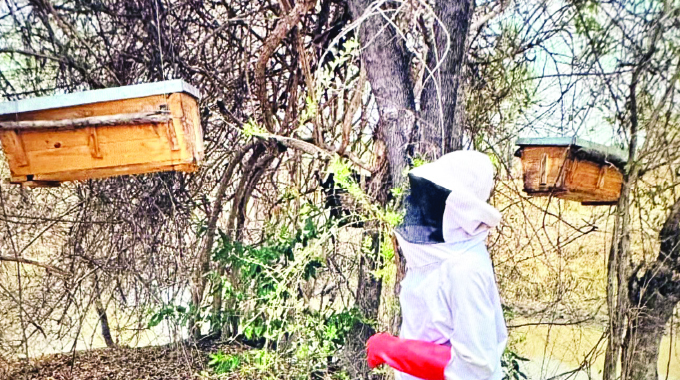
Conrad Mupesa Mashonaland West Bureau
Beekeeping was an emergency move for Mr Brian Mugumba, now 36, when he was 19 and had to earn a living somehow.
Mr Mugumba, who hails from Nyamakate’s Village 27B, started his business in 2005.
It stuttered on, with Mr Mugumba using traditional beehives made from tree trunks and bark.
But after being taught of sustainable beekeeping processes by a local firm, Carbon Green Africa, which champions environmental conservation, Mr Mugumba recently decided to broaden the business and he is now prosperous.
He has made a name for himself as one of the best honey producers and suppliers in Hurungwe, Kariba, Chirundu and Chinhoyi and now even exports to Zambia, where he has obtained a market.
A single harvest of pure organic honey generates about US$700 for Mr Mugumba.
His family now has a decent lifestyle because of the business.
“I have markets in Kariba, Karoi, Chinhoyi and as far as Zambia,” said the young father, who is also able to take his children to decent primary schools.
“I am also supplying villages in my Ward. I can generate an income of more than US$700 after a single harvest.
“Through income generated after honey sales, I have bought a motorbike, six cows, a scotch cart, built a five-roomed house and bought a residential stand in Chirundu.”
Mr Mugumba plans to buy a small truck to deliver his honey and seek new markets as the business is growing.
Before the intervention of Carbon Green Africa, Mr Mugumba was competing with tobacco growers to cut down trees so he could make more beehives.
At one point, he had 200 beehives made from tree bark and trunks.
He is now using broken plastic buckets and baskets to make environmentally friendly hives on top of standard hives donated to him by Carbon Green Africa.
“I started small with a few traditional hives made from tree trunks. I made more than 200 hives from tree bark until there were no larger trees for ring barking around our area. This made me start making beehives from broken buckets and baskets,” he said.
“Although I harvested over 500kg of honey from these hives, they started wearing away and the honey was not much compared to the number of hives I had.”
Mr Mugumba is among hundreds of villagers that have been supported by Carbon Green Africa, under its Kariba REDD+ Project (KRP) in four districts: Binga Rural District Council, Hurungwe Rural District Council, Nyaminyami Rural District Council and Mbire Rural District Council to promote environmental conservation.
It is a forest conservation project designed to provide sustainable opportunities for disadvantaged communities in northern Zimbabwe.
Northern Zimbabwe suffers heavily from deforestation, land degradation, poverty and drought.
While many other people are making a living using the aid and training offered, Mr Mugumba has remained outstanding in the Hurungwe and Nyaminyami districts.
Other beekeepers are drawing inspiration and lessons from him.
Said Mr Mugumba: “In 2020, I heard about a company in my area that was training beekeepers and equipping them with other vital information in line with environmental conservation plans under KRP.
“I started attending their meetings and training sessions, which affected me much since I had a lot of hives made from trees which are meant to be conserved. Carbon Green Africa staff in my area saw my passion in beekeeping but discovered that I did not know the environmental conservation part.
“Through KRP education, I then realised the danger I was causing to the environment, which made me think of quitting beekeeping.”
Mr Mugumba has since changed from the traditional way of beekeeping and adopted the new strategies under Kariba REDD+ Project.
Carbon Green Africa has given him a honey pressing machine set to improve the quality of honey when processing.
The pressing set is also being used by other beekeepers in the area.
“I have been processing my honey manually, which affected the quality of my product,” said Mr Mugumba. “I have been going to the market on a weekly basis and manual honey processing was not producing desired results.”
His exploits have motivated Mr Willard Phiri of Village 28, who has also improved his family’s living standards through beekeeping.
The former chef was failing to fend for his big family, as the effects of climate change took a toll on his farming.
Mr Phiri, who started beekeeping two years ago, has an apiary with over 30 beehives close to his homestead.
“Beekeeping has been a life-changer for most families here. Since starting the project, I am able to take care of my family from money I get from the project,” he said.
Mr Phiri has improved his product by adding more flowers and eucalyptus trees to change the flavour of the honey.
The flowers and eucalyptus grown close by, are meant to shorten the distance travelled by the bees to collect nectar.
Another villager, Mr Greatman Manyembere, has 10 beehives, but still wants more, as he has started realising the benefits of beekeeping.
Musakura village head Mr Gift Musakura said at least 50 households from the 62 under his purview, had been influenced by Mr Mugumba.
Carbon Green Africa managing director Mr Charles Ndondo said bee keeping was not only a way of saving forests, but supporting livelihoods of people in marginalised areas.
“As a nation, we should step up our efforts in protecting the environment and as Carbon Green Africa, these beekeeping projects are part of our initiatives to help mitigate environmental degradation and climate change,” he said.
“We also have over 70 families in Nyaminyami area under Kariba rural. The project has also been rolled out in Binga and Mbire districts.”
Hurungwe, one of the country’s largest tobacco producing districts, is battling unprecedented deforestation as farmers cut down trees to cure their tobacco.
Although tobacco buyers urge farmers to use other means of curing tobacco, such as growing woodlots so they have the fuel, communal tobacco growers rely heavily on indigenous trees.



 Online Reporter