

 admin
admin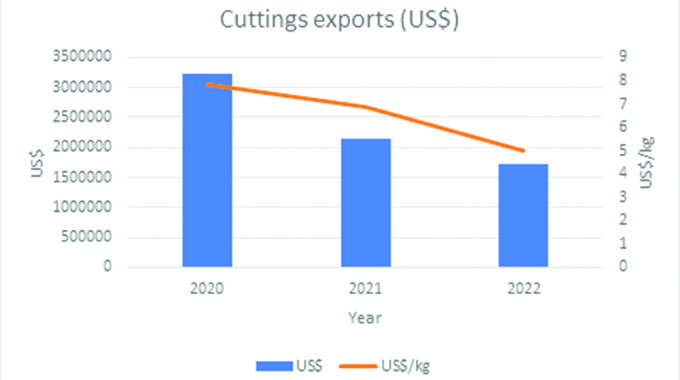
Edgar Vhera
Agriculture Specialist Writer
LOCAL producers of succulent crops may have to wait a little bit longer to fully exploit opportunities in the international succulents market amid revelations that demand for their cuttings had recorded a 20 percent decline from 30 to 25 million products annually.
This comes as the Horticultural Development Council (HDC) has called on the farmers to take advantage of the projected increase in demand for the succulents with the situation on the ground suggesting otherwise. Succulents are a group of plants that store water in their leaves. The leaves tend to be thick and fleshy, but some species have thicker leaves than others. Succulents tend to thrive in dry climates and don’t like a lot of humidity.
Zimflora Private Limited director Nicki Archer said global demand for succulents had shrunk over the years as a result of the negative influence of Covid-19 and the geo-political developments in Eastern Europe.
“The global demand for succulents has gone down, as a result of diminished disposable incomes from our traditional customers. This has led to customers prioritising other important family requirements, as opposed to these pot plants,” said Mrs Archer.
Mrs Archer also cited increased freight charges as having negatively impacted on their profitability.
“We are contemplating exporting via the cheap and environmentally-friendly sea route though it takes a few more days for our product to reach the market.
“We have an overstock of produce yet in the past we exported 30 million cuttings annually, but this has now gone down to 25 million,” she observed. Mrs Archer disclosed that aloe vera was among the succulents they produced on their 18ha Nyanga project. Seven hectares are under green house with the remaining 11 serving as open fields.
In a recent twitter posting, HDC revealed that Zimbabwe was one of the biggest succulent producers in Africa saying: “With the global succulent plant market anticipated to expand by US$2, 03 billion between 2022 and 2026, Zimbabwean farmers are presented with an opportunity to take advantage of the growing demand for succulent exports across the globe.”
Statistics from Zimbabwe National Statistic Agency (ZimStats) show that earnings from cutting exports, under which succulents fall, have been on a gradual decline both in volumes and average prices in the last three years.
The Government launched the Horticulture Recovery and Growth Plan (HRGP) in 2020 as a bold and transformative plan to increase horticultural exports anchored on rural agro-industrialisation, enhanced nutrition plus developed food systems and increased incomes while growing conventional horticultural enterprises.
The overall purpose of the HRGP is to guide and support the revival of the conventional horticulture industry by providing a relevant and evidence-based framework to guide and coordinate the development of commodity-specific strategies, projects and programmes as well as to stimulate a transformative rural horticulture sub-sector under the Presidential Horticulture Scheme covering all 1, 8 million rural households.



 Online Reporter