Chronicle Editor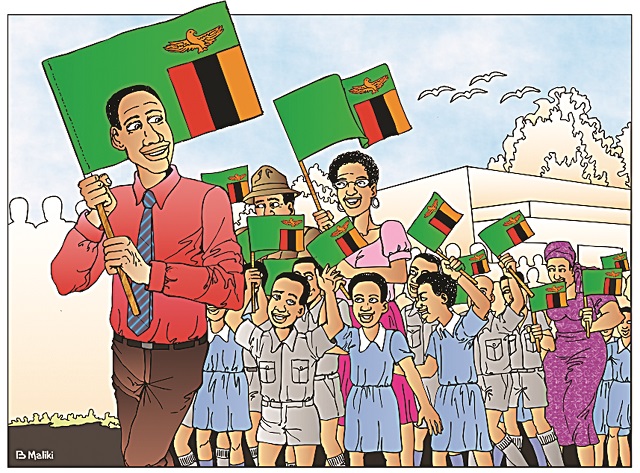
Boyd Maliki
Every year on Zambia’s Independence Day, October 24, I and friends I grew up with in Kitwe team up and join the Zambians in their celebrations. An amazing turnabout compared to our first reaction to self-rule as primary school children.
The year was 1964 and the middle term of the school calendar was almost coming to an end. We had just trooped out of our classrooms for the 10AM tea break when the familiar dark green Morris Oxford station wagon, owned by the Northern Rhodesia government, pulled up at Mutende Primary School in Kitwe. I was a Sub B (Grade 2) pupil at the school and this delivery vehicle was a regular sight at all schools in our area.
Clutching several manila envelopes in one hand, the driver slid out of the car, waved to a small group of chatty teachers nearby and he darted towards the headmaster’s office. But one teacher, Mr Katongo, had not even seen the driver wave — instead, he stood motionless, gaping at something very unusual at the back of the Morris!
Beckoning fellow teachers and pointing to the number plate of the government car, Mr Katongo screamed: “It has finally happened.”
The numerals on the number plates of government vehicles in those days were prefixed with the letters “NRG” which was the code for Northern Rhodesia Government. But, on this day, the NRG prefix had been supplanted by GRZ. This startling change had taken even us, the pupils, by surprise! We later learnt from another teacher, Mr Kapula, that GRZ was the acronym for “Government of the Republic of Zambia”.
As the Morris Oxford later sped out of the school yard, talk of the birth of a black government had become the subject of the day. The relentless fight for independence waged by the United National Independence Party (UNIP) under the leadership of Kenneth Kaunda, had forced the colonial government to settle for the ballot box and, UNIP won the election!
But, those of us who were too young to comprehend how a country was run had many questions that were begging for answers. Could we, the Africans, run the country on our own if the colonisers departed? You see, we grew up regarding the white man as superior and I still remember songs we used to sing in praise of the colonialists during our pre-school days at Lubuto Community Centre in Kitwe’s Chimwemwe Township.
During the period before the people cast their first vote, UNIP had taken the lead in fighting the colonial establishment using all available means, the stone being the most trusted weapon.
Picture a scene, for instance, where several riot policemen (white and black), armed with guns, tear gas, sjamboks, baton sticks and, assisted by trained vicious dogs, are pitted against a very determined group of stone-throwing liberation cadres on the other side. Things explode in the air, shots are fired and dogs are set upon the “natives” who, on their part, respond by bombarding the colonial forces with any form of “missile” they could lay their hands on.
The better armed colonialists would at first appear to take the upper hand, charging the freedom fighters but numbers always determined the outcome as the stone-throwers (ba Mposamabwe) came in swarms, attacking their enemy from all directions. Engulfed and subdued, the police often ended up retreating to their armoured vehicles, which were also never spared the stone and even set ablaze sometimes . . .
Such was the situation during those days, especially in Chimwemwe where even we, the children, also known as “amayufi” (the youth), partook in the melee but, merely for the joy of pelting a cop and his dog with something.
Cut to about four weeks before October 24, 1964. The Northern Rhodesians, now officially calling themselves Zambians, were in carnival frenzy, preparing for independence celebrations!
Posters, pamphlets and all manner of stationery including miniature paper flags of the new born nation were delivered to all schools and our teachers, viewed as collaborators of the white regime all along, had suddenly become patriotic and were now teaching us civics.
“This is the Zambian flag,” Mr Katongo pointed to a big poster pinned to the black board, “that will replace Britain’s Union Jack on October 24 . . .”
The flag had a green background which, he told us, represented Zambia’s agricultural resources. On the right edge of the flag were three vertical bands of red, black and orange and, just above the bands, was a hovering eagle also coloured in orange.
“Red stands for the blood Zambia shed during its struggle for freedom and Black represents the people of Zambia while Orange symbolises our copper and other mineral wealth,” Mr Katongo explained, turning around to face us with a wide grin, “Anything else you don’t understand?”
“The soaring eagle!” screamed the entire class.
“I see you’re paying attention,” he smiled. “The eagle represents the Zambians’ ability to rise above the nation’s problems.”
Next came the Zambia Coat of Arms and its meaning, followed by a history lesson on how the freedom fighters had (as if we didn’t know) liberated the country.
Exit the indoor lessons and enter the outdoor activities. Schools were now marching everywhere with pupils waving miniature flags and singing, “Happy, happy, happy day, nomba twapoka ubuntungwa.” a chant that was soon replaced by the familiar Zambia national anthem.
And it was on one of those days when we were rehearsing the Zambia national anthem during assembly when a truck pulled up in the school yard and offloaded what we could all clearly tell were cartons of packaged food. Later in the day, when another truck loaded with crates of soft drinks rolled onto the school, we realised a celebration party was in the offing.
October 23, 1964 fell on a Friday and a pleasant surprise awaited all children in schools and other centres in the entire country! It was party time as anticipated, and there was so much food and drink for everyone that even known gourmands in our class couldn’t finish it!
“Tell us, Teacher,” one pupil, Fisto Wangalwile, high on his third bottle of Canada Dry and almost choking on a mouthful of biscuits, stood up. “This is the last time we’re enjoying these goodies, don’t you think?”
“I’m beginning to think Canada Dry (a tangy orange drink) is alcoholic,” the teacher laughed. “What do you mean?”
“The whites who manufacture these things are going back to Europe,” Fisto observed, much to the amusement of everyone in class.
“Yes, yes,” Ephraim Musekesa concurred. “Can Africans, for example, make cars?”
“Or even a bicycle?” another pupil, Venture Chipamina, chipped in.
Teacher Katongo, smiling, tried to say something but his voice was drowned by noise coming from a low flying military plane we could clearly see through the classroom windows. “Bye, bye aeroplane,” Ngosa Paka teased. “We’ll have to manage our way around by road transport.”
“Temporary solution,” boomed a voice that sounded like that of Paul Chipoya from the back of the class. “Vehicles run on petrol or diesel, which we may never manufacture!”
At this point Mr Katongo interjected, asking to be heard too. “The Europeans are going nowhere,” he said. “They’ll work with us but, unlike during the old order, we the indigenous Zambians have taken charge of our country.”
“Some are leaving already,” I declared.
“Those who can’t stand black rule may have to leave,” he retorted.
“Are you sure things will continue as they are, teacher?” that must have been Aaron Sakamba or Inambao Mundia who asked the question.
Mr Katongo got hold of his cane and we shrank back in our seats. He moved to a social studies poster (one of many hung on the walls of our classroom) and pointed it with the cane.
“Do you remember where this picture was taken, class?” he asked.
“That’s a farm in Canada!” we chorused.
His stick moved to a boy and girl playing near a combine harvester, “What are the names of these two children?”
“Bob and Mary,” we shouted.
“And what’s this tall grass covering the entire farm?”
“That’s not grass, sir,” we responded. “That’s wheat!”
“Good! I also taught you that Canada earns a lot of money by selling its wheat to other countries, didn’t I?
“Zambia produces lots of copper which is sold world-wide and it’s because of our wealth England colonised us. Everything made in Europe will always be available as our money can buy these, including experts to replace those that are leaving . . .”
As Mr Katongo droned on about the good times ahead, our attention shifted back to the manna, some of which we were stuffing into our pockets and bags as takeaways, depriving Mr Henry Malenga’s grocery store, the chief beneficiary of our tea break money, a great deal.
Independence Day, Saturday, October 24, 1964, was an even bigger surprise for all Zambians for no matter how remote their area was from the nearest town, food, beer, and drink was delivered to a selected point near their dwelling. In Chimwemwe Township, for instance, tents were set up in different sections of the area and UNIP saw to it that everyone ate and drank.
Back to school after the celebrations . . . more eats and drink were handed out but our pessimism on self-rule had not changed, prompting our teacher to quip, “I know you kids threw stones at the colonialists but, boy, I am glad they didn’t allow you to vote!”— © [email protected]


 Online Reporter