Chronicle Editor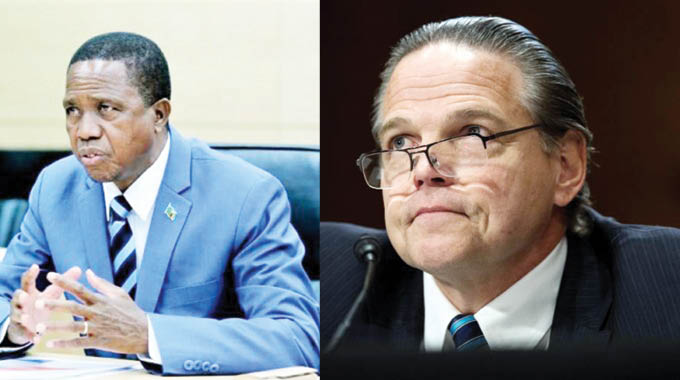
Stephen Mpofu, Perspective
The impact of foreign aid on developing nations has long been a subject of interest for students of international relations — with this writer researching, on a scholarship at his alma mater, the University of Cambridge’s Wolfson (international) College, the impact of foreign aid particularly on small nations in Africa and elsewhere.
The current standoff between Lusaka and Washington over two homosexuals being jailed in Zambia for plying their trade in that country, and with the American ambassador and the Zambian government trading criticism, raises once more the question of whether international aid should turn recipients into stooges that turn the other cheek even on matters impinging on values that identify people for who they are in the global village.
Zambia happens in this case to be one of the largest per-capita recipients of American assistants in the world, getting some US$500 million each year.
America’s ambassador to Zambia, Daniel Foote, had to be recalled after charging that “Zambia wanted diplomats with open pocket books in closed mouths”.
President Edgar Lungu said he would no more (rpt no more) of such people living among Zambians — a sentiment that other African leaders are wont to express if they found themselves in the same circumstances.
If truth be told, homosexuality may be nothing to frown upon in American and other, open Western societies that embrace such decadent values but not so in Africa.
To be fair, there may still have been residual traces of mud (rpt mud) of decadent values that once flooded the African continent during the colonial era but receded, impacted by the struggle for freedom which culminated in other countries, including our own, in armed revolutions that brought about uhuru.
Indeed, had the reculturisation of African societies by their colonisers from Europe been complete and irreversible, gay marriages would have today been competing for recognition alongside make-believe little children’s homes of tiny mud or grass huts setup in their playgrounds, the forecourts of their family residencies in both urban and rural areas.
Today, therefore, it is certainly a misnomer for anyone diplomat or not, to regard homosexuality, as the former American ambassador apparently did as a conditionality for continued aid inflows to any recipient country.
At present many foreign interests are looking at Zimbabwe’s many, rich natural endowments with their eyes smiling, or narrowed with hearts pulsating with greed, as the government pursues a reengagement campaign in hopes of receiving assistance in the form of international aid or foreign investment to resuscitate an economy savagely bludgeoned by illegal, Western sanctions as punishment for land reform by the Zanu PF government to re- unite the motherland with its colonially-estranged people, in celebration of independence and freedom resulting from a brutal armed revolution that saw many gallant sons and daughters of the soil sacrificing their precious lives to be reunited with the motherland.
Therefore, our people should resist in every possible way any open or subtle way by foreigners to use whatever assistance they give Zimbabwe as a conditionality for the recolonisation of our minds in post modernity.
Every deal between Zimbabweans on the one end and aid givers and investors should strictly be on a quid pro quo basis.
Which is why the government has been working hard on refining the ease of doing business with the outside world so that any business deals clinched are not only fair but are seen to be so on both sides.



 Online Reporter