admin
admin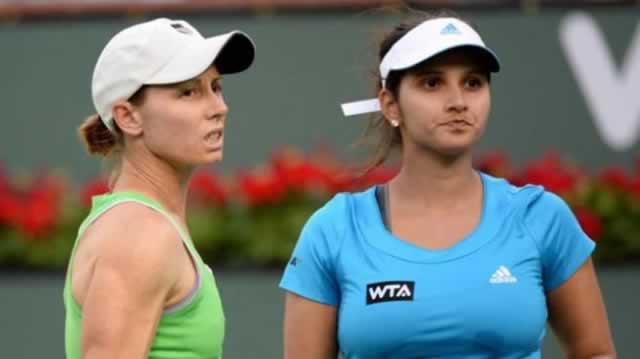
DUBAI — Statistically, Sania Mirza may be no match for all-time greats like Serena Williams, but it’s hard to overstate the tennis star’s impact on sport in India, especially for women.
Her black hair tied in a quick bun, Mirza’s dark eyes focused across the net on Tuesday, as she bounced the ball three times before serving, her iconic nose pin glinting with every move.
She was playing against Russia’s Veronika Kudermetova and Liudmila Samsonova at the WTA Dubai Duty Free Championships – hundreds of spectators, many of them fans from India, packed the courtside seating to watch her “last dance”.
Mirza and her partner Madison Keys lost the first round match in straight sets, drawing the curtains on her 20-year professional tennis career.
With six Grand Slam doubles titles under her belt, Mirza is easily India’s most successful tennis star.
Over the decades, she’s won 43 major career titles, becoming the first ever Indian to make number one in the WTA doubles rankings, a feat achieved in 2015.
The devotion of Mirza’s fans has remained unrivalled, surviving triumphs by her opponents and injuries that dogged her over the years. Her best run came in 2015 when she and Martina Hingis won 16 titles, including three grand slams, ranking them the greatest women’s doubles pair of all time.
But Mirza’s story is special because she made it as a professional sportswoman, despite the odds being stacked against her. Born in 1986, she grew up in the southern city of Hyderabad at a time when tennis as a profession was only for the wealthy.
She began playing aged six on pot-holed courts made of cow dung – a frugal trade-off between clay and hard courts.
Mirza turned out to be a natural and found success as a junior tennis player, winning the 2003 Wimbledon Championships girls’ doubles title when she was 15.
But she burst into the spotlight in 2005 when she made it to the third round of the Australian Open – the first Indian woman to reach this stage of a major in singles – to face superstar Serena Williams.
It was an extraordinary feat – cricket-obsessed Indians tuned in to watch the teenager go up against a player already cementing her place as the greatest of all time. Mirza lost the match but her career embodying not just tennis but women’s sport in India had taken off.
In a pre-internet era, her matches brought people together as they watched her play, glued to their TV screens. She was a regular feature in Indian sports pages. Many Indians have early memories of a player who, for once, looked and spoke like them, and was doing great things.
But while many celebrated Mirza’s rise, a group of Muslim clerics issued a fatwa, denouncing her tennis clothes as “indecent”, “un-Islamic” and “corrupting”.
It marked the start of waves of backlash the star, then just 18, would receive for the choices she made on and off court.
Mirza, proudly Muslim, practised her religion on her own terms without it really impeding her goals and aspirations and it was liberating to watch this unfold in public.
Her responses to comments on her clothes, like her tennis moves, were measured yet incisive, sometimes even dramatic. The player would wear T-shirts and caps with searing one-liners – ‘You can’t handle the truth’ or ‘You can either agree with me or be wrong’ – to tournaments and events.
Her immense popularity would often make her the subject of intense scrutiny and vitriol in her own country. But Mirza appeared to have an ironclad sense of self and was never seen cowed by it.
In 2008, she announced she had no desire to play in India as she chose to boycott its most prestigious tennis tournament, the Bangalore Open.
“Every time I play in India, there is a problem,” she told reporters.
Days before she had been accused of desecrating the national flag after she was caught on camera resting her bare feet on a table in front of the Indian colours. Earlier that month, she had also drawn the ire of Muslim groups after she filmed an advert at a historic mosque in her hometown, Hyderabad.
In 2010, Mirza married Pakistani cricket player Shoaib Malik, prompting frequent questions about her loyalty to the country of her birth.
Eventually, Mirza managed to do something seemingly impossible – transcend these differences to become a South Asian icon instead of just an Indian one.
On Tuesday, her fans in the Dubai arena and online cheered her on as she hugged her son after the match. It’s a testament to how Mirza managed unapologetically to dismantle notions about what she should or shouldn’t do. —BBC Sport



 Online Reporter