

 Chronicle Editor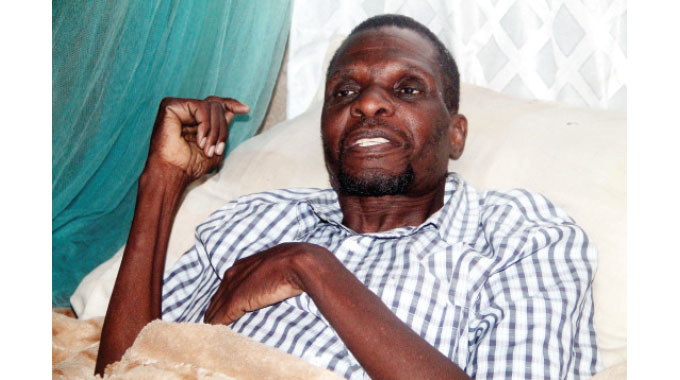
Flora Fadzai Sibanda, Chronicle Reporter
CDE Moffat Ncube (64) of at Bhagani in Mangwe District in Matabeleland South province was left with a permanent disability after stepping on a deadly landmine planted by Rhodesian security forces while in the battlefield during the liberation war.
His right foot was blown off by the landmine as he trudged through the forests in Lupane district, Matabeleland North while leading a group of recruits to the Zambezi River from where they intended crossing into Zambia.
After completing a nine-month training in Zambia, Cde Ncube whose pseudo name was Mathwathi Moyo, was deployed to Lupane.
He joined the liberation struggle at the age of 18 years.
Part of his duties involved assisting new recruits to cross the border to Zambia through Zambezi River.
He was in the line of duty when the horrific incident befell him.
“During the liberation struggle, I helped new recruits to cross over to Zambia and had done that for a year when the unfortunate incident occurred.
By virtue of being one of the experienced cadres, I would lead from the front,” he said.
“So, on that particular day, I was in the company of fellow guerrillas as I led a group of new recruits who were following me to the crossing point when I stumbled upon a landmine.”
Cde Ncube stepped on the landmine as they approached the famous Fighting Road that stretches from Nkayi to Binga.
“I actually stepped on a shrub since we were always advised to step on vegetation during our training as a strategy to avoid stepping on bombs.
From there, l hardly recall what actually happened and all I could remember was hearing a loud banging sound,” he said.
Cde Ncube said immediately after the blast, he looked back apparently thinking one of his recruits had been bombed.
“I saw them fleeing in different directions and when l tried to continue moving that is when I started feeling the pain on the foot.
Blood started gushing out of my leg and in that instance, I realised that was fully naked because my clothes had been blown away,” he said.
“I felt weak and the pain was unbearable. I tried to reach for my pistol so that I could finish off myself, but it had also been blown away.”
Two of his colleagues returned to the scene and carried him to a nearby camp.
He said nurses amputated part of his leg from the ankle using a sharp knife.
“They tried to look for numbing medication so that l could not feel the pain, but could not locate it.
So, they went ahead and cut my foot in my full glare. I have never felt so much pain in my life,” said Cde Ncube.
He was later taken to Botswana alongside other cadres who had sustained injuries.
They stayed in hospital in Francistown until 1979 when a ceasefire was announced.
Cde Ncube said the Heroes’ month evokes bad memories of the liberation struggle.
He joined the war in November 1976 having been inspired by the guerrillas who used to hide at his grandfather’s home in Bhagani.
“I grew up in Bhagani and my grandfather used to love accommodating the guerrillas.
They would share their liberation stories and spoke with passion about the need to liberate the country,” said Cde Ncube.
“I actually confided in one of the guerrillas that my desire to join the liberation struggle and they made arrangements for me to cross to Botswana.”
Cde Ncube said he was joined by his four friends and they went to Ngwane Primary where they assembled before the guerrillas came and collected them.
“The guerrilla told me to go with my friends to Ngwane primary school.
He made us swear not to say anything to anyone about where we were going in case the message reached the ears of the enemy forces,” he said.
“We crossed the border under the cover of darkness and guerrillas left us by the roadside in Botswana as we waited for a truck to pick us up and we were now about 40.”
From Botswana, Cde Ncube was flown to Zambia where he did his military training “We were ferried to the airport by a truck and flown to Zambia and taken to Mwembeshi, the first military camp that was established in 1976.
We were trained for nine months,” said Cde Ncube.
– @florafadzaisibanda



 Online Reporter