


 peter
peter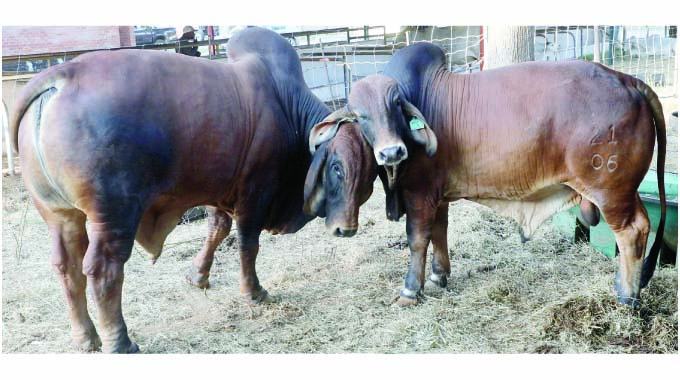
Bruce Ndlovu, Sunday Life Reporter
“WE have two heifers here and they will be up for grabs. Our reserve price for this one, the bigger one, is US$2 600,” said Dr Douglas Nyathi as he pointed to a bull that rested on the greying grass at the cattle pens at the Zimbabwe International Trade Fair.
“For the smaller one,” he continued. “We have set the initial bidding price at $US2 200. We won’t be taking anything less than that.”
At the trade fair, where all manner of technology and gadgets vied for the attention of exhibitors and visitors, it was these magnificent creatures of flesh and blood that caught the eye. Even to those that do not know the ins and outs of cattle breeding, Dr Nyathi’s Brahman studs appeared impressive even at first glance.
If it was not their slick darkish grey hide or just their sheer size, it was the large humps that sat majestically on top of their shoulder and neck. It was obvious to any curious passerby that this was not the sort of animal that was casually slaughtered for sale at the nearest butchery.
As one gazed at the Brahman stud’s loose folds of skin, it seemed blasphemous to even think that such a majestic beast could be cut down into tiny pieces mixed with vegetables and oil to fill random empty bellies.
In every sense, the Brahman stud is a different breed. These are cattle with a “birth certificate”, an animal whose family tree is studiously traced from birth. As Dr Nyathi gazed proudly at his stud, only stone’s throw away, Dr Morgan Sibanda’s three-year-old bull, Noble, paced about, as if bored by the small crowd that had gathered to watch as it took a leisurely stroll around its own enclosure.

Interest in Noble was high, as this was the same bull that attracted a $16 000 bid at the Zimbabwe National Bull Sale in 2022. That staggering bid was followed by another of US$30 000. That shocking sum was rejected by the farmer who runs a Brahman ranch in Beatrice, 75km south of Harare along the Beitbridge Highway. The bull is now said to be worth US$50 000.
To the layman, such figures are gobsmacking. How can one bull be worth $50 000 when farmers around the country regularly struggle to fetch even a fraction of that for their beasts?
The answer to that question is that the Brahman is not just another ordinary breed of cattle. This is an animal that needs careful and painstaking breeding if it to attain its full potential.
“Over and above, cattle breeding is a very viable business especially in Zimbabwe but it requires a lot of time. It is a full-time job, especially when it comes to these stud animals because you need to keep breeding records which is something important to take note of,” said Dr Nyathi.
When Brahman breeders speak about their studs, they speak of them in terms that people usually reserve for their most prized possessions or even people dearest to their hearts. They speak of them as animals that are intelligent, inquisitive and shy. They also mention that they are unusually thrifty, hardy and adaptable to a wide range of feed and climate. These are animals that are said to be affectionate and, depending on how they are handled, very docile.
For Dr Nyathi, who has 32 studs at a farm in Shangani and 78 commercial cattle at Malundi Farm along the Bulawayo-Kezi Road, even the texture and flavour of the grass his animals mow down daily is important.
“We currently have 38 registered animals under our stud’s name and we only focus on grey animals and in terms of our breeding programmes we have a bull which is our head sire.
We complement it with insemination and we import straws, some from Botswana. In terms of grazing, Shangane has great grazing, it has really sweet grass which is great for this breed of animal. Unfortunately, we have tenure issues as I mentioned and when you’re renting a farm you can’t develop that place and this is a problem because in stud breeding you need proper infrastructure. You need a borehole and you need cattle handling infrastructure but if the farm is not yours you really cannot develop that. You need a lot of capital and so these are just some of the challenges that we face as cattle stud breeders,” he said.
According to Dr Nyathi however, the business of selling studs has not been the same since cattle sales in Bulawayo were suspended in April 2015 after foot-and-mouth disease was detected in three beasts that were being sold at the showgrounds.
Before the suspension of cattle sales in Bulawayo, between 450 and 500 cattle were being sold per week. Over the years, livestock farmers in Matabeleland have expressed displeasure over the continued closure of the cattle sale pens saying this seriously affected thousands of commercial and communal farmers who survived on cattle ranching.
“Another thing that one has to take note of is the market for selling the cattle because we used to sell our animals at the ZITF some years back but it is now closed and this is a big problem for us as breeders.
You are now forced to sell your animals at your farm which is a bit of a challenge when it comes to fetching a price that can make your business viable.
“As Malundi we have stud animals, which you can see here, and we also have a commercial herd in Matobo, 90kms away from town. We used to sell our cattle at ZITF and here you would find maybe 10 to 15 people bidding for an animal and that in itself had a bearing on the price of the animal.
“Currently, with this decentralised system of selling cattle, we are losing out as farmers and I think we would be happy if government was to intervene and reopen the sales here at ZITF. We used to fetch good prices here and I remember at one point, I sold steers for US$1000. You won’t believe it but because of this new auction approach it’s now impossible to get that kind of prices,” he said.
However, despite such setbacks, Dr Nyathi lauded the work of the Matobo Research Station, whose work on artificial insemination had seen them grow their herds substantially. Artificial insemination increases fertility in cattle through use of scientifically proven technology.
The country is set to generate US$140 million per annum from the successful artificial insemination technology that has the capacity to produce seven million pedigree bull semen straws annually. The project was launched at Chinhoyi University of Technology in 2019. “We use Matobo Research Station. They condition the animals for insemination, we buy straws and they do the insemination for us.
The guys at the research station have done us proud and their success rate is very high which is all we could have asked for as stud breeders. They are an essential part of what we do and our work and their work goes hand-in-hand in producing the animals that you see today,” he said.



 Bongani Ndlovu
 Online Reporter