admin
admin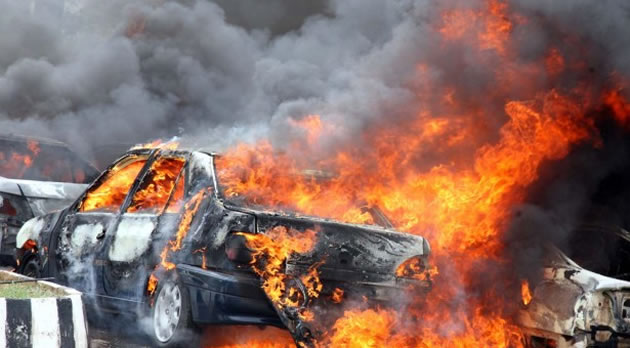
 Maiduguri — Three blasts hit the city of Maiduguri in northeast Nigeria on Tuesday killing a number of people, locals and the Red Cross said.
The “huge explosions” happened in the Ajilari Cross area of the city, which has been targeted by similar attacks twice in the last month, including on September 20 when at least 117 were killed.
The previous attacks were blamed on Boko Haram, which has increasingly hit “soft” civilian targets in recent months using suicide bombers and improvised explosive devices.
It was not immediately clear what caused the latest blasts, which happened in quick succession from 2010hrs, said Bashir Mohammed, whose house is near the scene.
“We’re all confused and people are running helter-skelter,” he said.
Sheriff Ahmad, a cleric in the area, said: “Many people have been killed. I don’t know how many and I don’t think anyone can tell you now.”
Ahmad described seeing body parts on his house, while Hafsat Sani, a nurse at the nearby Umaru Shehu Hospital, said: “There are many houses around the area and the blasts have affected many of them.”
The hospital quickly began receiving the injured while police, soldiers, the Red Cross and officials from Nigeria’s National Emergency Management Agency (NEMA) were mobilised, he said.
A Red Cross official said: “Obviously there are people that died but I don’t have figures.”
There was no immediate comment from the police or military while details were sketchy as Maiduguri is subject to a night-time curfew.
On October 1, at least 10 people were killed and 39 injured when four suicide bombers blew themselves up in a wave of attacks in Ajilari Cross, which is near Maiduguri airport and a military base.
At least two bombs were strapped to teenage girls, witnesses and the police said at the time.
The September 20 attack targeted a mosque and killed football fans watching a televised match as well as bystanders.
Amnesty International said last month that the Boko Haram conflict had killed at least 1,600 people since the start of June in Nigeria, Niger, Chad and Cameroon and called for more protection for civilians.
An AFP tally puts the death toll at more than 1,320 in Nigeria alone since Muhammadu Buhari became president on May 29.
Meanwhile, Nigeria has warned civilians that Boko Haram is using deadly cluster bombs but campaigners say the Islamists may have got the banned weapons from the military in the first place.
Defence spokesperson Rabe Abubakar urged people to be on their guard for “cluster bombs, sometimes scalled scatter bombs”, as engineers had recently found caches in north-eastern Adamawa state.
“The military high command has discovered that the Boko Haram terrorists in the areas have used such lethal instruments over time to push their callous terrorist cause,” he said last Thursday.
“These bombs are used against large areas containing many targets such as columns of vehicles, marketplaces, places of worship or large troop concentrations,” he added in a statement.
The insurgents, allied to the Islamic State group in Syria and Iraq, have in recent months increasingly used suicide and bomb attacks in northeast Nigeria, Chad, Cameroon and Niger.
Abuja has described the attacks, which have caused mass civilian casualties, as desperate acts following apparent army gains in the northeast when soldiers overran their training camps, and hundreds of fighters allegedly surrendered.
Cluster bombs are a category of ordnance dropped from planes or fired from artillery via a shell, missile or rocket and spread hundreds of tiny sub-munitions or “bomblets” over a wide area.
Many of the devices fail to explode on impact and effectively become de facto landmines hidden for years, making them difficult to clear and posing a significant risk to civilians.
More than 100 countries signed the UN Convention on Cluster Munitions that came into force on August 1, 2010, banning the use, production, transfer and stockpiling of cluster munitions.
Nigeria has signed but not ratified the convention and the Cluster Munition Coalition (CMC) campaign group said Abuja had still to declare its stockpiles and detail how it would get rid of them. — AFP


 Online Reporter