Online Reporter
Rutendo Nyeve [email protected]
SCHOOLS across Hwange District have received 115 bicycles for learners and 2 332 new curriculum textbooks courtesy of a partnership donation between the Zimbabwe Parks and Wildlife Management Authority (ZimParks) and the International Fund for Animal Welfare (IFAW).
The donation was handed over on Thursday at Hwange National Park by the Minister of Environment, Climate and Wildlife, Dr Evelyn Ndlovu.
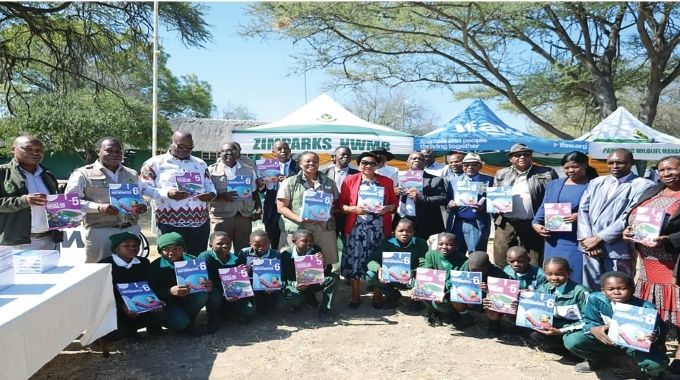
The donation dubbed ‘Riding for Conservation and Textbook Initiatives’ fall under the broader Environmental Stewardship Programme operating in the Hwange-Matetsi landscape, home to some of the country’s largest elephant herds and communities who daily navigate the delicate line between coexistence and conflict.
For years, learners in communities adjoining the park have walked up to 15 kilometres through dangerous terrain, crossing elephant corridors before dawn.
Many arrive late, exhausted, or not at all. Others, particularly girls, drop out entirely. The bicycle intervention directly targets this crisis.
Addressing headmen, school heads, and hundreds of pupils gathered at the park’s Main Camp, Minister Ndlovu described the moment as far more than a handover ceremony.
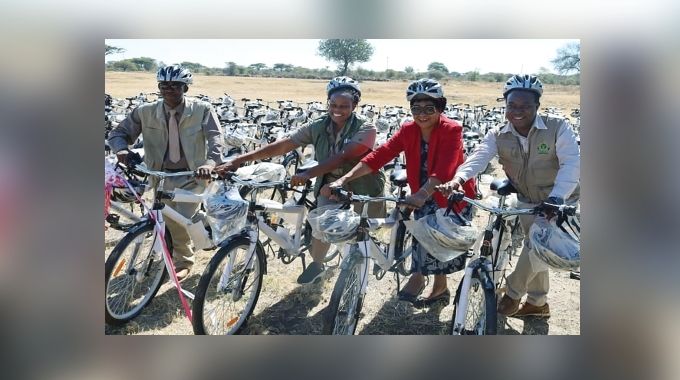
“It gives me immense pleasure to join you today for this very important occasion marking the handover of bicycles and textbooks under the Riding for Conservation and Textbook Initiatives,” Dr Ndlovu said.
“Today’s event is about transforming lives, strengthening communities, improving educational access, and building a future where conservation and human development move hand in hand.”
She said the Hwange-Matetsi landscape, while ecologically priceless, presents daily risks.
“Along these journeys, learners encounter elephants and other dangerous wild animals. These realities affect attendance, punctuality, concentration and ultimately academic performance,” she said.
With Thursday’s 115 bicycles, the total distributed under the initiative now stands at 365.
The textbooks, valued alongside the bicycles at approximately US$48 283, form part of a larger US$1.3 million already invested in these programmes.
“A month ago, I came across an article, which said that there were 518 cases of child pregnancies in Matabeleland North, Bubi District. This is very concerning, and shows that now more than ever, we need to come together to tackle these problems,” said Dr Ndlovu.
She called on communities to protect young girls, adding that solar lights provided under related initiatives would help children read beyond classroom walls.
IFAW country director Ms Alleta Nyahuye said the donation was set to secure the future of the young wildlife stewards who will inherit this landscape.
She emphasised that conservation cannot succeed without educated, empowered communities who see wildlife as an asset rather than a threat.
Matabeleland North Provincial Education Director Mr Jabulani Mpofu described the donation as a strategic charitable intervention.
“We are gathered today not merely to receive goods, but to witness a strategic partnership that understands a simple truth: an educated child who can reach the classroom is a child who can change the nation,” Mr Mpofu said.
“To the Department of Parks, we say thank you. Your stewardship extends beyond wildlife conservation; today, you are conserving the future of our children.”
Mr Mpofu said the distance deficit, has seen some children wake up at 4AM to walk 10 to 15 kilometres.
He projected an 85 percent reduction in lateness, a 20-30 percent improvement in pass rates for Mathematics,
English and General Paper, and a significant decline in dropout rates among girls. Crucially, he said bicycles reduce time spent in elephant corridors.
“This donation literally protects life while promoting learning,” he said.
The textbooks, he said, would address the learner-to-book ratio, ensuring that no child in Hwange shares one dog-eared book between six classmates. He called on mining and tourism sectors to emulate ZimParks’ example.
The bicycles will be stored securely and maintained by newly formed bicycle maintenance clubs, adding a vocational skills dimension to the intervention.