admin
admin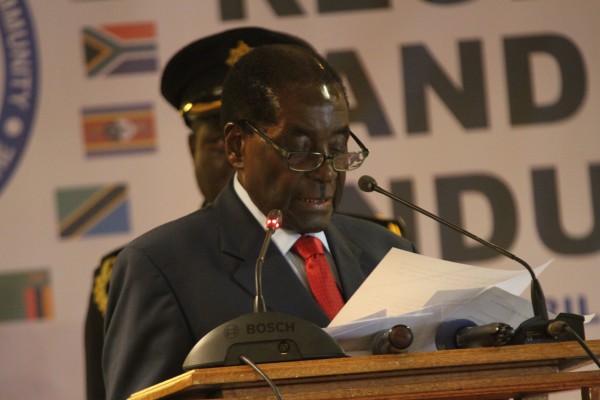
Joram Nyathi Spectrum
LET me be blunt: the politics of tribe don’t work. They have never worked; they are different from nationalist politics. There are many recent examples from Africa to Europe where issues to do with ethnicity have led to genocide. All that is needed is to have a few people whose tongues can only be described as trigger happy to spark a conflagration.
Sadly, it does appear that issues of tribe are not far divorced from Afrophobia.
President Mugabe’s recent so-called slur against the Kalanga being uneducated seems salutary. It is dangerous to live a lie, to nurse such a negative grievance without an opportunity to vent it out. Before the President’s comments we all seemed happy. But when incidents like that happen one realises we are living a lie beneath the false bonhomie.
It is saddening to imagine what we teach our children. Assuming their narrative is true, so a simple gaffe about the Kalanga being uneducated and, due to their geographical proximity to South Africa, are more likely to constitute a greater population of Zimbabweans in that country, evokes memories of Gukurahundi? And the minds of little children are being poisoned by the bitterness of Gukurahundi so that they grow up feeling that they are not part of the other ethnic groups in Zimbabwe!
Granted, mistakes have been made in the past and they will be made in future.
If nations were ruled by the gods or angels perhaps there would never be wars under the sun. But they are run by human beings who daily make mistakes the same way we do in ordinary life. But life must move on.
In Zimbabwe’s case, Parliament recently conducted interviews for people to be included in the National Peace and Reconciliation Commission. This is an organ that will look at past wrongs and consider what remedies should be instituted.
Although there are no terms of reference yet for the commission, we can safely assume that its major task is to cement the achievements of the Unity Accord signed between Zanu and PF Zapu on December 22 1987. Dr Joshua Nkomo and President Mugabe signed that historic agreement.
Whatever the claimed weaknesses of that accord, what cannot be denied is that it gave us the Zimbabwe we have today, with all its challenges and controversies which have drawn the attention of the world. We occupy a unique portion of the earth and should be proud of it.
It is, therefore, remiss in the extreme for people to declare that the Unity Accord is dead because of a tribal slur. It is dangerous populism to demand that Dr Nkomo’s bones be exhumed from the National Heroes Acre because of the same comments. Is that how cheaply we regard our national institutions? Do we seriously want to burn down everything which Zimbabweans have achieved together in the past 35 years over such comments? And who is supposed to be the beneficiary from the ensuing chaos?
The politics of tribe might make fantastic newspaper headlines but they don’t build nations.
Government has explained the context in which President Mugabe’s comments were made.
This is a free country. People can choose to believe the explanation or to call it whatever they like based on two postulates: that either President Mugabe spoke for himself or he was representing an ethnic view.
The latter position would be preposterous because it suggests that tribalism has been institutionalised, which it is not.
That leaves us with the first postulate, that President Mugabe was speaking for himself in light of a personal experience at a certain point in history. So why should that be cause for national acrimony today? Statistics are there to show the even distribution of the Presidential Scholarship Fund across all provinces.
What cannot however be ignored is that Gukurahundi left us a sad legacy of anger which has been exploited by political charlatans to bulkanise politics along ethnic lines and portray the western provinces of the country as the biggest “victims”.
It is no secret that the former PF Zapu political leadership in Matabeleland provinces and the Midlands has fared badly in elections since the Unity Accord because of their association with Zanu-PF. The result has been that almost every new political party can win seats in those regions regardless whether they have a useful manifesto or not.
People vote simply to spite Zanu-PF and its representatives or are naïve enough to believe that finally there is a party to avenge the grievances of Gukurahundi. The MDC-T in particular has been very successful in stoking flaming ambers into this wound that its biggest ever harvest of votes since its launch in 1999 was in Bulawayo.
But those seats often have very little influence on Government policy, and when Vice President Phelekezela Mphoko tries to explain this, he is accused of justifying the marginalisation of Matabeleland as a region. The result is a repeat of the same old cycle: the charlatans return and speak about the marginalisation of the region and how they will compensate the victims of Gukurahundi once they are voted into power.
Not a single original policy initiative. Not a single spectacularly developed region at the expense of the others. And the simple message is that we should all be working collectively as a nation to push Zimbabwe’s development agenda.
There should be no mistake of an attempt to justify what the President is accused of saying. It is simply to say we cannot lose a sense of perspective and blow little innuendoes and insinuations out of proportion like we are short of more pressing issues to attend to as a nation. In fact this whole hullabaloo reminded me of Winston Churchill, the British war prime minister who, in 2002 eclipsed Shakespeare and others as the “greatest Briton of all time”.
He made controversial statements on the use of poison gas against enemies, about the Scottish people, the Palestinians, and the Aborigines. But in the end that only proved that he was human, not an angel, and remains a hero of the British.
The comment about the Kalanga came in the wake of recent Afrophobia outbreaks in South Africa. Zimbabweans were among the victims of the violence, along with Zambians, Malawians, Mozambicans and Nigerians.
For the past 15 years Zimbabwe has been fighting a war to restore land expropriated from indigenous people with the advent of colonial rule. It is a war which has had casualties like every war. It has caused a dispersal of many Zimbabweans, like every war, mainly to neighbouring South Africa. Fortunately or unfortunately, it fell on the lot of this generation to fight that war.
Did we want our children or their children who have no clue about the liberation war to fight the land restoration war after we are gone? Starting from where? When they ask; what exactly inspired this war, what were the living going to say? That it was about land. Ok, so where is the land? In the hands of the settler whites. OK, so you lost the liberation war?
And that is not to deny that the war has exposed us to a lot of internal contradictions and deficiencies – rapacious leaders who have taken more land than they need, corrupt public officials who sell land and the corrupt ones who take bribes to allocate farms. But we must reject the reductionist theory that our travails through this war have been solely a result of corruption and economic mismanagement. It was never the purpose of the liberation struggle to manage a foreign economy.
The land war is a war that had to be fought.
Even Dr Nkomo was very clear about that and warned whites on several occasions that they risked such a war if they didn’t share their fertile farms with blacks.
It is this war which has driven some of our brothers and sisters to South Africa where they face attacks as immigrants, and shows just how much we always find it easier to turn against each other than confront the real enemy. That is how we find it easier to forgive the white man for colonial rule and have no problem with him retaining all the best land after independence but we will not forgive the wounds of Gukurahundi a laugh off a gaffe about uneducated Kalanga and move on. Instead it raises our hackles about past wrongs. I can’t understand us.


 Online Reporter