admin
admin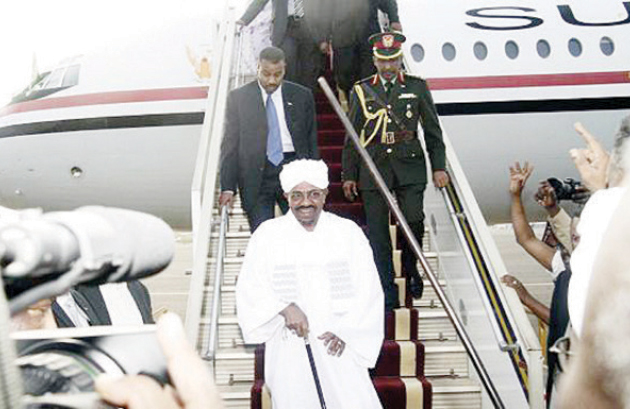
Chronicle Reporters
SOUTH Africa yesterday granted safe passage to Sudanese President Omar al-Bashir to leave the country even as a court ordered his arrest and extradition to the International Criminal Court (ICC) on war crimes charges.
President Jacob Zuma’s government, keen to avert a diplomatic crisis which would put it at loggerheads with the African Union (AU), let Bashir fly out from a military base, despite a High Court order barring him from leaving.
“South Africa generally suffers from a crisis of legitimacy in Africa — it wants to play a leadership role but it’s not always seen as deserving,” said Azwimphelele Langalanga, a researcher at the South African Institute of International Affairs. “If it had gone ahead and arrested Bashir, it would have further isolated Pretoria from the continent.”
Bashir — who has dodged an ICC arrest warrant for more than six years — had spent two days in South Africa attending an AU summit after obtaining immunity guarantees from the host government.
But he came closer than ever before to being arrested and sent to the Hague within hours of his arrival after a judge barred him from leaving the country until the courts could decide if South African was obliged to arrest him under international law.
Shortly after midday yesterday, however, Bashir boarded his jet at Waterkloof Air Force base and flew home to Khartoum, defying the judge’s ruling.
The Pretoria High Court hearing arguments for Bashir’s extradition and the South African government’s opposition to it was in recess when news trickled out that “Sudan 1” had taken off.
A few minutes later, the court resumed proceedings on the legality of arresting Bashir. But its work — like much of the ICC’s — felt suddenly and profoundly distant.
Judge Dunstan Mlambo ordered preparations to be made for his detention, only to be told by a state lawyer that he had left the country. The government’s actions were inconsistent with the constitution, Mlambo said.
The judge ordered the government lawyers to produce an affidavit indicating how Bashir was able to leave the country from Waterkloof Air Force base even after it was served an order to stop him from leaving.
Bashir’s flight put another dent in efforts by Western countries to hold the Sudanese ruler to account for his alleged involvement in the killing of 300,000 people in Darfur’s ethnic genocide.
His ability to evade arrest represented another blow to the ICC’s credibility on the continent, where it has repeatedly struggled to convince African leaders to turn over their own for prosecution.
“The ICC is wounded, it’s really wounded,” says Gilbert Khadiagala, head of the international relations department at the University of the Witwatersrand in Johannesburg. “Between the ICC withdrawing from prosecution of [Kenyan President] Uhuru Kenyatta and now South Africa letting Bashir go instead of carrying out its international obligation to send him to the ICC, it’s clear that the court’s legitimacy is on a serious downward slope in Africa.”
Bashir’s case brings to the fore the troubled relationship between Africa and the world tribunal.
The ICC indicted the Sudanese leader in 2009 for war crimes and crimes against humanity and later genocide in Darfur. But despite that, Bashir has travelled to numerous African countries — including Chad, Kenya and Nigeria — where anger at the ICC’s perceived bias against Africa meant calls for his arrest were ignored.
“Africa must pull out of the ICC. The pull out must be on the AU summit agenda in South Africa. What the West will say or do is not my business,” AU chairman and Zimbabwe President Robert Mugabe said in Addis Ababa back in February.
“The process the ICC is conducting in Africa has a flaw,” Ethiopian Prime Minister Hailemariam Desalegn told the AU in 2013. “The intention was to avoid any kind of impunity, but now the process has degenerated into some kind of race hunting.”
And last December, Ugandan President Yoweri Museveni called the ICC a “tool to target” Africa, but he failed in his effort to orchestrate a mass withdrawal by African states.
Rwanda’s president Paul Kagame has accused the ICC of “selective” justice.
“This world is divided into categories. There’re people who’ve the power to use international justice or international law to judge others and it doesn’t apply to them,” Kagame said in late 2013 in apparent reference to the United States which refused to sign the Rome Statute that established the ICC.
Established in 2002 as the world’s only permanent independent body to try war crimes, the ICC which is based at the Hague in the Netherlands has opened nine cases in eight countries, all in Africa.
Kenya’s then ICC-indicted presidential ticket running-mates, Uhuru Kenyatta and William Ruto, cast their election-winning 2013 campaign as a patriotic struggle against imperialism.
AU commission chair Nkosazana Dlamini-Zuma has also spoken out against Bashir’s arrest warrant, urging the balancing of reconciliation and justice.
Her country South Africa pioneered such an approach with its post-apartheid Truth and Reconciliation Commission that offered amnesty for honesty.
Around one-third of ICC member states are in Africa. African states have also played key roles in facilitating the ICC cases.
Of the eight countries where ICC investigations are underway or arrest warrants issued, four — the Central African Republic, the Democratic Republic of Congo, Mali and Uganda — are ICC member states which invited the prosecution to open investigations.
The UN Security Council had requested the investigation in Darfur — leading to Bashir’s arrest warrants for war crimes and crimes against humanity in 2009 and for genocide in 2010 — and also in Libya.
Benin and Tanzania were among 11 countries that voted in favour of the Darfur referral in 2005.
The ICC has brought just two convictions, both against Congolese warlords. Another Congolese militia leader was acquitted while the case against Kenya President Kenyatta collapsed in December, although his deputy Ruto’s trial continues.
Aware of the criticisms ICC Chief Prosecutor Fatou Bensouda, a Gambian lawyer, is proving less Africa-focused in her investigations than her predecessor, Argentinian Luis Moreno Ocampo.
Bensouda is conducting preliminary investigations into alleged crimes in Afghanistan, Colombia, Georgia, Honduras, Iraq, Palestine and Ukraine, as well as in Guinea and Nigeria.


 derick.khumalo