admin
admin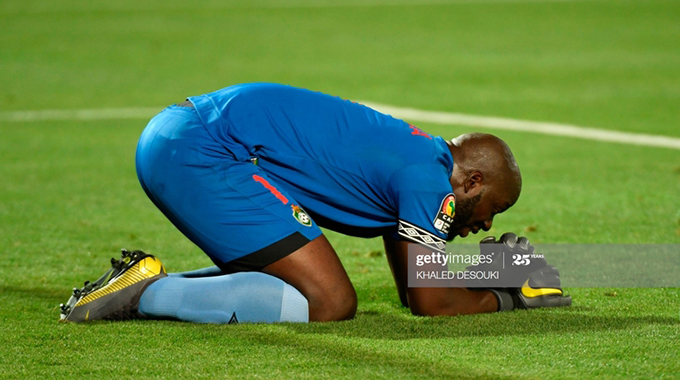
Robson Sharuko Senior Sports Editor
IT was the kind of spectacular goalkeeping performance, on which international careers are either built or revived — fittingly coming at the grand football theatre the Pharaohs call their spiritual home.
The imposing 75 000-seater Cairo International Stadium, a distinct symbol of both Egyptian and African football.
A fortress for the Pharaohs where, a quarter-of-a-century earlier, the Dream Team’s World Cup dreams appeared to have ended, in a chaotic 1-2 defeat, before FIFA nullified the result, and ordered a replay in Lyon, France.
The giant stadium where, on March 21, 1986, a record crowd of 120 000 fans poured in to watch Egypt edge Cameroon 5-4 in a penalty shootout, after a goalless draw, in the Nations Cup final.
Now, before 75 000 fans, after the capacity of the stadium was reduced when it was converted into an all-seater ground ahead of the 2006 AFCON finals, stood the latest generation of Pharaohs.
A group of men trying to once again win the tournament on home soil.
Most of the replica red shirts, inside the stadium, had a familiar number (10) and name (Salah) at the back — the iconic jersey that belonged to Mohamed Salah, the Egyptian Prince who was the then reigning CAF African Footballer of the Year.
The superstar footballer who, weeks earlier, had helped Liverpool win their sixth UEFA Champions League final.
Now, just like Mohammed Aboutrika before him, the dreams of a nation rested on his shoulders as Egypt, the first country to be crowned African champions in 1957, demanded to become the first nation to win the 24-team AFCON tournament.
But, for Salah, this just wasn’t a story of a footballer, at the top of the world after his Champions League success story, but one whose personal life was also in good shape.
After all, his wife Magi was almost two months’ pregnant by the time the Egyptian superstar lined up, in the red corner, for the opening match of the 2019 AFCON finals, at the Cairo International Stadium, on June 21, last year.
In contrast, the imposing heavyweight goalkeeper, standing in the opposite golden corner, trusted with providing the last line of defence for the Warriors, was still mourning the loss of his seven-year-old son, three months earlier.
Cedric Sibanda was just seven when he succumbed to asthma in March last year.
Now, his courageous father, Edmore “Zikeeper” Sibanda, who had kept goal for the Warriors just days after his death, in the final 2019 AFCON qualifier against Congo-Brazzaville, insisting it was the best way to honour the memory of his football-loving son, was again on national duty in that Nations Cup finals opener.
“The rest of my life is now dedicated to celebrating his life and the legacy he left behind,” ZiKeeper said.
“For a seven-year-old, he had such an effect on people who knew him, and many more who never had a chance to meet him, but only saw his videos.”
And, on the big stage of the Cairo International Airport, this time last year, ZiKeeper, playing because regular goalkeeper George Chigova was still injured, produced probably his best display of his career.
“It would have been easy for Edmore Sibanda to stand aside and let Egypt obliterate unfancied Zimbabwe,” Squakwa, the London-based sports website with a global reach, said in their analysis.
“The veteran stopper put in a magnificent performance from the first second to the very last.
“A collision with Marwan Mohsen (during which he made an amazing save) had left him carrying a knock on his knee, but he fought that, as long as he could, and put on a dominant display.
“Many expected Zimbabwe to turn up and get turned over. Or, at least, put up a defensive fight thanks to Egyptian profligacy. And whilst Zimbabwe needed a great display from Edmore Sibanda, as well some shocking Egyptian shooting, they did keep things tight at the back.”
And, another website, Sportskeeda, which has a global user base of about 25 million people a month, also praised the big goalkeeper’s performance that evening.
“Edmore Sibanda was the sole reason for Zimbabwe staying in the game after Egypt’s relentless attacking phase in the starting 20 minutes,” the website noted.
“The 33-year-old made a brave clearance off Salah’s cross by punching it away from the penalty area.
“Sibanda then made a stunning save to deny Ali Said from scoring in the eighth minute after a neat passing move initiated by Salah.
“Despite his best efforts, Edmore was unable to stop Trezeguet’s well-placed shot — the only goal scored in the match. The goalkeeper collided with Marwan Mohsen and injured his right foot.
“He carried on playing and produced another remarkable save to deny Salah. It was a pity that Sibanda couldn’t play the full ninety minutes as he succumbed to his injury.”
The authoritative Goal.com, who were running a live blog coverage of the match, were also impressed by Sibanda’s show on the night.
“Zimbabwe goalkeeper Sibanda is really on top of his game in these early stages of the encounter. He has single-handedly denied some good goal-scoring chances,” noted Goal.com.
“The goalkeeper has literally stood between Egypt and the opening goal.”
Sibanda limped off, with 13 minutes to play, and his injury meant he never played in the 2019 AFCON finals again.
For a man who had lost his son, just three months earlier, and was only playing because the regular ‘keeper was injured, his great performance, that night in Cairo, even in a losing cause, was the stuff on which careers are usually built on.
But, one year later, Sibanda has never played for his country again.
Although ZIFA insist he is eligible for selection, should the coach choose him, the big goalkeeper appears to be a victim of the purge which followed the chaos which rocked the Warriors camp, during their stay in Cairo, amid messy boardroom battles between the players and officials over payments.
If, this was his swansong show for the Warriors, ZiKeeper might just have saved his best, for last, in the Warriors’ shirt.


 Online Reporter