admin
adminAmerican militarism on a global scale.
Clinton’s itinerary included stops in nine nations: France, Afghanistan, Japan, Mongolia, Vietnam, Laos, Cambodia, Egypt and Israel. It focused on two interrelated US foreign policy objectives. The first is the elaboration of Washington’s counterrevolutionary strategy for asserting hegemony over the oil-rich regions of the Middle East and Central Asia.
The second is to promote the Obama administration’s “pivot” to Asia, which is aimed at containing Chinese economic, political and military influence through a combination of US military encirclement and the inflaming of regional tensions. In the course of her travels, the secretary of state proclaimed that “support for democracy and human rights” was the “heart” of American strategy. Clinton began her trip on July 5 with a conference in France of the “Friends of Syria” and consultations with the French government on operations by the US and its allies to foment and arm a sectarian civil war in Syria and prepare for direct military intervention aimed at regime-change — all in the name of “democracy and human rights.”
At the same time, she issued a dark threat that both Russia and China would be made to “pay a price” for failing to bow to American demands for intervention.
She concluded the journey on July 17 after final stops in Egypt and Israel. In the first country she paid homage to the country’s Supreme Council of the Armed Forces junta and its chief, Field Marshal Mohamed Hussein Tantawi, reaffirming Washington’s reliance on the Egyptian military as the bulwark of counterrevolution against the democratic and social aspirations of the country’s multi-millioned working class.
Officially, Clinton claimed that she was promoting a “democratic transition,” a phrase mouthed by the Obama administration since its failed attempts a year-and-a-half ago to prop up its long-time ally, the dictator Hosni Mubarak. In Israel, she made new war threats against Iran, insisting that Washington and Tel Aviv are “on the same page” and that the US is prepared to employ “all elements of American power” against Iran’s nuclear program. The second leg of Clinton’s tour took her to Afghanistan, where, together with the US-backed puppet president, Hamid Karzai, she announced Washington’s designation of the country as a “major non-NATO ally,” placing it on a diplomatic par with South Korea and laying the foundations for its indefinite occupation by tens of thousands of US troops.
Clinton also played the hypocritical human rights card in Asia, using a speech in Mongolia to promote the oligarchical regime there as a beacon of democracy and prosperity, in supposed contrast to one-party rule in China. That the masses of Mongolia live in poverty, while a thin layer at the top has enriched itself off of a mining boom, is of no more concern to Clinton than the endemic social inequality in the US itself.
Ironically, the New York Times pointed to the real conditions of the Mongolian people referring to masses living on the outskirts of the capital “in crowded Yurt slums some locals refer to as Mongolia’s favelas. Unemployment is rampant there; electricity and drinkable water are not. The less fortunate take shelter in the sewers, where they huddle beside hot-water pipes when the temperature plunges to 40 below.”
Clinton’s claim that Washington’s alliances are determined by “universal principles” of democracy are belied by its close ties to the torture regime in Uzbekistan, a key link in its supply route for the Afghanistan war, and the dictatorial government in Kazakhstan, the world’s largest producer of uranium, not to mention the long historical record of US backing for military dictatorships from Indonesia to South Korea.
Clinton’s tour also included a visit to Laos, the first by a US secretary of state in 57 years. Over the course of a decade, from the mid-1960s to the mid-1970s, American imperialism turned Laos into the most bombed country per capita on the face of the earth, dropping 0.84 tonnes of explosives for every inhabitant of a nation with which the US was not at war. In addition to the 30 000 Laotians killed in this firestorm, another 20 000 have died since from unexploded munitions.
Since 2010, the US has invoked its status as a “Pacific power” to claim the South China Sea, with its strategic trading routes and vast potential energy reserves, as an American lake, asserting its “national interest” in the area. Clinton’s visit to the region is being followed by that of two top Pentagon officials.
Navy Admiral Samuel Locklear, the new chief of the US Pacific Command, flew to the Philippines, where he met with top political and military officials and reminisced about his days as a junior officer at the giant Subic Bay naval base, clearly implying that a new US military presence is in the offing to further an anti-Chinese alliance.
Deputy Secretary of Defence Ashton Carter began a 10-day Asian tour on Tuesday for what a Pentagon spokesman described as “detailed discussions on what the US military’s approach to the Asia-Pacific will mean in practice.”
The Pentagon’s build-up in the region and the provocations staged by Secretary of State Clinton are both expressions of US imperialism’s strategy of offsetting its economic decline and containing the rise of a potential strategic rival in China through the threat and use of military might.


Online Reporter
- Herald
- September 18, 2026
- 19 views
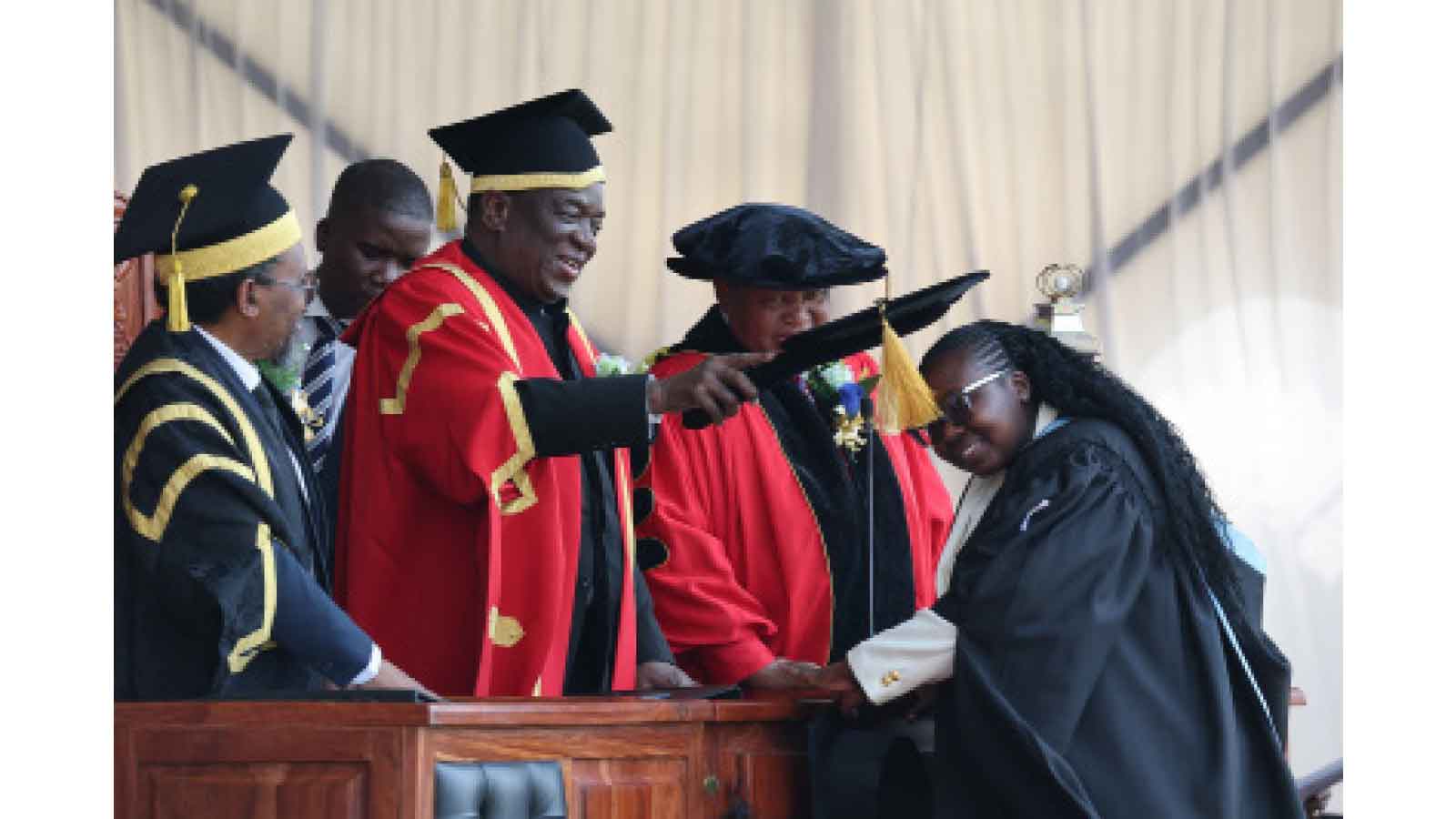
STEM Powerhouse . . . President caps 2 570 at NUST . . . 68pc get science, tech degrees
Raymond Jaravaza-Bulawayo Bureau NATIONAL University of Science and Technology Chancellor President Mnangagwa yesterday capped 2 570 graduates at the institution’s 32nd graduation ceremony, underscoring the university’s commitment to driving innovation,…