Chronicle Editor
Limukani Ncube, Editor
ZIMBABWE, blessed with vast natural resources, and an educated and hard-working populace, cannot be at the mercy of illegal sanctions imposed on the country by the West meant to collapse the economy, President Mnangagwa has said.
Writing in his weekly column published by this paper, President Mnangagwa said surrendering to external pressures through illegal sanctions imposed on the country by the West was not in the DNA of the country, and goes against the nation’s heroic experience as a people who survived and successfully resisted colonialism. The President said the country, especially under the Second Republic, has managed to develop despite the punitive measures of the illegal sanctions by using its natural resources and home grown talent.
“Our decision to reorganise ourselves internally in order to withstand more effectively those heinous sanctions has restored agency and given us initiative, thus helping us throw off the debilitating badge of victimhood and helplessness. A nation such as ours, with vast natural resources, and with an educated and hardworking, enterprising populace, can never be at the mercy of coercive measures meant to collapse our economy, and to force us to capitulate.”
President Mnangagwa said the stance adopted by the Second Republic since he took over as the Head of State in 2017 was to campaign against the illegal sanctions and also engage and exert diplomatic pressure on those who imposed the sanctions on the country.
“That way, we have been able to organise and mobilise ourselves internally, while still pursuing a dual policy of agitation, engagement and re-engagement. Engagement allows us to win to our side new friends and allies against those heinous sanctions; re-engagement enables us to continue dialoguing with those responsible for those sanctions which were visited on us unilaterally, and outside the norms and authority of the United Nations.”
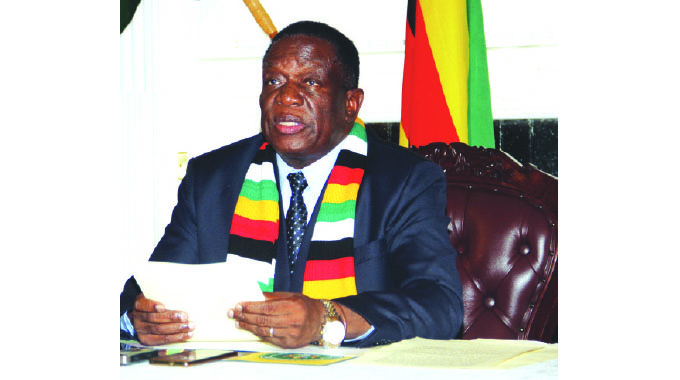
The President said as a response to the illegal sanctions, the country will continue to mobilise vast local mineral resources to improve the lives of the population.
“I am happy that Zimbabwe is now on the global map as a mining country, including as a major source of strategic minerals such as lithium, platinum group of metals and countless precious minerals which are keenly sought after globally. We are thus reckoned as a key player in the global transition to a green, non-carbon economy. Those countries which have chosen to be hostile to us are increasingly realising that there is more to be gained through positive bilateral cooperation than through unmerited, unilateral hostility. That new realisation is weakening the broad Western front forged in the past to impose sanctions against us. We thank SADC, Africa and the progressive world for taking up our case consistently, persistently, including yearly at the United Nations,” he said.
President Mnangagwa also stressed that agriculture remains the backbone of the economy, adding that the country will soon export wheat, becoming the first country in Africa to do so.
“ As I write, Zimbabwe is now exporting berries and citrus fruits to many parts of the world, including to the People’s Republic of China on preferential but competitive terms. We are also poised to export wheat, making us the first-ever African country to do so. These developments, alongside national food security, which have been made possible through mechanisation and modernisation of our agriculture, are key milestones in our struggle against illegal sanctions. Above all, they fortify belief in ourselves and in our capacity to turn things around, however harsh and hostile sections of the outer world might be.”
Zimbabwe will be joined by the rest of the continent and like-minded countries across the globe to mark the Sadc Anti-Sanctions Day on 25 October. The day was designated by Sadc as a day for solidarity against sanctions imposed on Zimbabwe by the European Union (EU), United States (US) and United Kingdom (UK) two decades ago.


 Bongani Ndlovu