Online Reporter
Wallace Ruzvidzo in BINDURA
TERTIARY institutions are key to the country’s modernisation and industrialisation efforts as they provide import substitution and spur economic growth, President Mnangagwa has said.
He made the remarks yesterday after commissioning Bindura University of Science Education (BUSE)’s Industrial Park, the state-of-the-art PALPO Technologies Production Plant, which assembles laptops, tablets and cellphones, as well as the tertiary institution’s main entrance.
He also toured BUSE’s Optometry Clinic and lens production plant.
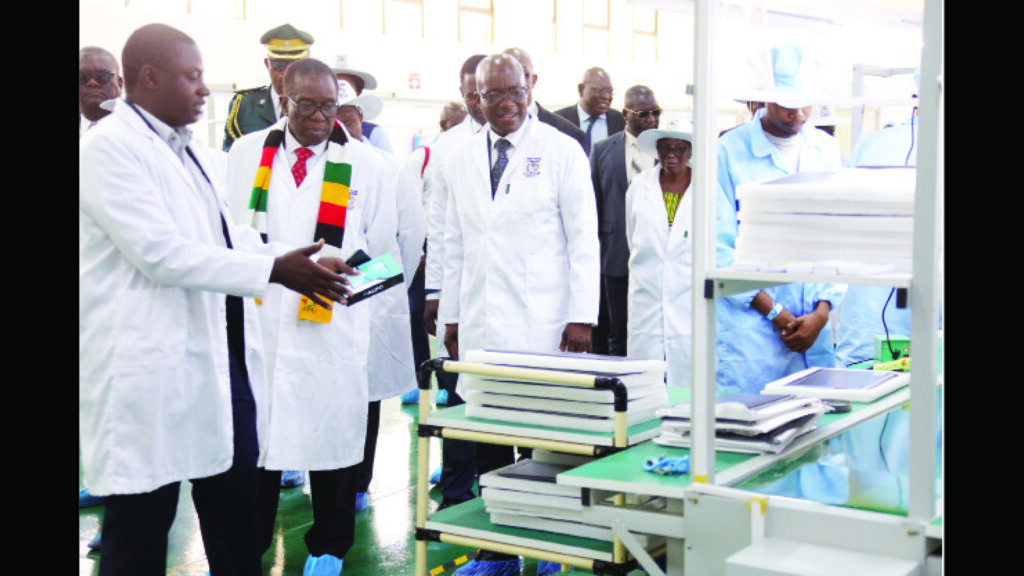
Bindura University of Science Education Chancellor President Mnangagwa and Vice Chancellor Professor Eddie Mwenje (third left) listen as an official briefs them during a tour of the Palpo Technologies plant which assembles cellphones, tablets and laptops at the institution yesterday. — Pictures: Justin Mutenda.
President Mnangagwa expressed satisfaction with strides being made by the country’s institutions of higher learning in advancing development, particularly BUSE.
“I am highly impressed by our team here (driving) innovation (and) technology development. This is what it ought to be across the country, across the board.
- Read more on the congratulatory supplement to the President of the Republic of Zimbabwe on Comesa Vice Chair election on: https://www.heraldonline.co.zw/congratulatory-supplement-to-the-president-of-the-republic-of-zimbabwe-on-comesa-vice-chair-election/
“Each time we come here, we find that this young man (Vice Chancellor Professor Eddie Mwenje) has new ideas, and that of course means that he is buying more and more time for himself in many ways,” said the President with a chuckle.
The locally assembled gadgets at the PALPO Technologies Production Plant will be more affordable than imports, thereby increasing accessibility for all and sundry.
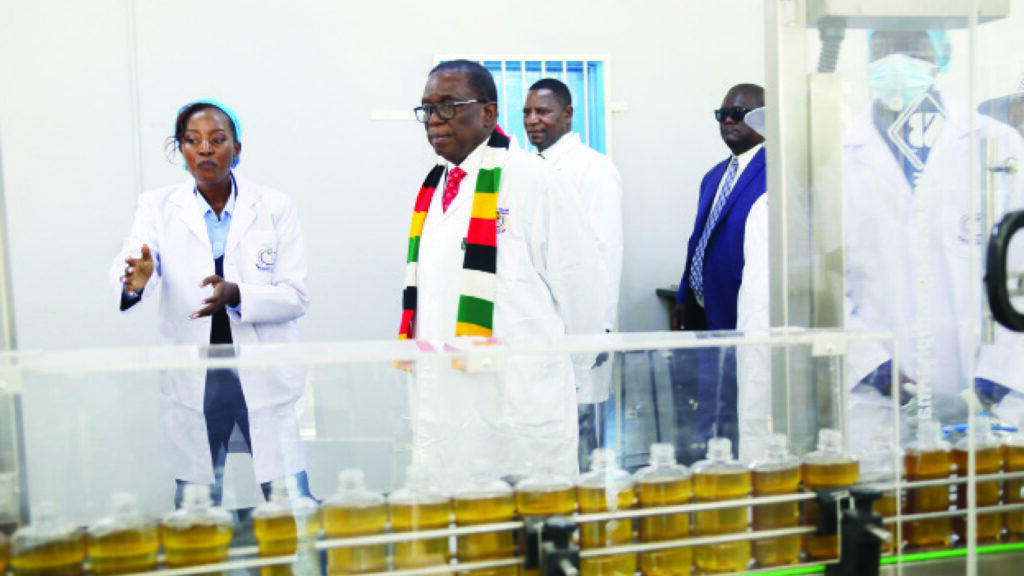
A university staff member explains to President Mnangagwa the bottling process at BUSE’s Household and Industrial Chemical plant.
At full operational capacity, the plant will produce up to 12 000 laptops and tablets, as well as 3 000 mobile phones.
Quizzed on how important innovations by the country’s universities are to Zimbabwe’s development agenda, the President said they were a vital cog.
“First of all, you are here asking me because you went through these facilities, that’s how important they are. Now that you are asking me, we must have such facilities across the board so that our people are educated,” he said.
President Mnangagwa said Zimbabweans needed to be informed on the development trajectory being spearheaded by the Second Republic.
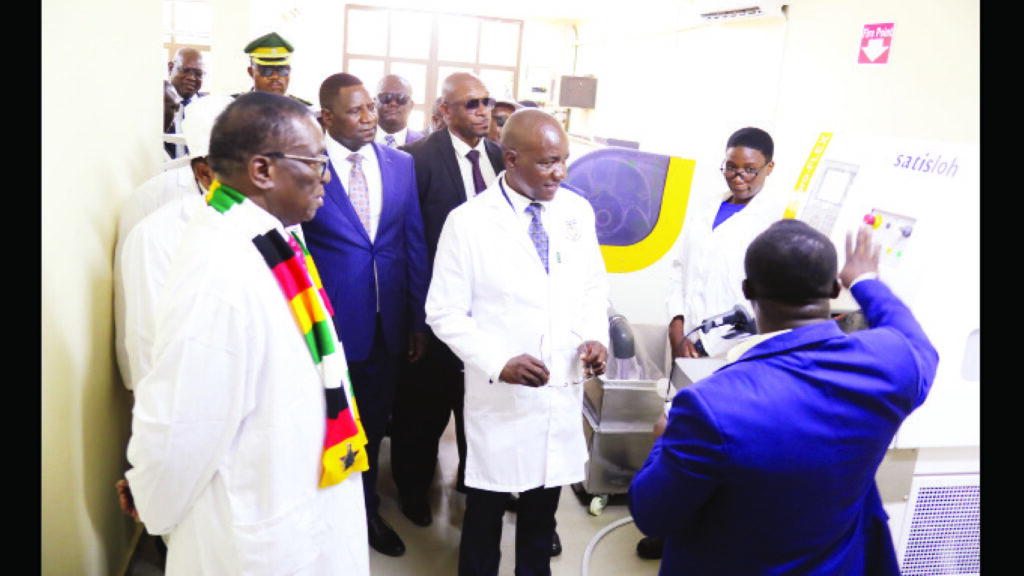
President Mnangagwa and Prof Eddie Mwenje (centre) tour the Optometry School at Bindura University of Science Education yesterday.
“We have a system of making sure we spread and have everybody across the country understand what we are doing, what our aims are, what our goals are, how much we are developing, where we were last year and where we are now, and where we intend to go.
“These are the occasions which showcase our agenda,” he said.
President Mnangagwa has been at the heart of driving the country’s education transformation agenda, particularly through the Heritage-Based Education 5.0 model, which focuses on five core missions for tertiary institutions in Zimbabwe.

President Mnangagwa officially opens the institution’s main gate yesterday.
These are teaching through imparting relevant knowledge rooted in local realities; research — generating new understanding based on local needs; community service — applying knowledge for societal benefit; innovation — creating new products and solutions; and industrialisation — transforming ideas into industries and jobs. This has resulted in most of the country’s tertiary institutions stepping up to the plate and leading in life-changing innovations that are responsive to the needs of the people.