MacDenias Moyo
History is often cruel to nations that dare to define their own destiny. It punishes those that refuse to conform and subjects them to relentless scrutiny long after others have been forgiven for greater failings. Zimbabwe knows this reality more intimately than most. For much of the past two decades, the country existed beneath a cloud of pessimism. Every challenge was magnified. Every setback was prophesied into permanence. Every achievement was dismissed as temporary.
Yet history possesses one immutable law. Reality eventually overpowers rhetoric.
The release of the latest International Monetary Fund Staff Report this month represents one of those defining moments when reality begins to dismantle entrenched narratives. The significance of this report does not lie merely in the economic statistics it contains. Its deeper meaning lies in what it reveals about the direction of a nation that has spent years rebuilding itself while carrying the burdens of sanctions, debt overhang and persistent external scepticism.
According to the Fund, economic activity in Zimbabwe has remained strong. Inflation has declined. The exchange rate has remained broadly stable. External sector performance exceeded expectations. The primary budget surplus surpassed expectations. Most significantly, the institution acknowledged that sustaining reform momentum would be critical in consolidating macroeconomic stability and supporting further international re-engagement efforts.
These observations are profoundly important because they emerge from an institution whose assessments are followed closely by governments, investors, multilateral lenders and global markets. They represent an acknowledgement that Zimbabwe is no longer being discussed primarily through the prism of crisis management. Instead, the discussion is increasingly shifting towards economic consolidation, policy continuity and developmental possibilities.
This is perhaps the most significant political consequence of the IMF report. It reflects a growing acceptance that the Second Republic has succeeded in establishing a platform upon which long-term transformation can be built.
At its core, the Zimbabwean story under the Second Republic is the story of a State attempting to move from the politics of survival towards the politics of construction.
It is the story of a nation striving to replace uncertainty with predictability, volatility with stability and stagnation with growth.
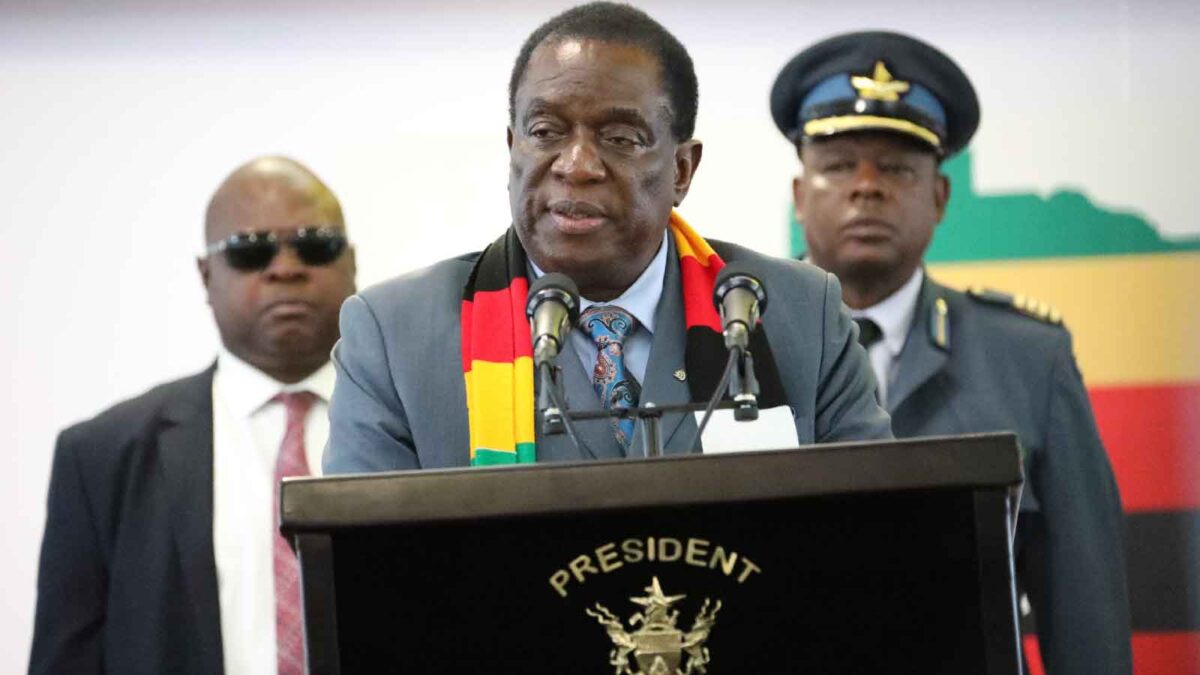
President Mnangagwa inherited an economy constrained by deep structural challenges, weakened confidence and strained international relations. The task before his administration was not merely to repair an economy. It was to restore belief in the possibility of national renewal. Such a mission was always going to require patience, discipline and the willingness to pursue reforms whose rewards would only become visible over time.
The results of that approach are increasingly becoming visible in the very indicators highlighted by the IMF. Zimbabwe’s economy is projected to grow by five percent in 2026. Growth is expected to moderate to3.5 percent in 2027 due to the anticipated impact of El Niño induced drought conditions on agricultural output. Yet what is particularly noteworthy is that Treasury projections contained within the policy memorandum accompanying the report anticipate a rebound to 5 percent growth in 2028 and average growth above 5 percent through to 2030.
This projection speaks to confidence in the underlying fundamentals of the economy. It suggests that temporary environmental disruptions are not expected to derail the broader developmental trajectory.
Indeed, one of the most striking aspects of the IMF report is its recognition that Zimbabwe’s external sector performance exceeded expectations.
This assessment carries significance beyond technical economic language. The external sector reflects the manner in which Zimbabwe interacts with the wider global economy through trade, investment, capital movements and financial exchanges. Stronger than anticipated performance in this area indicates that the country is increasingly integrating into regional and international economic systems. It is evidence that the policy of engagement pursued by the Second Republic is yielding dividends.
For years Zimbabwe was routinely characterised as a nation isolated from international economic currents. That depiction is becoming increasingly difficult to sustain. A country whose external sector exceeds expectations, whose engagement with international financial institutions continues to deepen and whose reform programme is receiving acknowledgement from multilateral bodies can no longer credibly be described as existing on the margins of global economic interaction. The gradual transition from isolation towards engagement represents one of the defining achievements of the current administration.
Equally important is the IMF’s observation that inflation has declined while economic activity has remained strong.
Inflation is not merely an economic statistic. It is a social phenomenon. It shapes the daily realities of workers, entrepreneurs, pensioners and households. A decline in inflation represents a restoration of confidence in economic management. It strengthens purchasing power, improves planning horizons and creates the conditions necessary for productive investment.
Combined with the Fund’s observation that Zimbabwe’s exchange rate has remained broadly stable, a picture emerges of an economy that is steadily reinforcing the pillars of macroeconomic credibility.
The importance of exchange rate stability cannot be overstated. Throughout modern economic history, nations that have achieved sustained growth have generally done so upon foundations of monetary stability. Business decisions require certainty. Investors commit capital when risk declines. Manufacturers expand production when they can forecast costs with greater confidence. Stability therefore becomes not merely a technical objective but a developmental necessity. It creates an environment in which enterprise can flourish and wealth can be generated.
The IMF’s finding that Zimbabwe’s primary budget surplus exceeded expectations is equally significant.
A primary surplus reflects fiscal discipline. It indicates that government revenues exceeded expenditures before interest obligations are considered. This is a critical measure because it demonstrates an effort to anchor development upon prudence rather than unsustainable borrowing. No country achieves long-term prosperity by sacrificing fiscal responsibility. Roads, power stations, dams, schools and industrial infrastructure require a stable fiscal foundation. The ability of Government to exceed expectations in this area suggests that macroeconomic management is becoming increasingly disciplined and focused.
This progress assumes even greater significance when viewed through the lens of Vision 2030. Too often critics speak of Vision 2030 as though it were merely a political slogan. Such interpretations fail to appreciate the role of national vision in the development process. Every successful transformation in modern economic history was guided by a long-term national objective. Nations do not industrialise accidentally. They do not become upper middle income economies through improvisation. They develop because vision is matched by execution and ambition is supported by policy consistency.
Vision 2030 represents precisely such an aspiration. It embodies the determination to create a Zimbabwe characterised by broad based prosperity, industrial growth, modern infrastructure and rising living standards. The projections contained within the IMF report suggest that this aspiration is not detached from economic reality. Rather, it is increasingly supported by indicators that point towards sustained growth and improving stability.
Of course, no serious discussion of Zimbabwe’s future can ignore the challenge presented by climate change and El Niño conditions. The anticipated slowdown in growth during 2027 reflects the reality that agriculture remains vulnerable to climatic shocks. Yet one of the defining features of the Second Republic has been its recognition that resilience must be built before crises occur. Investments in irrigation infrastructure, dam construction, climate smart agriculture, water harvesting systems and strategic grain reserves demonstrate an effort to reduce vulnerability to adverse weather conditions and protect food security.
What is emerging is a philosophy of development that recognises resilience as an essential component of growth. Economic expansion cannot be sustained if agricultural production remains hostage to rainfall patterns alone. By expanding irrigation capacity and strengthening agricultural preparedness, Government is laying foundations that will help cushion the economy against climatic disruptions while supporting continued growth across rural communities.
Beyond economics, the political significance of the IMF report is impossible to ignore. For decades Zimbabwe’s relationship with major international institutions was characterised by tension and distrust. Today the country is engaged in a Staff Monitored Programme that is explicitly designed to support re-engagement, strengthen credibility and advance debt resolution efforts.
This process is not merely administrative. It is geopolitical. It signals a country gradually rebuilding confidence and reclaiming its place within international economic discourse.
The broader message emerging from the November 2026 report is, therefore, unmistakable. Zimbabwe is no longer being assessed solely through the prism of its difficulties. It is increasingly being assessed through the prism of its possibilities. Growth remains positive. Inflation is declining. Fiscal discipline is strengthening. The external sector is outperforming expectations. International engagement is deepening. These are not indicators of a nation trapped by its past. They are indicators of a nation attempting to define its future.
The road to Vision 2030 will not be without challenges. Every developmental journey encounters obstacles. Yet the evidence increasingly suggests that Zimbabwe has moved beyond the era in which crisis alone defined the national conversation. The foundations of a more stable and prosperous future are being laid. The architecture of growth is becoming more visible. Confidence is gradually returning.
If this momentum is sustained, if reforms continue with consistency and if development remains the central organising principle of national policy, then Vision 2030 will cease to be merely an aspiration. It will become the logical culmination of a decade defined by resilience, reform and renewal. In that regard, the latest IMF report should be understood not simply as an economic assessment but as a marker of historical transition. It is evidence that Zimbabwe’s long march from sanctions towards stability, from isolation towards engagement and from uncertainty towards prosperity is steadily gathering momentum.