Chronicle Editor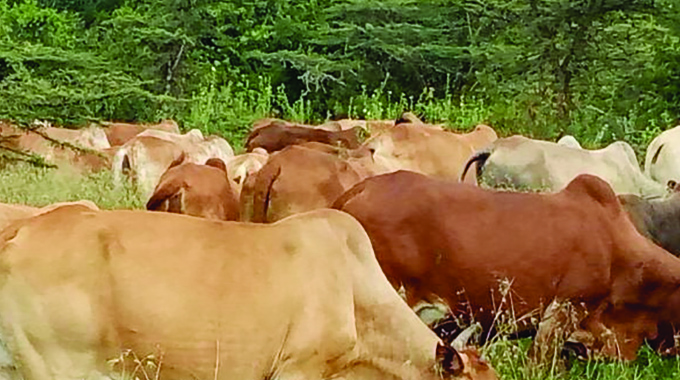
SMALLHOLDER livestock farmers hold the largest chunk of the national herd, at close to about 90 percent. This means that most of our beef is produced by smallholder farmers and they are found in communal areas, be they resettlement areas or the traditional rural communal areas.
There are, however, some smallholder commercial farmers in private-owned titled farms. One common characteristic of communal smallholder livestock production systems is shared resources.
The shared resources include grazing land, dipping facilities and watering points such as dams and boreholes.
These shared resources tend to suffer from collective neglect by the communities, making it difficult for livestock farmers to produce and thrive in communal systems.
The neglect of communal infrastructure as a result of collective irresponsibility by the users of the asset is what is described as the tragedy of the commons phenomenon.
No one feels obliged to fix or even care for the infrastructure because they are not the sole beneficiary. This could be a borehole, dip tank, paddock or any such communal infrastructure. It is actually very common to find users of the same assets vandalising and stealing its components.
This pen wishes to implore smallholder communal livestock farmers to exercise stewardship over the provided resources as these are meant to support their production system. It is frustrating and very wrong that Government and its development partners will sink hundreds of thousands of dollars to put up infrastructure which is meant to assist the farmers and it is vandalised or stolen within a short time.
A recent example is the highway boundary fence which was erected on the highway from Plumtree to Harare. I am not sure what length this highway fence covered but the last time I checked, which is a long time ago, it had gone as far as Ntabazinduna area.

Sadly, that fence has been both vandalised and stolen, yet it was meant to protect livestock, vehicles and human lives. So, livestock farmers along the highway are back to losing livestock from road carnage and endangering human lives as well as destroying property of road users because the communities are simply irresponsible even when the infrastructure is to their benefit.
Lots of solar-powered boreholes meant for irrigating gardens, and pumping water into dip tanks, have the solar panels stolen and the infrastructure rendered useless.
In some communities efforts by the Government and its development partners were made to erect paddocks as a means of grazing land management, or veterinary cordon fences for animal movement and disease control.
All these are vandalised by the same community that is supposed to benefit from the infrastructure. The same community is now struggling with transboundary livestock disease that affects trade as the areas are always under quarantine and their animals are down-graded in prices because of that.
The important question being how can communities be better capacitated to look after their infrastructure in order to promote livestock production? It is important for smallholder livestock producers to have better stewardship of their communal infrastructure as it is the one which makes their production system function.
Communities simply need to be primed to take care of their resources for their own good. I visited one community in a district in Matabeleland North Province, and through discussions, we discovered that the village has over eight boreholes, three of them high-yielding but not used because they are in the grazing area.
In fact, the boreholes are said to be neglected and abandoned, yet the same community is screaming about a shortage of water for livestock!
Simply solarising the high-yielding boreholes would solve the livestock drinking water problem, especially in a drought year like this one. It is this kind of attitude from communities in communal areas that is bringing down the production system of a sector which holds 90 percent of our national herd.
This needs to be corrected so that the communal livestock production systems can function optimally and contribute to the national GDP as they should. Without improving the way communal areas manage communal infrastructure, the Government will always be burdened with repairs and installation of new equipment as it continues to be vandalized.
There is huge potential for livestock production especially in quality improvement but we have to get the production system working first and this starts with better managing the shared infrastructure. Uyabonga umntakaMaKhumalo.
Mhlupheki Dube is a livestock specialist and farmer. He writes in his own capacity. Feed back [email protected] cell 0772851275


 Online Reporter