Sundaymail Editor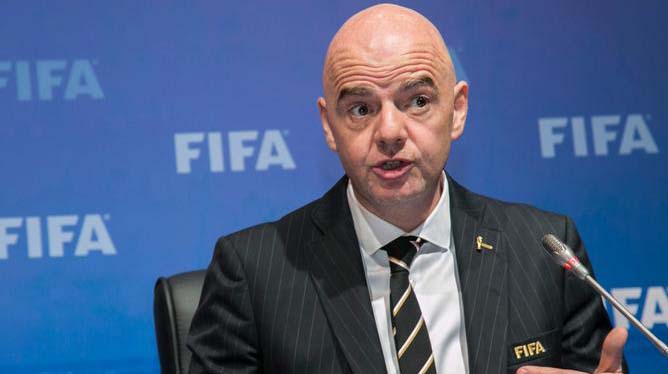
In an exclusive interview with AS, FIFA president Gianni Infantino answers questions on the European Super League (ESL) and major clubs’ conflict with UEFA, and discusses the issue of sanctions for the 12 breakaway rebels. He also talks about young people’s waning interest in football, clubs’ multi-million-euro losses and the need to control spending on transfer fees, players’ salaries and agents’ commissions, something he describes as “exploding to unhealthy levels”
************
Q: As the former secretary-general of UEFA, you appear to be the ideal person to mediate in the conflict between European football’s governing body and the major clubs involved in the European Super League breakaway attempt. What can you do to help?
A: I am the president of FIFA and my responsibility is to defend football as a whole and all around the world. This includes small, medium and big clubs, leagues and federations of all over the world with different levels of development, all the players, coaches, officials and each and every stakeholder, always having in mind the fans, which are and should be at the centre of everything we do.
I have been very clear in what is mine and FIFA’s position on this matter. We stand by UEFA in rejecting the Super League.
We are against it and we will always be against any competition which is not part of the international structures of football and that threatens the unity and solidarity that should always exist in the football pyramid, which links grassroots and amateur level to the top stars.
Having said that, it is also my duty to advocate that all the parties should enter into a profound and hopefully constructive dialogue in search of positive solutions. Our duty as the world governing body is to have our doors open to everyone, we need to face the problems in football together.
Q: It’s a conflict that has been bubbling away for years, because each side has its arguments: UEFA because it organises the competition, and the clubs because they are the ones who pay the players. What solutions would you propose?
A: Our game is so incredibly successful also because there is a bond, a link between the bottom and the top of the pyramid. Between a girl or a boy playing in school or on the streets and a professional player scoring a goal in the final of a big competition.
The clubs are an essential part of that pyramid, but there are also other structures to ensure that everyone is united and there are solidarity and control mechanisms put in place in order for the less privileged to benefit, even if just partially, from the success and popularity of the most successful and powerful ones.
As in everything in life, a fair balance needs to be sought so that everyone’s interests are defended. As I said, in FIFA, our interest is the defence of football as a whole, from grassroots to the big stars, and all around the world, not only Europe but also in the Americas, the Caribbean, Africa, Asia and Oceania.
We, for example, proposed and have approved a competition which we think fills a gap in this particular context.
With a proper new Club World Cup — which will replace two competitions (the current annual Club World Cup and the Confederations Cup) so it won’t be an extra burden to players, and for which several big clubs will qualify — a new revenue stream will exist with benefits not only for the participating clubs but also to all the entire football pyramid.
In fact, FIFA will not keep one single dollar from this competition and we will make sure that a percentage goes to non-participating clubs, leagues, federations, youth and women’s football all around the world.
Speaking of which, we will be announcing soon the creation of a women’s Club World Cup, which I think will be also a great success.
We need to find solutions together and I have been proposing an extensive and in-depth debate on where we are today and how we can move forward stronger and better prepared for situations like the one which occurred with the pandemic.
Q: You have said you prefer dialogue rather than sanctions for the clubs; some have considered this an attack on UEFA and its president?
A: Let me be very clear on that: FIFA and me personally support UEFA and its president against the Super League.
I think we need to think carefully on the next steps because this is a complex matter and goes well beyond a single competition – it is about the entire global football ecosystem.
As for the sanctions, there are independent and competent bodies that should analyse what can and should be done in this respect and it is therefore not for me to comment on this.
Obviously I don’t exclude, therefore, that sanctions are implemented at national, continental or a world level.
I said it once and I say again very clearly: Either the clubs want to be part of the football structures, or they will have to face the consequences.
This is obvious and I am sure they know that. By the way, since we are talking about it, let me clarify that when I said that a leader has to think on why we are where we are, I wasn’t referring to the UEFA president.
I was calling on all football administrators to come together and reflect on the context we live in.
I would like all the parts to get together and have a constructive dialogue to find the best solutions for everyone.
A peaceful solution is always better than conflict. I repeat, this goes beyond a single competition.
This has a global impact as, for example, there are players from all over the world playing for these clubs and FIFA needs to protect global national team football.
In any case, I believe everyone should be entitled to say what he thinks in the best and most effective format possible with all the stakeholders present, not just a few.
Many are willing to enter into a dialogue and of course FIFA’s doors are always open to everyone in football, having always at heart the superior interests of football.
One thing has to be very clear though: We won’t accept proposals that represent a contradiction of the values of our game like sporting merit, solidarity, integrity and the fair access to competitions.
Q: What do you make of the fact that of the four Champions League semi-finalists this season, three — Manchester City, Paris Saint-Germain and Chelsea — have been investigated for Financial Fair Play breaches? You were one of the major champions of FFP — don’t you think that it is no longer effective and that it could be one of the reasons for the creation of the ESL? Because it’s clear that UEFA’s control mechanisms have failed and that the ESL seeks peer oversight.
A: UEFA has independent bodies to deal with those cases and I shouldn’t comment on them. When FFP was introduced, it was done in agreement with all the clubs and there was a consensus that these rules were necessary. In 2011, European clubs were having a net deficit of 1,7 billion euros and, after the introduction of the FFP, in five years, also thanks to those rules, the losses were reduced to less than 300 million euros.
It’s true that with time, things change, and the Covid-19 crisis also showed us that we need to adapt. What was effective and adequate 10 years ago might need to be revisited to see if it still makes sense and if it works, but I think football will always need transparency and control mechanisms at all levels.
Q: In the UK, many supporters took to the streets to protest against the ESL, but none of the Premier League clubs who signed up are British-owned. Their owners are Arab sheikhs, American billionaires and Russian oligarchs. Does football really belong to the fans?
A: Fans have to be at the heart of everything we do. Without fans and their passion, football wouldn’t be what it is and we need to keep that in mind all the time. Football is and should be essentially for the fans and we have to find ways to protect their interests.
Investments in football should be welcome but, as I said, as long as they are transparent and there are control mechanisms to ensure a competitive balance, as well as a healthy and sustainable industry.
Q: Of the world’s biggest clubs, there are only two that continue to follow the romantic ideal of being exclusively fan-owned: Real Madrid and Barcelona. Do you understand why they feel like Asterix’s village?
A: There are some other examples like in Germany and other countries, but I understand your question, which should also be put into the context of the legal framework where sport fits.
Sports and football have a specificity that everyone needs to understand and respect, including political authorities because we don’t live in a bubble.
This article was originally published in Spanish newspaper Diario AS. The author of that article is Joaquín Maroto (@AS_Maroto)


 Online Reporter