Online Reporter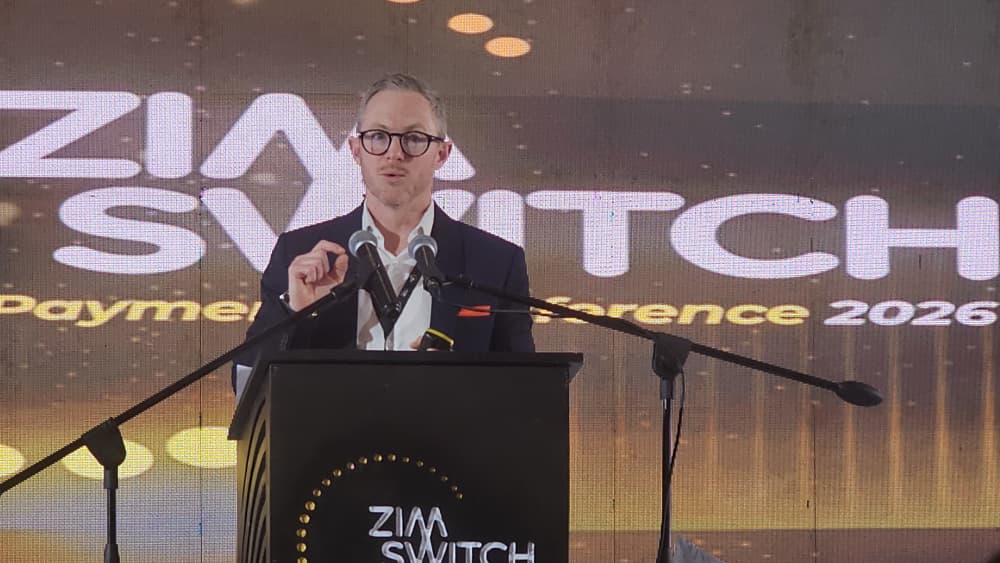
Business Reporter
Zimbabwe is perfectly primed for the next stage of digital payments growth, with stable inflation creating the right condition for formalisation, the chief executive of Mukuru Financial Services has said.
Addressing the Zimswitch Payments Conference in Victoria Falls, Mr Douglas Tait Knight said the country had moved beyond short-term panic and was now looking at medium to long-term opportunities.
“The inflation is perfectly manageable. It’s got a stable monetary background – for the first time in a long time,” Mr Knight said. “These are the right conditions that are perfectly primed to move into the next stage of growth.”
Mr Knight highlighted how informal digital rails had self-organised in the absence of formal infrastructure, pointing to the use of WhatsApp for instant currency swaps between Harare and Lusaka.
“Without any technology other than WhatsApp, it has digitised the parallel space. It is almost instantaneous,” he said.
He noted that such transactions required no identification, making them attractive to those seeking frictionless exchange.
“I don’t need your ID and I don’t need your number. That is attractive to guys who just want to transact with everyone.”
Mr Knight said businesses were increasingly seeking to offload the burden of cash management, particularly given security concerns.
“People don’t want to be driving around with thousands of dollars in their car – having to defend themselves against someone who knows that they’re about to go into payroll,” he said.
“They want to externalise that cash risk to the financial service providers here.”
He said the risk profile around cash transport was shifting, impacting how far operators could extend their services.
The Mukuru CEO cited examples from Argentina and Nigeria where digital adoption had surged despite challenging economic conditions, noting that adoption proved “highly elastic”.
He said the size of the prize was not Zimbabwe’s formal GDP but the estimated 60 percent of economic activity hiding in the parallel sector.
“The informal or parallel sector is not a bunch of criminals. It’s just folks looking to manage their small everyday business,” he said. “If you provide them with a solution that is quick and safe, they will adopt it.”
Mr Knight identified three key priorities: taxing the rails to create incentives for formalisation, building shared infrastructure on the Zimswitch platform, and leveraging payment data for credit underwriting.
“Payment data is the credit,” he said.
Mr Knight noted that when Starlink became available, it was oversubscribed on day one with 18 000 subscribers – demonstrating that the market understood the solutions available.
“Everyone knew what the solutions were. This is not an education point. It’s not an adoption point,” he said.
Mr Knight said Zimbabwe could skip traditional banking infrastructure and move directly to open digital payments.
“You can skip the branch. You can skip card. And go into open immediately. That’s available today,” he said. “You go to your point of sale, you tap your phone number – and it looks like a dream.”
He noted that while access to finance for women had moved up 20 percent and mobile money now reached 60 percent of adults, the key challenge remained managing the informal sector.
“The challenge moving forward for this forum is: how do you manage the informal piece which is such a large part of our lives?” he asked.
Mr Knight said payment history could unlock credit for small businesses, noting that informal lending rates of 40 percent per month were not unusual.
“We can easily do better than that in the formal sector,” he said. “It’s a perfectly sustainable model for SME business groups.”