admin
admin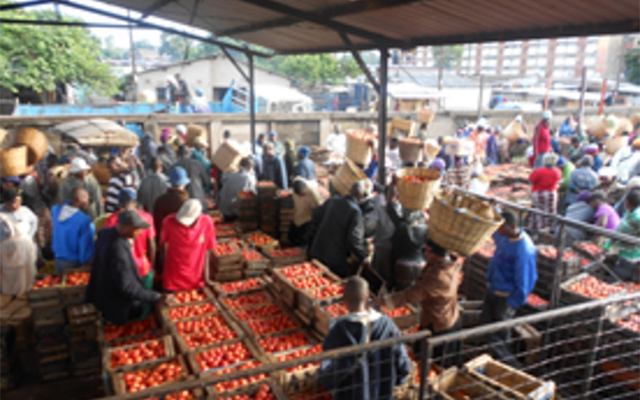
Charles Dhewa
Over the past few decades, Zimbabwean agriculture has witnessed a surge in the growth of informal markets and decline of formal ones. Informal markets currently absorb more than 70 percent of agricultural commodities.This transition has disrupted supply chain management systems built over many years. On the other hand, the absorption capacity of informal markets is largely undocumented and unpredictable in terms of actual volumes that can be taken up per given period.
An increase in market participation by hundreds of smallholder farmers following land reform has not been matched by investments in corresponding supply chain management systems.
The formal market system used to be driven by organised supply chains dominated by medium and large-scale companies. It was also supported by proper logistics, cold chain and strong internal markets for processing industries as well as support for the export market.
The whole supply chain management system was based on reliable information, inputs, finance and contract arrangements. Parastatals like the Grain Marketing Board (GMB) and Cold Storage Company (CSC) had meaningful roles in keeping the agricultural commodity supply chain efficient. In fact, the GMB was popular for handling more commodities like small grains and legumes than just for dealing with maize.
Supply chain management more about reliable information
During the days of formal markets, data and information around production patterns and irrigation systems was properly coordinated to enhance supply chain decision making.
While the participation of previously excluded smallholders in agricultural markets is highly commendable, it has coincided with a decline in processing companies and formal markets.
Since agricultural financing was tied with formal markets, the transition to informal markets has been characterised by unpredictable financing which also negatively affects supply chain management.
Lack of consistent data makes it difficult to tell who the actors are and how many volumes they can take consistently. In addition, governance systems in informal markets are not properly structured to enable collection of reliable data.
Given that many value chain actors are not keen to pay for information, which they consider a public good, very few knowledge brokers are willing to gather and provide information that would strengthen supply chains. As a result, supply chains remains erratic as gluts alternate with deficits.
Proper data capture systems will support a supply chain-informed market-driven production system. Supply chain management is possible where there is timely and coordinated information sharing. That is a major gap at the moment.
A lot of information is held separately by farmers, traders, transporters and food chain stores. Reluctance or inability share this information weakens the supply chain.
On the production side, where data is available, it lags behind market data. There is need for fluid data flowing into markets and back to producers. Since NGOs, Agritex and farmer unions all try to collect data from the same farmers, there is a high risk of double counting particularly in irrigation schemes where farmers receive support from these diverse actors.
This creates potential for over-estimating the amount of supplies destined for the market from farming communities. As long as we have disjointed information systems, we cannot have a strong supply chain management system. Like all management principles, supply chain management focuses on planning, coordination, organising and controlling.
In the agriculture sector, supply chain management is about distribution and that speaks to the market. While Agritex, NGOs and some private sector players are mainly on the production side, who is responsible for organizing, coordinating and controlling the market? This is a big gap.
Collective inability to deal with a changing climate
Another critical issue is failure by producers and supporting institutions to anticipate and deal with climate change. For instance, following late summer rains, the past three months of 2016 been favourable for tomato production.
This has contributed to a glut of tomatoes in the market. It seems we lack proper technology that can accurately predict climate and weather patterns to inform producers accordingly. This affects the supply chain management system.
All this connects with the absence of appropriate infrastructure along the value chain — logistics, warehousing and cooling facilities. The majority of farmers are forced to supply since there is no mechanism for managing and regulating supplies. If available, cooling and warehousing facilities would regulate supplies.
Unco-ordinated transport systems also add to the pains of supply chain management. The majority of smallholder producers do not have control over transport, therefore they often try to load all commodities including unripe ones in case they don’t find transport when they need it. Unsure when the next transport will come, farmers ferry all commodities to the market including unripe ones.
The dilemma of incomplete value chains
Some crops like small grains do not have complete value chains. Many farmers are being encouraged to produce small grains but producers bear the frustrations of being stuck with tons of finger millet and other small grains due to absence of reliable markets.
A number of development partners are promoting small grains without thinking about the whole supply chain including the market. Such half-baked interventions prevent investment in efficient supply chain management.
For most farmers, access to finance and inputs is not guaranteed and this affects decision making in terms of when to plant and when supplies will be due for the market.
In most cases planting starts the moment money comes with farmers rushing to plant, thinking about loan repayment as opposed to farming with the market in mind.
Financial institutions are also funding agriculture irrespective of market demand for particular commodities. This ad-hoc farming style affects supply chain management.
Opportunities and possibilities
Budgetary support for agriculture from the fiscus should be unbundled into production, logistics, marketing and processing. Unless that happens, we will continue with more support going to production at the expense of the supply management system.
Local authorities are satisfied with providing trading space but they lack evidence of what is going into the market. While the ministry of agriculture is interested in price, price is not the only determinant of supply.
It is important to consider other determinants. For instance, informal markets are dominated by micro, small and medium enterprises. What is the role of the Ministry of SMEs in informal agriculture markets?
Given that women and youth constitute more than 60 percent of informal agriculture markets actors, what is the role of ministries of gender and youths in empowering women and youth in the agricultural supply chain?
Supply chain management should be a relay connecting government departments, development organisations, private sector, farmers, information brokers and the market.
Policy makers should create an enabling environment that promotes knowledge sharing. Financial institutions should also be involved so that they do not finance production independent of markets as they are doing at the moment.
An agricultural commodity exchange is built on supply chain management
A commodity exchange cannot take place in isolation without proper infrastructure and systems. Both context and content are fundamental. Supply chain management systems can be a starting point based on agro-economic drivers (what drives production in each community?)
This can be backed by community knowledge centres where all value chain actors contribute their information. What is currently a barrier is that most value chain actors such as processors are not sharing trusted information with each other because they consider each other cut-throat competitors.
However, they may be willing to contribute such information to a community knowledge centre. Such an information system can be developed from wards, districts and provinces for consolidation at national level.
Community knowledge centres can also provide important information for setting up infrastructure like cooling and warehouse facilities. This process is not very difficult because it can simply be based on different perishability nature of various commodities.
Some commodities like tomatoes can be kept in a warehouse for a few days while others like butternuts and sweet potatoes can stay for longer.
Tripartite business models can then be developed between local authorities and the private sector towards market infrastructure development through Built-Operate and Transfer (BOT) relationships.
Without a fully operational supply chain management system, the end result is an inefficient informal market. We need to explore other businesses tied to the growth of the SMEs sector and understand all important pieces towards developing reliable supply chains.
An expanding catering industry alongside the informal market is barely understood. Technology in the form of farming and processing equipment are being produced for processing peanut butter and producing all kinds of juices. All these enterprises need to be understood as part of a supply chain.
Where you are managing supply, it assumes you are also managing production. How much is demanded on the market informs supply? Organised supply should be based on demand. It also means understand consumption patterns.
Besides managing supply chains, resource allocation in the agriculture sector should be based on understanding demand. Unless you know the demand and market behaviour, commodities will be dumped on the market.
Otherwise, subsistence agriculture will continue for the next 100 years. Smallholder farmers will remain locked in informal markets due to various reasons including lack of export programmes. Zimtrade is far too small for this game because it only caters for a few isolated producers.
We need a robust export strategy from the ground supported by exposure visits for farmers. At the moment, SMEs who visit China, India and other markets are those not involved in agriculture. We cannot grow when someone exhibits commodities on behalf of real producers.
Charles Dhewa is a proactive knowledge management specialist and chief executive officer of Knowledge Transfer Africa (Pvt) (www.knowledgetransafrica.com) whose flagship eMKambo (www.emkambo.co.zw) has a presence in more than 20 agricultural markets in Zimbabwe. He can be contacted on: [email protected]; Mobile: +263 774 430 309 / 772 137 717/ 712 737 430.



 Online Reporter