

 Chronicle Editor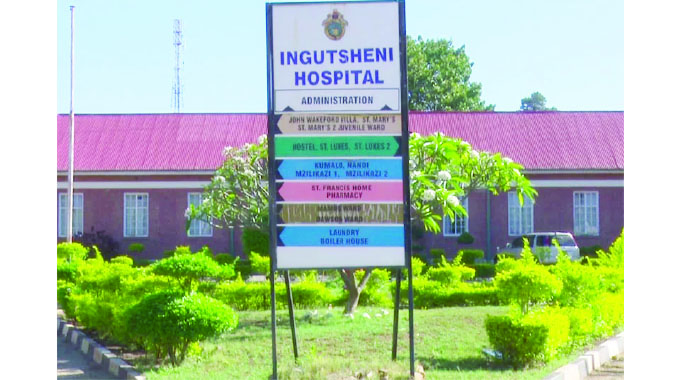
Tafadzwa Chibukwa,Features Reporter
Misconstrued as being a looney house full of mentally unstable people running around, Ingutsheni Central Hospital provides refuge to many of Bulawayo’s “rejects”.
It has been widely assumed that the hospital is primarily meant for patients with mental illnesses yet its reach goes far beyond that.
The hospital, which has an admission capacity of 708 patients and sees over 2 000 outpatients annually, offers a wide range of services.
Renowned psychiatrist and Ingutsheni Central Hospital clinical director Dr Wellington Ranga lamented how the hospital has always been referred to as small, full of mentally unstable people closed up in a room.
“The hospital has always been thought to be a small place with all patients admitted into one room and all the patients suffering from mental illness. Society has always ignored the side of the hospital that has many different wards that specialise in different issues and that patients are admitted with different problems.
“We have a number of wards that deal with different issues such as the Khumalo Ward which is a male admission ward for patients who are fighting drug addiction. Mambo Ward is for patients with a criminal history. The Juvenile Ward is for female patients with learning disabilities. We have St Luke’s 1 for males with learning disabilities and the Mzilikazi 1 for males with developmental and behavioural disorders among others.
“Other wards are The St Mary’s female admissions ward for patients who are acutely ill, Nandi for elderly female patients and St Luke’s 2 for male elderly patients. We have the Dawson Ward for male patients who are stable, and JW Villa Ward, an open ward for male and female patients who are stable. We also have Mzilikazi 2 Ward,” said Dr Ranga.
He said all the mentioned wards offer different services to different patients and it would be unwise for society to remain ignorant about what the hospital is all about, hence the need to shed more light on the functions of the hospital.
The hospital is home to some who do not need to be there, but because of the nature of their situation, they find themselves there.
Dr Ranga said there are some instances where families with an admitted relative visit for the first few days and then disappear leaving their family member stranded at the hospital.
“We also take care of children who are born with disabilities. At times parents come with them here and request us to take care of them while they work or pay for their stay here and then disappear. Some patients are not accepted by society even after being discharged, and they return for refuge since they would’ve been cast off by their relatives or members of society after having been discharged. We have a number who are here not because they’re mentally unstable. We have a man who has served the longest; he could easily step out and go home but he has no one to go to,” he said.
There has been an increase in the number of patients admitted as a result of drug abuse since the onset of the Covid-19 pandemic.
Of the total admissions at Ingutsheni Central Hospital this year so far, 184 of them have been admitted due to substance and drug abuse.

An occupational therapist at the institution, Mr Unity Chitapi said these statistics were concerning.
“This increase in drug-related admissions is something we’re really worried about. It’s disappointing that we have such several patients admitted due to drug and substance abuse. What is more alarming is that the number keeps growing and as a facility, we’re compelled to deal with the challenge,” said Mr Chitapi.
What is worrying most is the age group of the patients admitted, with the youngest being 15 years old and the ages ranging up to 30 years.
He said the institution uses different ways to rehabilitate patients.
“The institution is a de facto detox centre so when our patients come, we manage their psychotic symptoms during the time they’re closed in, while their body flushes out the drug from their system,” said Mr Chitapi.
Members of staff engage patients during the healing and rehabilitation process.
l To Page 5
l From Page 3
Mr Chitapi said the institution has taken on the challenge by engaging patients in various exercises.
“We give them insight into their problem; make them understand the impacts and effects of drug abuse on them as individuals, their families and the society at large. We do this so that the patients understand what it means to do drugs so that when they leave, they’re not encouraged to go back the same route,” he said.
Some of the patients admitted to Khumalo Ward said since the institution is home to many with different needs and wants, there is a need to establish educational services for patients.
“While we’re admitted here, we must not just pass time doing nothing; it starts a bad habit which would be hard to get rid of after being discharged. This is one of the major reasons why many discharged patients fail to integrate well into society. If we’re to enrol in different courses while we’re here, we’re guaranteed to leave the place equipped with skills that will benefit us,” said one of the patients.
Some suggested that the hospital should also conduct follow-up visits to check on the progress of discharged patients.
They said a lot of the time, many end up going back to drug abuse after being discharged from the hospital.
Ingutsheni Central Hospital also offers outpatient services through which patients can get help without necessarily being admitted.
Dr Ranga said they have had many outpatients getting counselling services and therapy from the many therapists around the hospital.
The institution has become a haven for young people around the city requiring counselling services amidst growing numbers in mental health conditions such as depression and suicide attempts. Mr Chitapi said the institution has taken on the challenge by engaging patients in various exercises.
“We give them insight into their problem; make them understand the impacts and effects of drug abuse on them as individuals, their families and the society at large. We do this so that the patients understand what it means to do drugs so that when they leave, they’re not encouraged to go back the same route,” he said.
Some of the patients admitted to Khumalo Ward said since the institution is home to many with different needs and wants, there is a need to establish educational services for patients.
“While we’re admitted here, we must not just pass time doing nothing; it starts a bad habit which would be hard to get rid of after being discharged. This is one of the major reasons why many discharged patients fail to integrate well into society. If we’re to enrol in different courses while we’re here, we’re guaranteed to leave the place equipped with skills that will benefit us,” said one of the patients.
Some suggested that the hospital should also conduct follow-up visits to check on the progress of discharged patients.
They said a lot of the time, many end up going back to drug abuse after being discharged from the hospital.
Ingutsheni Central Hospital also offers outpatient services through which patients can get help without necessarily being admitted.
Dr Ranga said they have had many outpatients getting counselling services and therapy from the many therapists around the hospital.
The institution has become a haven for young people around the city requiring counselling services amidst growing numbers in mental health conditions such as depression and suicide attempts. — @Sagepapie14


 Blessing Chizhande
 Online Reporter