Wallace Ruzvidzo and Victor Maphosa Zimpapers Writers
PRESIDENT Mnangagwa has said Zimbabwe’s innovation-driven transformation in education remains central to the country’s long-term strategy of lifting citizens out of poverty and creating sustainable prosperity.
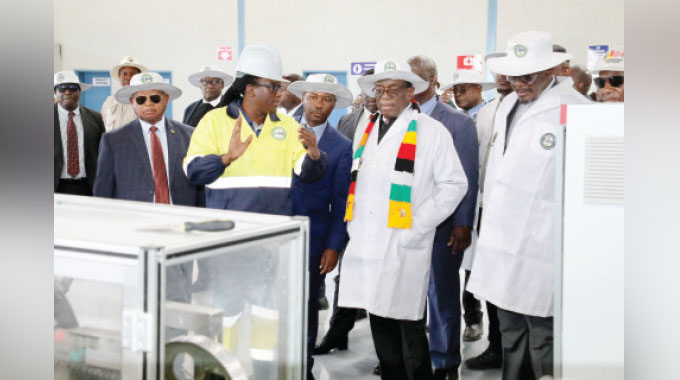
Speaking at the official opening of the Mutoko Bioeconomy Industrial Park yesterday, the President said the project was tangible evidence of the success of the Second Republic’s investment in education, research, science, technology and innovation.
The industrial park, which is expected to become a major centre for value addition and manufacturing, forms part of Government’s broader efforts to drive rural industrialisation, create employment and promote economic growth through innovation.
In his address to thousands of people who attended the event, President Mnangagwa said the facility demonstrated the positive outcomes of reforms implemented under the Heritage-Based Education 5.0 model.
“Here, we are, therefore, witnessing the outcome of the Second Republic’s continuous investment in research, science, technology, innovation and basic education of high quality, which are all essential ingredients for sustainable national development. The Heritage-Based Education 5.0, is enabling our great motherland to build a knowledge-based economy, driven by our own people,” he said.
Land has been set aside within the industrial park for manufacturing infrastructure, agricultural research and other economic activities.
Once fully developed, the facility will comprise a cooking oil processing plant, a soap manufacturing plant, a biodiesel refinery, stock-feed production units and milling plants, among other enterprises.
President Mnangagwa said such facilities were becoming centres of innovation and industrial production, where knowledge generated through research is translated into practical economic development.
“The power of economic empowerment, especially for those in rural areas, is directly in the hands of our citizens. Employment creation through increased production and productivity, as well as value chain development, will continue to be core priority areas for our ZANU-PF-led Government. No nation, in its development agenda, can neglect the quality of its education system, more so given the direct correlation between rising educational standards and sustained national progress.
“In line with this fact, my Administration introduced the Heritage-Based Education 5.0 model, which prioritises national development, anchored on the production of goods and services, by our citizens. The unveiling of this project comes at the right time in our nation and will help enhance local production and self-sufficiency as well as aid in the import substitution thrust,” he said.
The President said the cooking oil plant alone is expected to produce approximately 1,8 million litres of cooking oil, helping to satisfy domestic demand and reduce reliance on imports.
In addition, glycerine produced during the manufacturing process will support soap and detergent production, creating further value-added products for both local and export markets.
President Mnangagwa said the project was another demonstration of Government’s commitment to delivering on its development agenda.
“…We are a Party with a rich history; ZANU-PF is the Party with a Vision for a more prosperous future, for all our people.”
No one and no place will be left behind. Musangano wedu we ZANU PF unemuono we remangwana rinowunza budiriro kuvana vese veZimbabwe,” he said.
The President said future phases of the project would also contribute significantly to the livestock sector through the production of sunflower cake, a key component in animal feed.
According to President Mnangagwa, this will complement existing production while strengthening agricultural value chains and supporting livestock growth.
“This is set to create a wider pool of high-quality livestock feed and further stimulate growth in the broader agriculture value chain industries. I am assured that the Mutoko bio-diesel plant will produce biodiesel from Jatropha and other oil plants such as castor.
“This is welcome, with regards supplementing local energy solutions and the required through-put into the feed-stock industry, especially that Jatropha, is locally produced by the farmers, here in Mutoko,” he said.
“I challenge the responsible Ministries to work with relevant stakeholders, including the private sector, to ensure that the plant makes the much-needed contributions to meet our fuel demands, in a manner similar to that of sugar-cane.”
President Mnangagwa called on the private sector and other stakeholders to support the growth of the Bioeconomy Industrial Park through out-grower schemes for sunflower and Jatropha production.
He said such programmes should be expanded beyond Mashonaland East and Mashonaland Central provinces to other suitable agro-ecological regions across the country.
“These must extend across other appropriate agro-ecological regions, beyond Mashonaland East and Central provinces. Local Authorities in both rural and urban areas are once again directed to avail land for industrialisation. We should not procrastinate on this matter but urgently and deliberately put in place the right ecosystem to realise the aspirations we have pronounced,” he said.
A notable feature of the project is the significant involvement of local students and apprentices in its construction.
Most of the construction work and installation of machinery were carried out by students from Masvingo Polytechnic, Harare Polytechnic and apprentices from the Industrial Trade Testing Department.
President Mnangagwa commended their contribution, describing it as proof that the Heritage-Based Education 5.0 model is producing practical results.
“Your good work shows that the Heritage Based Education 5.0 model is a success and that indeed, Nyika inovakwa, inotongwa, inonamatigwa nevene vayo/ ilizwe lakhiwa, likhu-le-ke-lwe ngabanikazi balo.
“Furthermore, under the Integrated Skills Expansion Programme, the Higher Education sector trained significant numbers of local youths during the construction phase of the project, thereby delivering tertiary education to those previously marginalised. Well done.
“These young citizens from the community now possess skills and qualifications previously deemed out of reach. They are poised to enter the workforce or become entrepreneurs, to better their livelihoods, transform local communities and subsequently the national economy as a whole,” he said.
The President said student participation in construction, research, equipment management and production would provide valuable practical experience while supporting the country’s industrialisation drive.
He challenged the Ministry of Higher and Tertiary Education, Innovation, Science and Technology Development and other stakeholders to accelerate the commercialisation of research outputs and innovations being developed at institutions of higher learning.
“I challenge the Ministry of Higher and Tertiary Education, Innovation, Science and Technology Development, to continue deploying the systems-thinking framework that saw the timely completion of this project.
“I equally call upon stakeholders in the sector to accelerate the full commercialisation of research outputs, start-ups and inventions being churned out by institutions of higher learning.
Ndinotenda madzimambo ose, nekutsigira ma projects eHurumende nekubatsira kwenyu kusimudzira maruwa edu.
“Government looks forward to the full development of the Industrial Park and Nyakadecha Estate, which will provide the Jatropha feedstock and employ many more people in the production of throughput for the plant. This is sustainable development and dignified wealth creation for our communities unfolding here in Mutoko. Congratulations to you all,” said the President.
President Mnangagwa said Government envisages replicating the Mutoko Bioeconomy Industrial Park model in all eight remaining rural provinces by 2030.
He said service shops should also be established within communities and townships to improve access to affordable locally manufactured goods.
“Service shops should equally be set up within our communities and townships to secure access to affordable, made-in-Zimbabwe goods and products for our people. Under the Second Republic, Zimbabwe is rising. We are marching forward. Nyika inovakwa, inotongwa, inonamatigwa nevene vayo / Ilizwe lakhiwa, libuswe, likhu-le-ke-lwe ngabanikazi balo,” said President Mnangagwa.
The President also emphasised the importance of unity, peace and hard work in driving national development, while reiterating his party’s commitment to improving the lives of Zimbabweans.
“Ngatirambei takabatana, tichishanda nesimba, murunyararo, tichidzivirira Nyika yedu kubva kuvavengi. Ngatitevedzere tsika dzedu, tidzidzise vana vedu tsika nehunhu hwedu hweZimbabwe.
“The work ahead is great; however, in unity and peace, the development we desire for present and future generations will be realised. ZANU PF is the only party with the people and communities at heart. We deliver on the promises we make. We deliver on our decisions and resolutions,” he said.
President Mnangagwa concluded by thanking party supporters and community members who attended the official opening ceremony.
“Ndinokutendai mose nekuwuya kwenyu kuno kuzo tsigira ma projects eHurumende yedu ye ZANU PF. Rutsigiro rweyu rwe musangano wedu rwuno kudzwa. Murimusvo we Musangano,” he said.
Among those in attendance were Cabinet Ministers, Chief Secretary to the President and Cabinet Dr Martin Rushwaya, senior Government officials, Service Chiefs and traditional leaders.