Online Reporter
Theseus Shambare-Features Writer
IMAGINE a farm where forests and food coexist!
This is a reality in Hatcliffe, on the northern edge of Harare, where Raregold Farm rises like a green oasis. Here, the rhythm of agriculture merges seamlessly with the heartbeat of conservation.
Rows of tomatoes glisten with dew under drip irrigation, goats graze in carefully managed paddocks and indigenous woodlands border the fields, their ancient whispers reminding visitors that farming and forests need not be at odds.
This balance is the brainchild of Sarudzayi Mboweni, a farmer, mentor and visionary.
“Agriculture must never destroy forests,” she shares with The Herald in an interview recently. “We can farm and restore ecosystems at the same time.”
Her conviction is not theoretical.
It stretches across Zimbabwe, from this lush farm in Harare to the parched landscapes of Mwenezi, Masvingo Province, more than 400km away.
The journey from Harare to Mwenezi is long and rugged.
Leaving behind the city’s bustle, the road winds past farmlands, savannahs and eventually the semi-arid plains of Masvingo.
Mwenezi lies in Natural Region V, Zimbabwe’s driest agro-ecological zone, where annual rainfall rarely exceeds 400mm.
Decades of deforestation, overgrazing and climate stress have left hillsides bare, soils sandy and communities vulnerable.
According to the Forestry Commission, Zimbabwe has been losing 330 000 hectares of forest annually over the past decade.
Without intervention, entire ecosystems, and the livelihoods tied to them, risk collapse.
But in villages like Joseph, change is underway. And, it starts with something as small as a seed.
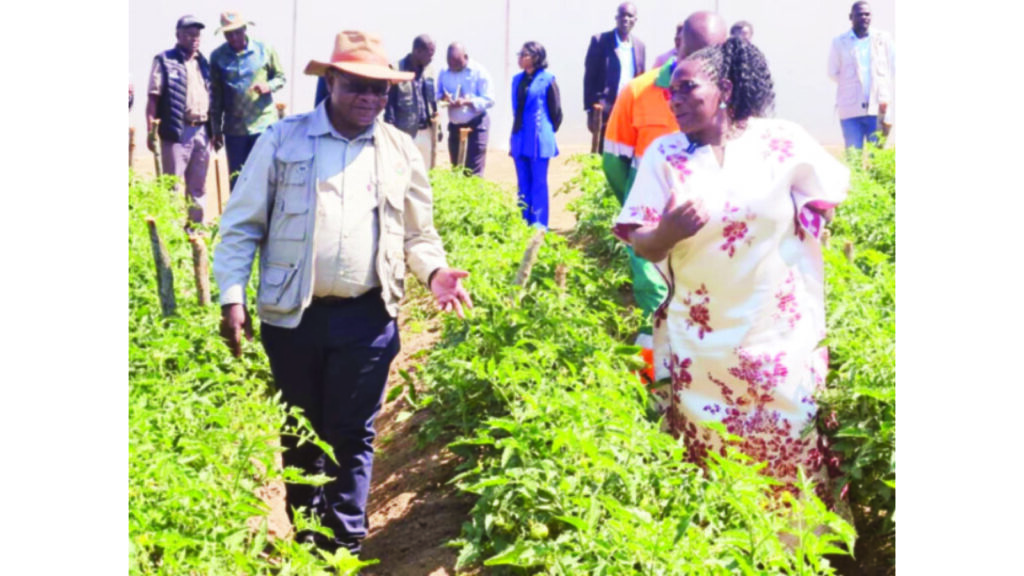
Sarudzayi Mboweni (right) shows off her thriving tomato crop to Professor Jiri at her Mwenezi field where forests and food crops coexist.
In Mwenezi, Mboweni introduced a simple but powerful idea: instead of cash handouts, communities collect seeds from indigenous forests and raise them into seedlings.
Raregold Farm then purchases these seedlings for use in Harare and beyond, creating an income stream linked directly to conservation.
“Before this, we had nothing,” says Chipo Mandaza, a mother of four.
“Now I can sell seedlings, plant trees around my home and see the land grow green again. My children are learning that forests are our wealth.”
For young farmer Tawanda Ncube, the model has been life-changing.
“I never thought collecting seeds could pay school fees. Now our village is greener and we are proud of what we are doing.”
Today, over 500 households in Mwenezi are part of this network. Together, they are reforesting degraded land while sustaining livelihoods—proof that conservation can be an economic driver.
Beyond numbers, Mboweni’s work is breathing life back into tree species once teetering on the edge of disappearance.
Her nurseries now nurture mutamba, muuyu, mupfura, mutohwe and musau—trees once abundant but nearly erased by deforestation.
“These are trees I grew up eating from, but for years I could not find them,” says village elder Nyasha Mutsvairo.
“Now we see their seedlings again and we know our children will taste matohwe like we did.”
For Mboweni, restoring these species is both ecological and cultural, a revival of heritage intertwined with survival.
Back at Raregold, the seedlings find a second life.
They are planted alongside horticultural crops in agroforestry systems that blend productivity with sustainability.
Fruit trees, legumes and indigenous woodlands provide shade, restore soils and regulate microclimates, making crops more resilient to drought.
“The trees conserve water and protect soils from erosion,” explains Tendai Nyamadzawo, an agronomist at Raregold.
“Our research shows higher yields and better soil moisture where trees are integrated. Farmers see immediate results.”
Scientific studies support this.
Agroforestry systems can increase soil organic carbon by 20–30 percent over a decade, while reducing runoff and boosting biodiversity.
In drylands like Mwenezi, they act as natural climate buffers.
For Mboweni, the project is not only ecological but deeply personal.
Married into Mwenezi, she saw firsthand how deforestation was stripping the land and communities of their resilience.
Instead of despair, she chose action.
“I decided not to give rural people money but to create productivity,” she recalls. “When they produce seedlings, they earn. They restore the land. That is dignity, not dependency.”
Her focus on women is deliberate.
In Zimbabwe, women provide 70 percent of agricultural labour, yet often lack access to land, finance, or markets.
By turning seedling production into a livelihood, Mboweni empowers women to earn, educate their children and shape their landscapes.
“We can all do it,” she says firmly. “Dependency is a mindset we must change. My mother-in-law is almost 80, and is still farming successfully in Region V. If she can do it, so can we.”
Raregold Farm doubles as a training hub.
Youths from Harare and Mwenezi come for hands-on courses in seedling production, irrigation and climate-smart agriculture.
Some stay for weeks, learning not just how to farm, but how to do so sustainably.
“We have a generation that has lost touch with the land,” Mboweni laments. “Here, we reawaken that connection. Farming is not punishment—it is innovation.”
Through agro-tourism, visitors also engage directly, harvesting vegetables, walking forest trails and even camping on-site.
“When people experience it, they believe it,” she says. “They go home inspired to start something small in their own communities.”
Recently, Raregold hosted its inaugural Agricultural Excellence Expo, themed “Agriculture Transformation for a Competitive, Inclusive and Sustainable Agriculture.”
Farmers, innovators and policymakers gathered to share knowledge and solutions.
Among the exhibitors was Zoro-nemugoti, a homegrown enterprise that has mastered the art of turning indigenous foods into products that are both nutritional and medicinal.
Using traditional knowledge blended with modern processing, Zoro-nemugoti produces herbal teas, fortified flours and dried wild fruits, all sourced from forests and woodlands.
Each product tells a story of resilience: baobab pulp that boosts immunity, moringa leaves that strengthen the body and marula kernels pressed into oils prized for their healing properties.
“Our forests are pharmacies and supermarkets combined,” says Zororo Taruvinga, Zoro-nemugoti’s founder.
“The problem is we have been ignoring them. By adding value, we are not only promoting health but also creating jobs and ensuring that these resources are protected.”
For women and youths in Mwenezi, the partnership with Zoro-nemugoti opens new income streams.
Seedlings planted through the Raregold initiative eventually grow into fruiting trees, supplying raw materials that are processed into high-value products.
This cycle—from seed to seedling, to tree, to processed product—is a living example of sustainable forest management powering local economies.
Nutritionists at the expo highlighted that such value-added forest foods could tackle Zimbabwe’s 30 percent child stunting rate by diversifying diets with affordable, nutrient-rich foods.
Traditional healers, too, saw a future in which medicinal forests could be sustainably tapped without being destroyed.
The event also drew the attention of the Government.
Lands, Agriculture, Fisheries, Water and Rural Development permanent secretary, Professor Obert Jiri, praised the initiative.
“This transformation is a testament to the resilience of our smallholder farmers. What we see here in Hatcliffe and Mwenezi can be replicated across Zimbabwe’s dry regions to build food security and restore our forests,” he says.
The ripple effects are undeniable.
In Mwenezi, reforestation efforts have improved groundwater recharge, reduced soil erosion and provided shade for livestock.
Regionally, the model aligns with Zimbabwe’s National Development Strategy 1, which prioritises climate-smart agriculture and land restoration.
It also contributes to the African Forest Landscape Restoration Initiative (AFR100), which aims to restore 100 million hectares of land by 2030.
Globally, initiatives like Mboweni’s address urgent challenges.
According to the UN’s Food and Agriculture Organisation, forests support the livelihoods of 1,6 billion people worldwide.
Restoring them is key to achieving both the Paris Climate Agreement and the Sustainable Development Goals.
As dusk settles over Raregold Farm, Mboweni tends to a bed of mango seedlings destined for Mwenezi.
Her hands, calloused yet gentle, cradle the saplings with the care of someone who knows each one is a future forest, a future livelihood.
Her story is not about a single farm.
It is about a model; an ecosystem where agriculture and forests thrive together, where communities prosper while healing the land.
“We are planting more than trees,” Mboweni says, smiling. “We are planting futures.”