Online Reporter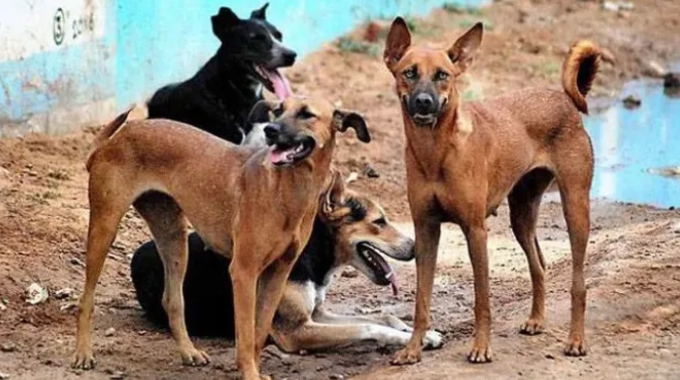
Bruce Ndlovu, Sunday Life Reporter
IF you asked most Zimbabweans if they knew a dog that falls under the Africanis family breed, you would likely draw blank stares.
Tell them they have probably owned one, or know someone who has, and the disbelief would only deepen.
In truth, this breed is common enough.
What is to many a nameless breed is synonymous with names like Spotty, Bobby, Danger, Bingo or Rex.
Medium-sized, with its distinctive black patch around the front of the muzzle, the Africanis is found in most Zimbabwean communities.

From the high-density suburbs in major cities to farms and peri-urban centres, this is the dog whose behaviour lives up to the animal’s tag as man’s best friend.
It usually roams around neighbourhoods, leaving homeowners fuming as it fells rubbish bins in search of unwanted or leftover treats. It is a dog that sometimes becomes such a common sight around neighbourhoods that people forget the household it initially belonged to.
It is a part of the “furniture” in most communities.
However, while it is largely unthreatening to friend or foe alike, even these seemingly peace-loving dogs can pose a health menace when they bare their canines.
The end of innocence
Most Zimbabwean children growing up on farms or in high-density suburbs have an unpleasant story to tell about these dogs that roam around neighbourhoods, untethered and sometimes uncared for.
Children’s small size, unpredictable movements and lack of understanding of animal behaviour make them more vulnerable to dog attacks.

Earlier this year, Health Minister Dr Douglas Mombeshora revealed that dog bites jumped from 25 057 in 2022 to 26 273 in 2023, then spiked to 30 363 in 2024.
As of mid-2025, 13 537 cases had already been recorded, with two rabies deaths confirmed.
“The situation is dire. Most of the bites come from dogs whose vaccination status is unknown, with many roaming communities unattended. This increases the risk of rabies, which is nearly always fatal,” said Dr Mombeshora.
Around the country, attacks by stray or poorly secured dogs have become regular headline makers.
Caroline Chari, a 13-year-old learner, was fatally mauled on 29 September while walking home from school with four friends at St Mannocks Farm.
Police reported that the group of children scattered when the dogs charged, but the animals caught up with Chari.

In July, a nine-year-old boy, Shelton Panganai, was tragically killed in Darwendale after being mauled by four dogs while playing football with friends at Bornvalley Farm.
Police confirmed that the dogs, believed to be Boerboels, allegedly escaped from their owner’s property.
In the same month, dogs belonging to Mike Mupinga of bluff hills in Harare scaled a low perimeter wall and attacked Samuel Machara, who was walking along a nearby street. Machara sustained severe injuries to his neck, hands, legs, abdomen and other parts of his body, leading to his death.
While most people usually associate dog bites with breeds like Boerboels, Pitbulls and Rottweilers, dog expert and trainer Nhlanhla Dube said that any dog, even the beloved Africanis, was capable of being vicious.
“I have heard people speak about vicious dogs, but any dog can be vicious depending on how you keep and look after it. Yes, some dogs have a greater propensity for viciousness than others, especially the bigger dogs. Again, it all depends on how they have been trained and looked after, so just slapping a ‘vicious dog’ tag on any big dog is due to ignorance,” he said.
He drew an analogy.
“If you speak to cattle farmers, they will tell you that Brahmans are wild and they will chase you around and this is true because they have a propensity for wildness. However, it also depends on how you have selected their parentage and how you raise them. Do you talk to them? Are you close to them? They can be as tame as a sheep. It all depends on what you are doing with your animals.”
A history of neglect
The beloved Africanis dog is regarded as an ideal pet for African homes for its loyalty and its ability to weather all storms.
This is a dog that is reputed for going an entire lifetime without seeing a vet. It is said to be low-maintenance due to its hardiness and its simple food requirements.
While such characteristics make it an easy choice for those seeking dogs as pets, it has also made it prone to abuse as owners believe it can endure anything.
The dogs that attacked Chari, for instance, were last vaccinated in 2024 and were not part of the Department of Veterinary Services’ 2025 rabies vaccination programme.
While the Africanis is a prevalent and often mistreated breed, the same can be said of more expensive canines like Boerboels and Pitbull Terriers.
“The Zimbabwe Republic Police is disturbed by the increasing trend of vicious dogs being allowed to roam freely without leashes or proper supervision. It is the responsibility of dog owners to ensure public safety,” said police spokesperson commissioner Paul Nyathi recently.
Dog expert Dube noted that the new trend of acquiring bigger and temperamental dogs had become a problem due to the failure of the animals’ owners to understand the requirements needed to keep such animals in line.
A secure property — including a fence or a wall — as well as the owners’ own behaviour towards the animals helps keep the public out of harm’s way.
“You must select a dog whose food and medical budget you can support. I think there must be a lot of deliberate education around dogs. These are not supposed to be animals that you can kick aside when you want to. Dogs must be owned by people who are really committed towards them and we are talking about people who understand what any particular dog is meant for,” stressed Dube.
“What I must insist on is that people should know what kind of dog they are getting and its temperament, potentially. You need to know what handling requirements are needed for each dog.
Big dogs, for example, require a pack leader. They must be controlled and they must be guided. If you cannot control your dog, then you must not own a dog.”
With bigger dogs seemingly joining the stray population of canines due to the negligence of their owners, authorities around the country are now seeking legal channels to confront the stray dog menace.
Tightening the leash
In a recent meeting in Bulawayo, Ward 25 Councillor Aleck Ndlovu called for more vigorous action against reckless dog owners and the growing stray dog population.
“The dog tie-up order was issued and apparently, there are some people who are very reckless with their dogs,” he said.
“Stray dogs cause a lot of fear, especially among children. Despite the widespread issue, only 21 notices have been issued and there is a need for more enforcement from the responsible teams.”
Recently, the City of Bulawayo’s Director of Health Services, Dr Edwin Mzingwane, said the issue of vicious dog breeds would be addressed by a policy currently being drafted.
This policy is awaiting input from other stakeholders such as the Society for the Prevention of Cruelty to Animals (SPCA), Zimbabwe Republic Police and Veterinary Services.
“As part of contingency measures to reduce dog bites, the City has been implementing a tie-up order to put down stray dogs. The Dog Tie-Up Order, which was carried out during the last week of July, saw 79 dogs being put down and the operation will continue during the last quarter of the year,” reads a report from the city’s newsletter.
Dog expert Dube said while such steps might seem like they were designed for the discomfort of dog owners, they were ultimately a positive for the rest of the population.
“Controlling the dog population is a good thing. It would be unbecoming to have dogs running around helter-skelter all over. Dogs must be secured within a premise and must be on a leash when they are with their owners, and they must understand basic commands.
“So, I think it is a good thing for regulation to be there because in town, dogs are there for guard duties and also as pets, so regulation will go a long way in making sure that we look upon them in that light,” he said.