Chronicle Editor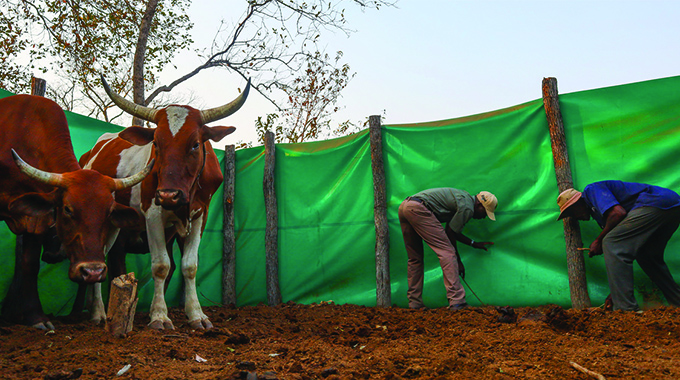
Leonard Ncube, [email protected]
THE International Fund for Animals Welfare (IFAW) has injected over US$35 000 for the construction of predator-proof bomas to protect livestock from marauding predators in human-wildlife conflict hotspots in Matabeleland North.
So far, a total of nine bomas have been set up in Hwange, Lupane and Tsholotsho areas with 40 more expected to be constructed.
Recently, conservationists discovered that while traditional sturdy bomas are not always a reliable way of keeping cattle safe from predators such as lions, cheetahs and hyenas, a simple opaque plastic sheet supported by posts can protect the livestock.
In the communities close to Hwange National Park, IFAW, in partnership with ZimParks and the Wildlife Conservation Research Unit (WildCRU), is promoting the use of predator-proof mobile bomas.
It is a simple yet innovative conservation initiative that uses thick plastic sheeting to help curb human-lion conflicts.
Areas adjacent to national parks especially in Hwange, Lupane and Tsholotsho districts have a high prevalence of human-wildlife conflict with lions, hyenas and jackals killing cattle, goats and donkeys during the day and sometimes following them up in cattle pens at night.
To help communities protect their livestock, some organisations came up with different kinds of interventions to mitigate the conflict.
IFAW, in partnership with ZimParks and other partners came up with the boma concept and some villagers in Mabale, Matetsi, Lupane and Tsholotsho have benefited.
Villagers can now peacefully sleep at night knowing their livestock is safe from attack.
In some communities, collective bomas have been set up where all villagers pen their cattle and goats together and they periodically shift the position of the boma.
The bomas are mostly situated in fields and have fertilised the Kalahari soils thereby boosting food security.
IFAW Southern Africa communications officer Mr Luckmore Safuli said they have teamed up with ZimParks to foster a sense of co-existence through community engagement, awareness campaigns and effective interventions including setting up innovative predator-proof bomas to reduce livestock predation.
He said the predators, particularly lions visualise and select their prey before launching an attack
“However, once there is a barrier in front of them, they simply do not know what to do. An opaque canvas sheet-made livestock pen supported by poles around the perimeter works as a barrier that deters lions from accessing livestock,” said Mr Safuli.
“As part of our ongoing conservation work in the Hwange-Matetsi-Zambezi landscape, we are taking bold and decisive action to foster harmonious relations between people and wildlife.”
Mr Safuli said if left unattended, human-wildlife conflict poses a serious threat to the well-being of the communities and biodiversity integrity of the greater Hwange ecosystem.
“The International Fund for Animal Welfare in partnership with ZimParks are promoting the use of the predator-proof bomas, an innovative conservation initiative of curbing human-wildlife conflict. To date IFAW and partners have installed 39 bomas in human-wildlife conflict hotspots, especially in Hwange Rural District Council wards 15 and 17 and ward 24 in Kusile Rural District Council,” he said.
To scale up the initiative, Mr Safuli said 40 more Bomas have been secured and will be installed in Tsholotsho, Lupane and Hwange.
He said a total of US$35 000 has been invested.
Mr Safuli said the initiative seeks to reduce livestock losses, enhance food security and promote peaceful coexistence between people and animals.
The bomas are a departure from the traditional kraals made of poles and acacia thorny branches, which enabled lions to easily spot the cattle.
Matabeleland North Provincial Affairs and Devolution Minister Richard Moyo said local communities have encountered great losses through cohabiting with wildlife thereby affecting livelihoods and human life.
“I am reliably informed that IFAW has invested over US$31 000 towards the procurement of predator-proof bomas to safeguard cattle from predators such as lions, hyenas and 29 bomas have been installed while 40 others are set to be installed at the end of this month,” he said.
“This gives the community confidence to co-exist with wildlife and confidence to harmonise. This innovation has also left fertile soils in the fields, which are Kalahari sands giving communities a better harvest.
Chief Dingani-Nelukoba of Mabale implored implementers of the Boma project to buy materials from locals as they have the capacity.
Hwange RDC Councillor Sikhathele Moyo said a number of villagers have benefited from the bomas and their cattle are now safe from marauding animals.


 Online Reporter