Theseus Mauruki Shambare [email protected]
EVERY meal tells a story.
It begins on the farm, passes through processors, traders and retailers before finally reaching the family table.
Yet somewhere along that journey lies a stage few Zimbabweans ever think about.
Behind every trusted product is a scientific process designed to answer a simple but important question: is it safe?
At a time when counterfeit and substandard products are quietly finding their way into homes, from cooking oil and flour to toothpaste, cosmetics and alcoholic beverages, the work carried out inside laboratories has never been more critical.
For many consumers navigating difficult economic conditions, the difference between genuine and fake products is often invisible.
In many cases, the only obvious difference is the price, a vulnerability that counterfeit syndicates exploit by offering cheaper alternatives that can put public health at risk.
Recent findings by the Standards Association of Zimbabwe (SAZ) revealed the scale of the challenge, with nearly half of products sampled from tuckshops, market stalls and other informal outlets failing to meet required standards.
Inspectors uncovered counterfeit versions of commonly used household products, including petroleum jelly, flour, rice and toothpaste, exposing how deeply fake goods have penetrated consumer markets.
The threat extends beyond household goods.
Authorities have raised concerns over counterfeit alcoholic beverages, with investigations uncovering illicit operations producing fake spirits using unregulated substances before packaging them under the names of trusted brands.
Recently, Zimbabwe Republic Police spokesperson Commissioner Paul Nyathi said counterfeit products have become more than an economic crime.
“The issue of counterfeit products is a security threat, a health threat and an economic threat which requires a collective approach,” he said.
But before enforcement officers can act and before consumers can be protected, there is another line of defence — the laboratory.
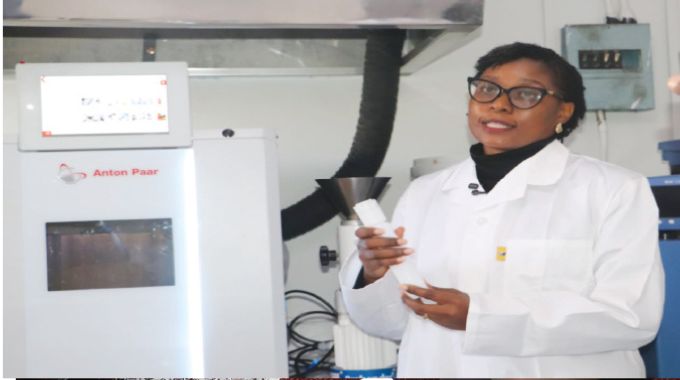
Here, where precision is measured in microscopic particles and mistakes can have serious consequences, Ms Rumbidzai Svosve (36) quietly shoulders a responsibility that extends far beyond the four walls of her workplace.
“The whole of Zimbabwe looks up to me for safety,” she said with a smile that carries both pride and the weight of responsibility.
As laboratory manager at SAZ, Ms Svosve leads a team responsible for analysing food and environmental samples for toxic and trace elements, helping ensure that products consumed locally and exported abroad meet required safety standards.
It is a role that places her at the intersection of science, public health and national development.
Yet her journey into this space was never guaranteed.
Growing up in Ruwa, with family roots in Hwedza, Ms Svosve dreamed of pursuing science at a time when many girls were still being raised with the expectation that their primary role was to become homemakers.
“I always wanted to challenge the social myths that women cannot excel in certain fields,” she said.
That dream was tested by societal expectations.
“There were certainly people who discouraged me. The community believed girls were supposed to be raised to become housewives.”
Rather than accept those limitations, she pursued Food Science and Nutrition, determined to prove that ability is shaped by passion, discipline and opportunity — not gender.
Her story mirrors a global challenge.
Despite women performing equally well as men in science-related subjects at school level, they remain underrepresented in scientific careers.
Data from Unesco shows that women make up only about a third of the world’s researchers, while the World Economic Forum estimates women account for about 28 percent of the global STEM workforce.
The gap widens further in leadership positions, where women remain a minority in many science and technology fields.
Experts describe this as the “leaky pipeline” — a process where girls who show interest and ability in science gradually disappear from scientific careers due to social stereotypes, workplace barriers and limited opportunities.
Ms Svosve refused to become part of that statistic.
After joining SAZ, she spent 12 years building her expertise before rising to lead a critical national laboratory.
Her success, however, did not come without challenges.
Leading one of Zimbabwe’s important testing facilities has often meant producing internationally credible scientific results while working with limited equipment.
“The biggest challenge has been the lack of equipment, yet we were expected to produce precise results,” she said.
“But against all odds, I always told my team that nothing is impossible and indeed we produced results.”
That resilience has helped shape her leadership philosophy — one built on teamwork, determination and refusing to surrender to difficult circumstances.
The arrival of new technology at SAZ marks a turning point.
The United Nations World Food Programme (WFP) recently donated a microwave digestion system worth US$70,000 to the organisation, equipment expected to improve laboratory efficiency and strengthen Zimbabwe’s food safety systems.
For WFP Zimbabwe Country Director Ms Barbara Clemens, such investments are critical if Zimbabwe is to reclaim its former position as a regional food procurement hub.
Years ago, Zimbabwe supplied food to humanitarian operations across Southern Africa and beyond.
However, production challenges and repeated climate shocks affected that position.
Ms Clemens said rebuilding that role requires more than agricultural production.
“It requires strong quality assurance systems and internationally recognised laboratories capable of testing and certifying food locally,” she said.
For Ms Svosve, the new equipment represents more than improved technology.
It is an affirmation that Zimbabwean scientists are capable of delivering world-class results when given the right tools.
“We are happy that development partners and private players are now showing interest in investing in advanced technology,” she said.
The microwave digestion system converts solid and semi-solid samples into liquid form before analysis.
Previously, conventional preparation methods could take between one and two hours to process a single sample.
The new system will reduce preparation time to between 20 and 40 minutes while allowing up to 24 samples to be processed simultaneously.
The controlled system also improves accuracy by preventing the loss of volatile elements during analysis, allowing scientists to better detect trace and toxic substances in food and environmental samples.
SAZ Director General Mr Cosmus Mukoyi said strengthening laboratory capacity is essential for building confidence in Zimbabwean products.
“Resilient food systems require more than production — they require testing systems that protect consumers, support trade and provide evidence-based decisions,” he said.
For years, Ms Svosve and her team have carried that responsibility, often away from public attention.
Behind the laboratory coat is also a mother of two.
Balancing motherhood with managing a national laboratory has been one of Ms Svosve’s greatest personal challenges.
“Pressure has made me who I am,” she said.
“Whenever I feel no pressure, I actually feel useless. I have adapted to the demands because all things work together for good.”
Like many women in leadership, she admitted there were moments of self-doubt.
“Yes, I doubted myself. When you face challenges, you begin to feel you are not good enough.
“But something inside kept telling me that since I had started this journey, I had to finish it and produce results. I am results-oriented, but I also believe in teamwork.”
Today, her greatest hope is that her journey inspires another generation of girls to pursue science.
“Continue dreaming big,” she said.
“At 36, I am already a manager. It is possible, and anyone else can do it.”
For Ms Svosve, success is not measured only by a job title.
It is measured by the invisible impact of her work.
Every food sample cleared for consumption, every toxic element detected before reaching consumers and every standard upheld represents another family protected.
As Zimbabwe works to strengthen its food systems and regain its place in regional markets, the spotlight will naturally fall on farmers, exporters and processors.
Yet behind every safe product and every certified consignment are scientists like Rumbidzai Svosve.
Most Zimbabweans will never know her name.
They may never see the laboratory she spends her days in.
But every meal placed on a family table with confidence carries a part of her work.
In a world where women still represent only a fraction of scientific professionals, Ms Svosve’s greatest achievement has not only been leading a laboratory.
It has been proving that excellence has no gender.