admin
admin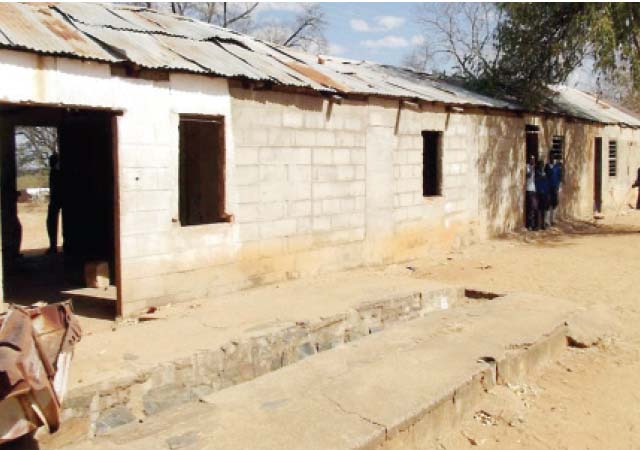
Lungile Tshuma
RESETTLED farmers in Irisvale in Umzingwane district are determined to lock the donor community out of their area.
They are a self-reliant lot who believe they can develop their own community using local resources and labour.
As a statement of intent in their march towards self-reliance, the resettled farmers are constructing their own secondary school – Irisvale Secondary.
Local headman, Fani Ngulube, 77, says they are trying to run away from donor dependency as it is not a sustainable approach to development.
“God gave us hands to work and brains to think,” says the traditional leader. “We’ve to use our talents and resources to improve our lives. No one will develop this community for us. It’s through unity that we can overcome challenges that come on our way.”
Ngulube is among many of the resettled farmers who settled at Irisvale farm in 2000. There was no school for the farmers’ children.
The community converted a farm house garage into a make-shift secondary school which is still being used today.
A blown up roof, cracked walls and open rectangular spaces constitute the school. The rectanglular spaces, proof that there were once some windows, are now making it difficult for pupils to concentrate in their lessons as they let in cold wind from a nearby dam.
A foul smell of goat urine greets the visitor from the shanty classroom block, a testimony that the school is turned into a goat’s pen over night.
This is Irisvale Secondary School as it is now.
“Very soon the rain will begin to fall and that will signal the end of lessons because as you’ve seen for yourself, children are as good as learning under a tree,” said Ngulube.
But the local community, which is a hardworking one, is determined to upgrade the school.
Irisvale resettled farmers have decided to take the bull by the horns instead of rushing to engage donors asking for a new school. They are building the new Irisvale Secondary School on their own.
The School Development Association chairperson, Jericho Sibanda, 60, said the new school is almost complete, at roof-level.
He says Irisvale community shuns donor aid and is committed to develop their area on their own.
Councillor Jabulani Makhala of Ward 13 is confident the Irisvale community will complete the school project.
“Nothing is impossible under the sun,” he says. “The future of these children is bright as we’ve embarked on a journey of self-empowerment. This is what we mean by Zim-Asset and I want to categorically point out that money is not the only solution to our problems. This is the time to speak with one voice”.
Zim-Asset, which is supposed to guide the government’s economic development thrust until December 2018, requires funding of $27 billion.
But the Irisvale people are making Zim-Asset work on their own.
They have managed to build two classroom blocks which can accommodate the whole school.
Clr Makhala says the resources were entirely mobilised by the community.
“Development starts with us and the Zim–Asset blue print is not only for the government but also for communities. We can’t wait for the Ministry of Primary and Secondary Education to build schools for us when we can do that on our own. In building this school each homestead contributed $30 towards the project. Those who could not afford donated whatever they could manage. Builders came from the community and I’m also a builder myself. This is what God has done for us,” he said with a beaming smile while pointing at the two classrooms that are now almost complete.
A villager, Ruth Ndlovu, says solutions to communities’ challenges can work if people are united.
She says the poor infrastructure at the school was making it difficult for teachers to produce good grades.
“It takes only a miracle to produce good results under the conditions which our teachers are subjected to. As farmers, we’ve a right to support the government through developing our communities and we did just that here,” said Ndlovu.
Through the communities’ contributions, 60 bags of cement were bought while the school contributed an additional 30 bags. Moved by the Irisvale community initiative, cement manufacturer, PPC, gave the school 100 bags of cement.
The school was relying on two toilets for both pupils and teachers before it embraced Washen (Water, Sanitation, Hygiene and Energy).
Consequently, the community built six Blair toilets used by the school and two other latrines for people living with disability are under construction.
Respected educationist, Samukele Hadebe, says sound infrastructure has a bearing on the performance of pupils.
He says there is still a need for authorities to improve the infrastructure of schools in rural areas if results are to improve.
“The possible reasons for the mediocre performance of rural schools could be attributed to many factors. These include key infrastructure like classrooms, availability of science laboratories or essential facilities for practical subjects, state of teachers’ accommodation, availability of learning resources, experience of teachers and whether the appropriate subject teacher teaches in that subject,” said Hadebe.
The government intends to build 2,000 primary and secondary schools in the country’s 10 provinces. Primary and Secondary Education Minister, Cde Lazarus Dokora, has said the government is working on measures to address poor infrastructure in schools.
“We’ve a huge deficit of infrastructure in the country for schools and that infrastructure begins with teachers’ housing and then we look at classrooms. In 2013, we produced an analysis which we submitted to Cabinet to say 2,056 schools needed to be constructed but each time when we say schools — whether urban or rural — we must include school teachers’ houses,” said Dokora.
The Umzingwane community has taken their “do-it-yourself” initiatives to other areas outside education.
There are efforts aimed at promoting the Sustainable Development Goals to ensure critical health issues are attended to in the district.
Child and maternal deaths were on the increase as women in the district were forced to travel long distances to deliver at Irisvale Health Care centre. The only clinic in the area had no mothers’ waiting shelter, a place where expecting mothers can wait for their due date of delivery.
“A mother’s shelter was set up by this same community which is building the secondary school. It was becoming painful to attend funerals of women who were dying on their way to the hospital. Such incidences are now a thing of the past.
This was made possible through the spirit of unity among us. We’re grateful to the Church Community Mobilisation Process (CCMP) for their words of wisdom. They taught us that unity is key to development. What I’ve realised is that every community has got something which they can use to develop their area. What we need is for us to open our eyes and realise that we’ve a crucial resource at our disposal,” said Clr Makhala.
CCMP is a church organisation which empowers communities using bible studies.
The church is entrusted with the role of spearheading development in a community. The organisation which has its roots in Tanzania was established in Zimbabwe in 2012.
At Esihlengeni in Umzingwane district’s Ward two, women were failing to access medical help, especially at night owing to the shortage of nurses’ accommodation. Nurses were being forced to commute from town daily resulting in the local clinic, Hlangano Clinic, failing to operate during the night.
“We once shelved the clinic house project after we failed to mobile resources. We had women delivering on the verandah at night as there would be no nurses to attend to them.
“Others were delivering on their way due to the long distance,” said Renita Madzingira, director for Christian Aids Task Force.
Church leaders are now mobilising people to attend development meetings where they encourage them to participate fully on development initiatives.
There is now a five-roomed clinic house built by locals using their own resources.
Dorothy Tshili, a local villager and chairperson of the Hlangano Clinic building committee says locals decided to construct clinic houses on their own after failing to attract willing partners to help them in the past decade.
“We tried to contribute $1 per household but this was not enough as only a building foundation was set up. Some were finding hard to pay $1 but builders donated their skills and some people brought sand.
“With the help of CCMP we managed to start the clinic house project. We asked them (CCMP) not to give us lunch but instead buy cement with that same money,” she said.


 derick.khumalo