admin
admin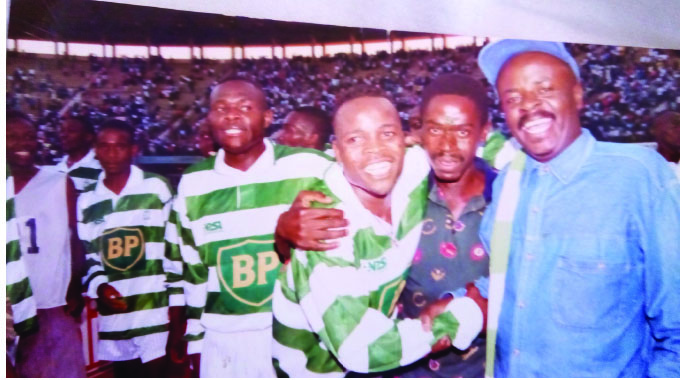
Sharuko on Saturday
THEY say 1973 was a good year for our football — Peter Ndlovu was born in Bulawayo and CAPS United were born in Harare.
Just imagine, for a moment, trying to narrate the history of our national game without the part played by the Flying Elephant?
It means we can’t beat our chests, as we regularly do, to remind everyone that the first African to play in the English Premiership was one of us.
We can’t wear the badge of honour, which comes with being the only African nation to produce a footballer to score a hat-trick, at Anfield.
That the last visiting player to score a hat-trick at Anfield had done so in 1961, 34 years earlier, hammered home the significance of Peter’s achievements.
It remains very huge and you only need to bring the legendary Didier Drogba into the equation, to understand the special nature of what Peter did at Liverpool’s fortress.
Imagine that for all his grand exploits, in the English Premiership, Drogba NEVER scored a hat-trick, in a league match, away from Stamford Bridge.
Now, this is a man who won four league titles, four FA Cups, three League Cups and, with 164 goals in 381 games, is the fourth highest goal-scorer in Chelsea’s history.
Only 10 African footballers, including Peter, have scored a Premier League hat-trick, away from home, in the 30 years of the world’s most supported top-flight league.
Without Peter’s footprints, in our game, the beautiful memory of that superb fourth goal, against Bafana Bafana, in that four-goal romp, would not have been part of our game’s history.
That samba dance made Steve Khompela and his partner look very ordinary.
And, in that moment of their humiliation, they appeared to have ditched their roles as defenders and, somehow, joined the fans as witnesses to this amazing piece of magic.
The Dream Team would not have had their X-Factor, the superman they all turned to, in our hour of desperation, when we collectively cried out for a hero.
Peter is 5o this year, a man celebrating his Golden Jubilee.
CAPS United are also 50 this year.
They are a club celebrating their Golden Jubilee and hoping to mark it in a better way than Dynamos did, when their special occasion came along, 10 years ago.
The arrival of Green Machine, just like Tongai Moyo’ emergence to challenge Alick Macheso, has been good for the Glamour Boys.
It hasn’t only provided DeMbare with a huge rival to keep them in check, and on their toes, but it has helped the Glamour Boys strive to be more competitive all the time.
It’s been a healthy rivalry for both sides.
And, it’s not a coincidence that the two giants have tended to suffer, in terms of failure to win major silverware, when one of them struggles to find a competitive edge.
Their rivalry was at its peak at the turn of the ’80s and in the mid-’90s and, while the Harare Derby remains a box office attraction, it has lost a bit of the special appeal it had back then.
I always wonder how Dynamos’ life story would have panned out had the Green Machine not been established, to provide the quality opposition, in the relentless battle for the soul of the capital.
It’s sad that in celebrating DeMbare’s historic march to the ’98 Champions League final, little is said about the massive contribution, which Makepekepe made, in transforming those Glamour Boys into a very efficient fighting force.
Those brutal battles, which these two giants fought in 1996 and 1997, did not only test both sides to the limit but they strengthened their soul and spirit.
What emerged from those fiery battles were not only the scars from the battlefront but battle-hardened troops who would not be fazed by an opposition and any terrain.
This is what helped CAPS United score seven goals against seasoned Ugandan campaigners, Express, in the first round of the ’97 CAF Champions League.
CAPS UTD, THE CLUB DEMBARE NEEDED
Remarkably, this was the first CAPS United adventure in Africa’s premier interclub competition, which was a bit strange, given the impact the Green Machine had made in local football.
It sounds strange but the reality is that Joel Shambo, the ultimate midfield magician with a pop star hairstyle, and movie star facial features, which provided the full package, never played Champions League football.
The same is also true for Shackman Tauro who, in the eyes of many, is the greatest natural goal-scorer, which this country produced.
They even said he used to induce a significant degree of fear in the opposition defenders, they ended up saying he resembled a hyena, every time he was on the hunt for goals.
So, they nicknamed him ‘Bere,’ a bone-crushing animal which, in many parts of Africa, is as mythical as it is feared.
In some parts of Tanzania, especially the Mtwara Region, they even believe that if a child is born at night, while a hyena is crying, he will likely end up being a thief.
It’s a reflection of how deadly Shacky Tauro was that fans saw him as dangerous as a hyena while others simply referred to him as Mr Goals or Chinyaride.
He was the first CAPS United star to win the Soccer Star of the Year award in 1979.
He also played in the greatest CAPS United side of all-time, a vintage generation, who later established themselves as Cup Kings.
The Green Machine have never had a goal-scorer as deadly as Shackman.
Crucially, and this is very important, his genius was not only limited to the familiar locker room of the Green Machine but to the tougher battles of national assignments in the colours of the Warriors.
IS BUNJIRA A CAPS UNITED LEGEND?
In 1996, a diminutive forward, with pace to burn and a swagger to display, arrived at CAPS United nursing a heartbreak.
His name was Alois Bunjira.
A few months earlier, he had come very close, yet very far, from being crowned a champion only for Blackpool to lose the championship race because they had scored fewer goals than Dynamos.
We all know that DeMbare were given an unfair helping hand by the PSL leaders to win that crown but this is a subject which has been exhausted.
Whether this had a bearing on firing Bunjira and Stewart Murisa, who was also at Blackpool the previous year, to go on a blitzkrieg in search of the title, we might never know.
But, what is undeniable is that the two Musketeers were virtually unplayable during the ’96 campaign, as if powered by the fury of that injustice.
I had seen a lot of Alois in 1995 because I covered a lot of Blackpool matches that season and, in a way, ended up feeling I had developed a spiritual connection to the club.
He was good, very good, and it made me understand why Reinhard Fabisch had given him a chance, at the young age of 17, to have a crack with the Dream Team.
But, the Alois I saw in ’96 was on a different wavelength and like Muhammad Ali he was revelling in floating like a butterfly and stinging like a bee.
He was simply magical, amazingly efficient, a young man who was playing the game with the freedom of a bird, the wizardry of a football version of Harry Potter and the conviction of chess grandmaster.
In just six months, he wrote the finest story ever written by a new recruit in the history of the domestic Premiership, if not on the entire continent.
By May that year, he had already scored 17 goals, half of his team’s tally of 38, in just 13 games.
He only played up to August, when his season was cut short by a horrific injury, but no one could eclipse his tally of 22 goals and he took home the Golden Boot.
He lost the battle for the Soccer Star of the Year to Murisa by just one vote.
And, given the latter had three extra months to boost his campaign, Bunjira’s strong showing in the poll reflected that he was the best player that season.
They gave him the Kingsgate Player of the Year award, which appeared to have been specifically created to ensure his incredible show that season would also be rewarded.
He returned in 1997 and was outstanding again but, just like the previous season, his campaign did not go the full distance after being cut short, once again, by injury.
CAPS didn’t defend their league championship, losing to Dynamos, but in the BP League Cup final replay, against the old enemy, in August that year, he ran the show.
He scored twice, including the winner in extra-time, as CAPS United won 3-2 at the National Sports Stadium.
Little did we know it but CAPS United’s Cinderella dance, under Steve Kwashi, was basically over.
And, another seven years would pass before Charles Mhlauri worked his magic to drag them back to the top in 2004.
By then, Bunjira had left CAPS United, six years earlier, having crossed into South Africa, where his skills were clearly very much in demand.
So, in recent weeks, I have been asking myself — is Bunjira a CAPS United legend?
It probably sounds like a very stupid question and I can understand those who will feel that way.
I fully understand those who will say that this feels mischievous and a waste of time because “it’s given that Alois is a CAPS United legend.”
Surely, playing a leading role, as Alois did, in guiding the Green Machine to their maiden league title, in the era of our independence as a country, is a password for legendary status.
Surely, playing a leading role, as Alois did, in helping a club like CAPS United end a lengthy 17-year wait for the league title, should be a password for legendary status.
I understand that argument.
My concern, though, is how will then rank someone, let’s say, like Lloyd Chitembwe?
He was a key member in that ’96 league winning team, who then went on to win the league in 2004 and 2005 and, as a coach, guided CAPS United to the league title in 2016.
How can a lengthy shift and dedication to the cause of a club, stretching close to three decades, loaded with league titles, both as a player and coach, end up propelling such an individual to the same ‘legendary’ status as someone, say, who spent three years at the same club, as a player?
Maybe, we have to differentiate legends and have a place for those, like Chitembwe, who can be called, let’s say, ‘SUPER LEGENDS.’
I know legendary status is not about time spent at a club but contribution to the cause.
But, how can someone like Joel Shambo, who spent his entire career at CAPS United and is their most decorated captain, be classified, in terms of legendary status, as the other guys who spent, let’s say, three or four years at the Green Machine?
Maybe, Joe also belongs to the ‘SUPER LEGENDS’ category.
How can someone like Shackman be classified at the very same legendary status as the boys who won the ’96 league championship?
The tragedy about all this is that if we were to run a poll today, asking fans to vote for the greatest CAPS United player of all-time, the likes of Shambo and Shackman might not even feature in the top five.
Therein lies my fears about our preservation of history and, as CAPS United celebrate their Golden Jubilee, I felt it’s time we should remind ourselves about the distortion of this great club’s history.
To God Be The Glory!
Peace to the GEPA Chief, the Big Fish, George Norton, Daily Service, Sitting Bull, Crazy Horse and all the Chakariboys still in the struggle.
Come on United!!!!!!!!!!!!!!!!!!!!!!!!! Brunoooooooooooooooooooooooo!
Text Feedback 0772545199
WhatsApp 0772545199
Email – [email protected]
You can also interact with me on Twitter (@Chakariboy), Facebook, Instagram (sharukor) and Skype (sharuko58)


 Online Reporter