Matters of Faith
In the church’s early days, controversies erupted over what books of the Bible were truly authoritative. Marcion of Sinope is a famous example.
Born around the time the last New Testament books were being written, he argued that the Old Testament portrayed a different God than the New Testament.
The Old Testament described an angry, spiteful God; the New Testament revealed a kinder, more loving God in the person of Jesus. Marcion was so committed to this idea that he even made his own copy of Luke’s Gospel, cutting out the Old Testament quotes and allusions.
In his famous work, aptly titled Against Marcion, the great theologian Tertullian of Carthage points out that Marcion wouldn’t have a New Testament without the Old. The New Testament, he rightly reasons, depends on the Old for its foundation. One of his most common arguments is that “one and the same God” is revealed consistently across the biblical storyline.
Seeing the Trinity in the Old Testament often feels difficult, largely because we do not see the names “Jesus” or “Holy Spirit” like we do in the New Testament. We wonder if the Trinity is something new introduced in the first pages of the Gospels.
We may be tempted to think Marcion was right — maybe we have two different Gods at work. At our best, though, we know better; we sometimes just need good interpretive principles to make sense of it.
To see the Trinity in the Old Testament, we need to hold two fundamental principles: (1) Scripture reveals this God as Father, Son, and Holy Spirit, and (2) Scripture is the unified revelation of God from Genesis to Revelation. We will not see the Trinity in the Old Testament unless we affirm who God is and how he reveals himself in Scripture.
These two principles will help explain that the God who created all things in Genesis 1 and the God who promises to make all things new in Revelation 22 is the same triune God – Father, Son, and Holy Spirit.
Our Perfect, Unchangeable Triune God
The doctrine of the Trinity is a mystery of faith, but Scripture nonetheless teaches it clearly: We confess one God in three persons — Father, Son, and Holy Spirit. We worship one God who alone can save us and into whose name we are baptised (Deut. 6:4; Isa. 44:6; Matt. 28:19; 2 Cor. 13:14).
In our triune God, we have three distinct persons described in uniquely divine ways: a Father who desires to save, a Son who puts on flesh to live and die in our place, and a Holy Spirit who seals our inheritance and adoption as sons and daughters (Gal. 4:4-7; Eph. 1:3-14).
“Salvation belongs to the LORD,” says Psalm 3:8, and yet this salvation is only possible through the one Lord who is Father, Son, and Holy Spirit. To be faithful to Scripture, then, we must affirm the divinity of the Father, Son, and Holy Spirit without arguing there are three gods or only one divine person.
Notice a few points from the explanation above. First, both the Old and New Testaments testify to God alone as Creator, Saviour, and the One worthy of our worship. Scripture is a unified revelation of God, not merely a bunch of disconnected books patched together over time.
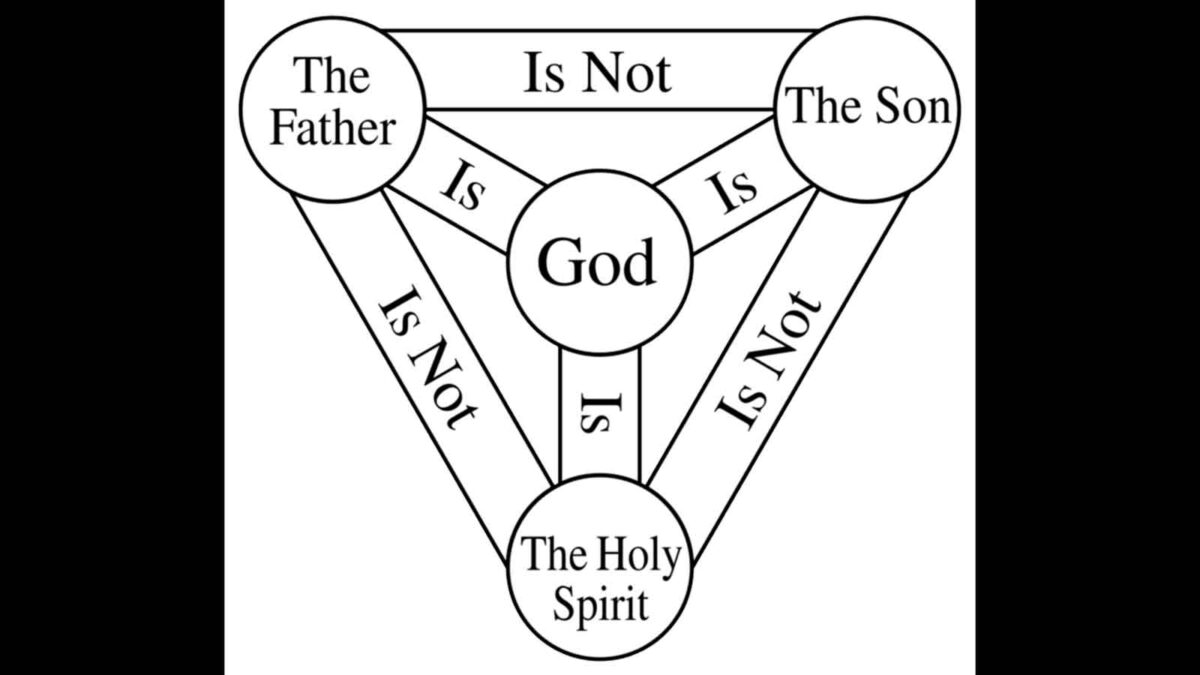
So, the same God is described in different ways, depending on issues like Scripture’s various genres (e.g., poetry uses different wording and images than Paul’s letters). Second, descriptions and actions reserved for God alone (e.g., creation, salvation, and reception of worship) are applied to Father, Son, and Holy Spirit equally and without apology. In short, these three persons are each God but they are not each other.
Two-Testament Witness to the Trinity
Matthew 1:21-23 tells us that Jesus (“God saves”) is Immanuel (“God with us”). These names are packed with significance about Jesus’ identity: Mary’s child, conceived by the Holy Spirit, is the Son of God himself in the flesh (see also John 1:14). In these three verses at the beginning of the New Testament, we get a glimpse into the doctrine of the Trinity. Not only that, but both these names intentionally bring to mind the Old Testament — Joshua and Isaiah, respectively.
Scripture constantly quotes and refers to itself.
The Old Testament refers back to other stories and forward to future stories; the New Testament does the same. This is relevant for how we think about the Trinity, because the New Testament’s claims about the divinity of Christ and the Holy Spirit rely on the Old Testament in the first place. Jesus and his apostles describe the Son’s and Holy Spirit’s divinity using Old Testament texts and themes.
Worship Our Triune God
Yes, the Trinity is in the Old Testament. Our triune God has always existed in a communion of love, long before the world began (John 17:5). All of Scripture teaches us this beautiful mystery: that we worship the one God who is Father, Son, and Holy Spirit. The Word who gave life to all things is the Word who gives us new life in himself. The Holy Spirit whose presence assured creation of its Creator is the Holy Spirit who dwells in us as new creations.
The triune God who made all things is the triune God who will make all things new. – The Gospel Coalition.