Chronicle Editor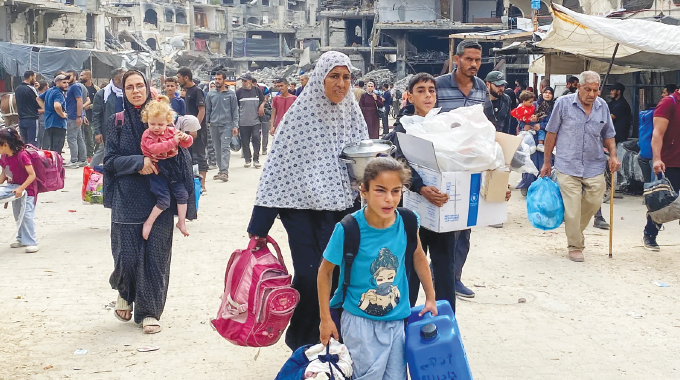
Lawson Mabhena, [email protected]
GIVEN the current turmoil in the Middle East, it’s easy to see why English philosopher Thomas Hobbes described humanity as “mushrooms sprung out of the earth without any obligation to one another”.
Hobbes’ bleak view of human nature, articulated in his seminal work Leviathan, seems eerily prescient when we examine the ongoing conflicts and humanitarian crises in this volatile region.
The Middle East has long been a theatre of conflict, with historical, religious and geopolitical tensions fuelling a seemingly endless cycle of violence. From the Israeli-Palestinian conflict to the civil wars in Syria and Yemen, the region is marred by strife that often appears intractable. These conflicts are not just about territorial disputes or political power; they are deeply rooted in historical grievances and ideological divides that make resolution incredibly complex.
The human cost of these conflicts is staggering. Millions of people have been displaced, creating one of the largest refugee crises in modern history. Families are torn apart, children grow up in war zones and entire generations are scarred by the trauma of violence. The international community often seems powerless to intervene effectively and humanitarian aid, while crucial, is a band-aid on a gaping wound.
On Monday morning alone, Israeli artillery fire killed at least 10 people at a food distribution centre in the Jabalia refugee camp in northern Gaza. On Sunday, an Israeli attack on a school sheltering displaced Palestinians in central Gaza resulted in the deaths of at least 22 people, including 15 children.
The UN has since expressed strong condemnation over the “significant civilian casualties” resulting from recent Israeli strikes on northern Gaza.
The interventions by the United States, Russia and other global powers — driven by strategic interests rather than humanitarian concerns — often exacerbate conflicts rather than resolve them.
In anticipation of a retaliatory attack on Iran, the US will be deploying a high-altitude anti-missile system, which President Joe Biden said is intended “to defend Israel”. Put differently, Israel is killing innocent civilians — including children — in Gaza, the West Bank and Lebanon, but instead of discouraging such acts, the US is sending cutting-edge technology that will make Israel even more invincible.

Might is always right, goes the old saying, which suggests that power and strength justify actions, regardless of their moral or ethical implications.
The US has one of the most powerful and technologically advanced militaries in the world. This military strength allows it to exert significant influence globally, often intervening in international conflicts and shaping geopolitical landscapes. Critics argue that this military dominance sometimes leads to actions that prioritise national interests over international law or ethical considerations.
“Might is always right” also reflects how economic leverage is used to achieve political and strategic goals. Being one of the largest economies globally enables the US to influence global markets, trade policies and international financial institutions.
US foreign policy has often been characterised by a willingness to use force or economic sanctions to achieve its objectives. Historical examples include interventions in Iraq and Afghanistan, as well as economic sanctions against countries like Russia, Iran, North Korea and Zimbabwe. These actions are sometimes viewed as the US using its power to enforce its vision of global order, or rather global submission.
The US has been claiming to promote the values of liberty and democracy since its independence declaration in 1776, and the underlying belief is that US security is enhanced when more nations embrace liberalism. This approach reveals the US’s commitment to advancing liberal values, often pursuing this goal regardless of the cost.
More often than not, the pursuit of liberalism has come at the cost of ethical foreign policy. In the war against the people of Gaza, US and Israeli leaders talk of acting in “the national interest”, ethics are never mentioned.
Realists like Hobbes could never be shocked by American duplicity. National interest simply means all nations are like “mushrooms sprung out of the earth without any obligation to one another”. Those with the MIGHT are always RIGHT! This is a cruel world for the powerless.
The weak people of Gaza, the West Bank, Lebanon and soon Iran, can’t even tell their own story. American culture, through media, technology and consumer products, has a pervasive global presence. This cultural influence can shape global norms and values, reinforcing the idea that American ways of life and thinking are dominant or “right”.
The reality of the current Middle East crisis is that only America can stop Israel. If you can’t defeat America, you can’t defeat Israel. The rest of the world can burn in the name of Israel’s “national interest”, and the ethical foreign policy approach can go down the drain.
The UN will continue to condemn “the large number of civilian casualties in the intensifying Israeli campaign in northern Gaza, including its schools, displacing sheltered Palestinian civilians,” but there’s no stopping the killing, destruction and displacements.
Ethics are what the mighty say are ethics. They have no obligation to anyone or anything except “national interest”, which, unfortunately, is also what they say it is. They don’t use their power to maintain global stability and protect democratic values, they only use it to advance their imperialistic and hegemonic interest.
All we can do is pray for the innocent children and civilians of Gaza, the West Bank, Lebanon and Iran. These victims will always be RIGHT!


 Online Reporter