Chronicle Editor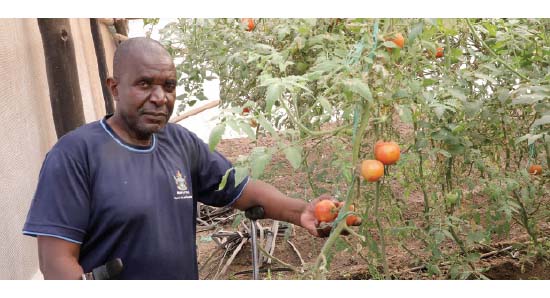
Peter Matika, [email protected]
JAIROS Jiri Training Centre in Bulawayo has established a greenhouse and agro-processing plant in Nguboyenja suburb as part of efforts aimed at boosting productivity at the institution and promoting inclusive development and active participation for persons living with disabilities.
The facility is attracting students and partners from across the Sadc region. The centre, which is home to 95 inmates, has over the years managed to launch several projects aimed at generating income from and subsidising other operational costs at the institution. Jairos Jiri Training Centre’s greenhouse and agro-processing plant offer students an opportunity to practice horticulture using drip irrigation.
Vegetables, which are produced and cultivated from the greenhouse include tomatoes and green and yellow peppers.
Some of the produce subsidises food costs while the other is sold in an open market.
Some of the vegetables that are harvested from the greenhouse are then processed at the institution’s agro-processing plant, which boasts equipment such as a solar dryer, peanut butter-making machine, juice mixer, and an oil processing machine.
Jairos Jiri Training Centre’s acting manager Mr Stephen Makwanya said nothing goes to waste from the agro-processing plant. He said they were optimistic that the plant would be fully functional by the end of the month.
“Nothing goes to waste, and we harness every little bit that we get here and ensure that we realise an income from everything. For instance, when it comes to our peanut butter-making process we have a shelling machine, which separates the nuts from the shells,” he said.
“We then sell the shells to farmers who use the shells as stock feed for their livestock.”
Mr Makwanya said tomatoes and fruits such as bananas and mangoes, which they cultivate from the institution are then dried using a solar dryer and then packaged using a plastic sealer.
“The same goes for our oil pressing plant, and after we harness the oil from sunflower seeds, what remains is what we call cake, which we then sell to farmers for their stock feed,” he said.
“So as you can see we yoke everything we can. In the case of the solar dryer, it was donated by a well-wisher. We have a specific market for our produce and we hope to one day export what we produce.”
Mr Makwanya said while the centre offers various vocational courses for people living with disabilities, they hope to attract more able-bodied people by fighting off the stigma associated with the institution.
“Our drive is to be identified as a centre of excellence in Southern Africa. We have introduced several vocational courses that we hope members of the local community will adopt, particularly unemployed youth,” he said.
“We are aware that the centre is stigmatised because it is home to people living with disabilities. However, our thrust is to ensure that we get rid of this stigma we will be introducing exciting courses that will be of interest to all.”
Mr Makwanya said the centre seeks to promote inclusive development and active participation for persons living with disabilities.
“Our services include short and long courses. We have both a day school and boarding facilities, and most of the short-course students are either self-funded or catered for by other organisations,” he said.
Mr Makwanya said the institution has partnered with some stakeholders to bring in more entrepreneurial courses.
“We now have courses such as domestic solar photovoltaic system installation and maintenance, sales and marketing, solar agro-processing and climate-smart market gardening. For short courses we have office management, hotel and catering, agriculture, leather works, welding and fabrication, ICT, and electronics among others,” said Mr Makwanya.
He said the institution also offered integrated skills outreach programmes such as poultry management, pig production, fish farming, artificial insemination, beekeeping, mushroom production and greenhouse and drip irrigation management.
Mr Makwanya said the centre faced various challenges such as a lack of financial resources to procure equipment for other practical courses.
“We suffered a long strain from Covid-19. This led to low enrolment and eventually, we are operating below standard. Another major issue is stigma, which is associated with people living with disabilities” he said.
“We do not discriminate against anyone whether all people are alike and our mandate is to educate, and train people working towards the development of Zimbabwe We are all included in President Mnangagwa’s vision to attain an upper middle-income economy by 2030. It is everyone’s mandate to deliver,” said Mr Makwanya.
The Jairos Jiri Centre also trains teachers to teach pupils with disabilities and other special educational needs.
The centre is an affiliate of the Great Zimbabwe University (GZU)’s Robert Mugabe School of Education and Culture. The centre was founded by the late legendary philanthropist Mr Jairos Jiri who was the first black person to establish support services and special schools in Zimbabwe.
Among its many activities are inclusive schools, special schools for the deaf and blind, hostels and homes, and vocational training centres.


 Online Reporter