Online Reporter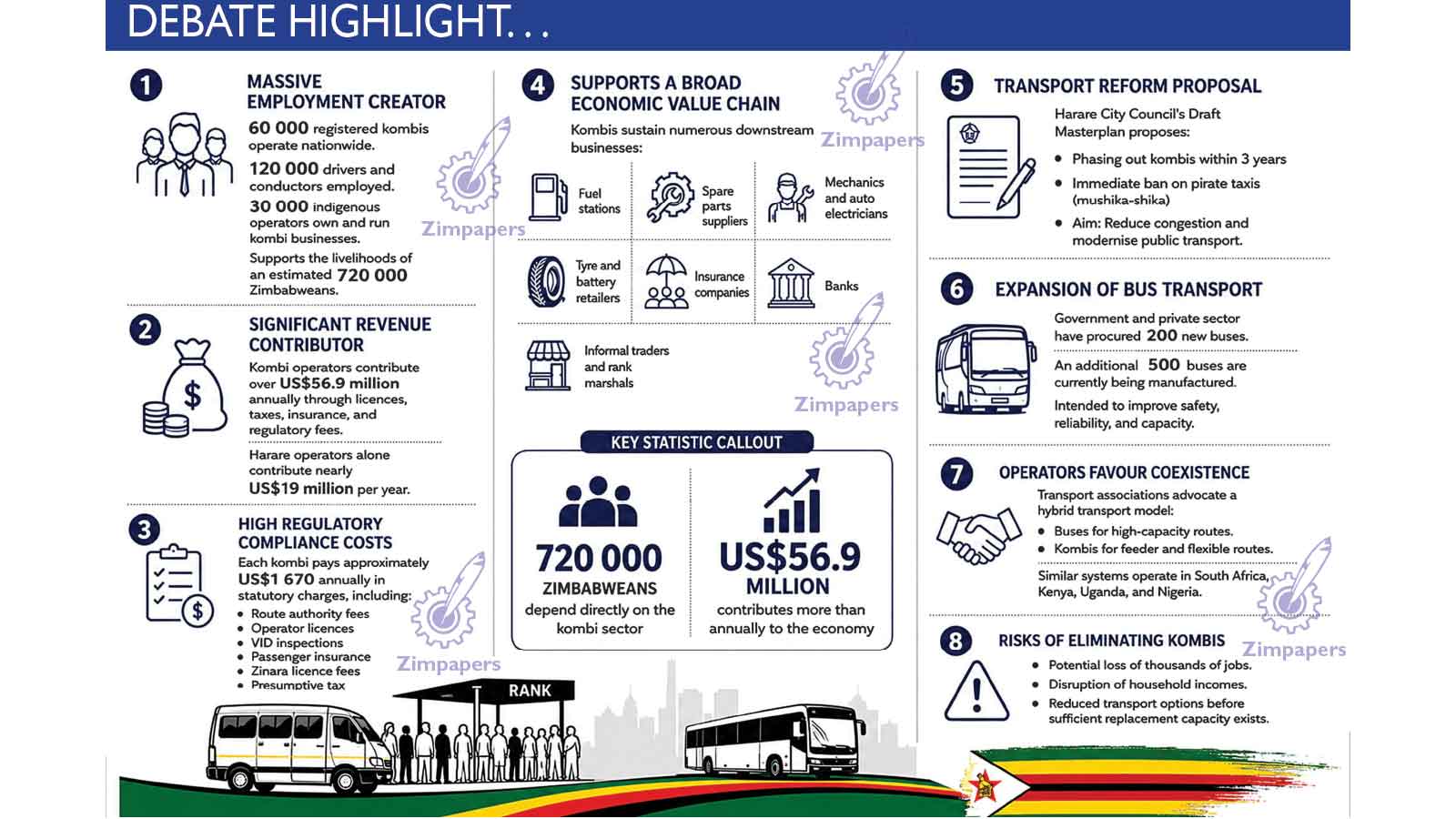
ARE commuter omnibuses simply a traffic nuisance that cities should phase out or have they become too deeply embedded in Zimbabwe’s economy to be replaced?
That question has gained renewed urgency following the Harare City Council’s proposal to remove kombis from the capital’s roads within three years under its draft master plan (2025-2045), as the private sector, with Government support, expands its fleet of buses through the procurement of 200 new coaches.
An additional 500 buses — expected to be of the expanding fleet — are presently being manufactured.
While critics argue that kombis contribute to traffic congestion, indiscipline and illegal touting, transport operators contend that the industry has evolved into one of Zimbabwe’s largest indigenous economic sectors, supporting hundreds of thousands of livelihoods and contributing millions annually in taxes, licence fees and regulatory payments.
So, how important are kombis to Zimbabwe’s economy, and can the country realistically do without them?
Why the debate?
The debate has been reignited by Harare City Council’s proposed transport reforms.
Policy 109 of the draft master plan seeks to phase out commuter omnibuses from the capital within three years, while Policy 110 proposes an immediate ban on pirate taxis (mishikashika) as the authorities seek to modernise urban public transport, reduce congestion and dismantle illegal transport cartels.
At the same time, the expansion of public transport is part of an effort to build a safer, more reliable and integrated public transport system.
Transport operators say they support modernisation but argue that reforms should integrate commuter omnibuses into the future transport system rather than eliminate them altogether.
But how big is the kombi industry?
According to figures compiled by the National Public Passenger Transport Association Apex (NPPTAA) — the representative body of the country’s main transporters’ associations — Zimbabwe has approximately 60 000 registered commuter omnibuses operating across the country, making the industry one of the country’s largest locally owned businesses.
The association says the industry directly employs about 120 000 drivers and conductors, while around 30 000 indigenous operators have invested in commuter omnibuses as a source of income. Using the national average household size, the association estimates that more than 720 000 Zimbabweans depend directly on the sector for their livelihoods.
Harare alone has an estimated 16 000 commuter omnibuses, although only about 4 500 are currently registered as public service vehicles.
NPPTAA chairperson Fradreck Maguramhinga believes discussions about the future of commuter omnibuses should consider not only urban planning but also the industry’s contribution to employment and economic activity.
“The discussion should not be about removing kombis. It should be about preserving one of the country’s biggest employment creators while improving regulation and service delivery,” he said.
Far from operating outside the formal economy, transport operators say commuter omnibuses collectively contribute more than US$56,9 million every year through statutory payments. In Harare alone, operators contribute nearly US$19 million annually.
These payments include vehicle licences, insurance premiums and charges for route authorisation and vehicle inspections, among other things.
The industry’s contribution to Government revenue becomes even clearer when examined at the level of an individual vehicle.
Before a single commuter omnibus can legally operate, its owner is required to pay nearly US$1 670 a year in mandatory statutory, licensing and insurance charges.
These include a local authority rank disc fee of US$138, route authority fees totalling US$43, an operator’s licence costing US$41,67, a US$40 Vehicle Inspection Department (VID) fitness fee, US$188 for passenger insurance, a US$150 Zimbabwe National Road Administration (Zinara) vehicle licence, a US$84 Zimbabwe Broadcasting Corporation (ZBC) licence, a presumptive tax of US$720 and US$264 for third-party insurance.
Collectively, the mandatory payments amount to US$948,67 per vehicle annually, illustrating the significant regulatory and fiscal obligations borne by operators before accounting for fuel, vehicle maintenance, wages, financing costs and other day-to-day operating expenses.
The figures, according to the association, demonstrate that commuter omnibuses form an important revenue stream for the Government and local authorities. The economic impact of commuter omnibuses extends well beyond drivers and vehicle owners. Every kombi on the road supports a wide network of businesses and service providers, including fuel service stations, spare parts retailers, tyre suppliers, mechanics, auto electricians, battery suppliers, panel beaters, insurance companies and vehicle workshops.
The sector also creates income opportunities for loaders, rank marshals and numerous informal traders operating around transport terminuses.
“The transport sector supports fuel service stations, tyre suppliers, spare parts retailers, vehicle workshops, panel beaters, mechanics, battery suppliers, insurance companies, banks and many other downstream businesses,” said Maguramhinga.
“Every kombi that operates creates business opportunities for numerous other Zimbabweans who may never drive or own a vehicle but earn a living because that vehicle is on the road.”
For many small-scale entrepreneurs, commuter transport has become one of the few industries requiring relatively modest capital to establish a business, allowing thousands of indigenous Zimbabweans to accumulate assets and create employment.
Harare Youth Transporters Association (HAYTA) chairperson Edmore Tirivanhu Gwengwe said the sector had enabled many families to escape poverty.
“For many Zimbabweans, this industry is their only source of income. Operators employ drivers, conductors and loaders, and every vehicle feeds several households,” he said.
But can buses replace kombis?
The Government’s investment in high-capacity buses is widely seen as necessary to improve the quality, safety and efficiency of public transport.
However, operators argue that replacing commuter omnibuses overnight would be difficult given the sheer size of the existing network and the number of people it serves daily.
Instead, they advocate a complementary system in which buses and kombis operate alongside each other, with each serving different routes and passenger volumes.
Transport operators, Gwengwe said, were not opposed to the introduction of more buses.
“We are not against buses. We support mass public transport because commuters need reliable services. What we are asking for is a win-win situation where buses and kombis complement each other instead of one replacing the other,” he said.
The association points to countries such as South Africa, Kenya, Uganda and Nigeria, where governments have retained or formalised minibus transport while simultaneously investing in buses, commuter rail and bus rapid transit systems.
Harare Mayor Councillor Jacob Mafume said: “We have not yet planned to remove our registered commuter omnibuses as they hold an integral part in our transport system, but what we want to completely remove are the pirate taxis and the mishikashika.”
“We need to complement what to commuter omnibus industry is doing.”
He added: “We need not raise false alarm, but I believe in what we agreed on in the new master plan that we expand our transport systems, and there is room for kombis, buses and light railway trains. Let us find a mix where all these transport systems complement each other, not working against one another.”
What else needs fixing?
Operators argue that successful transport reform should extend beyond the type of vehicles operating on the roads.
Gwengwe said many commuter ranks remain in poor condition despite operators paying daily fees to local authorities.
He said inadequate shelters, poor lighting, flooding, a lack of ablution facilities and deteriorating road surfaces continue to affect both operators and commuters.
“We are concerned that our customers are now failing to cross the flooded areas to come here. We need proper infrastructure because we are paying money to them every day,” he said.
“Our commuter omnibuses are spending almost two hours without loading because people are not coming here because of the dilapidated infrastructure.”
He also questioned the underutilisation of existing waiting bays, saying infrastructure deficiencies should be addressed alongside broader transport reforms.
But what happens if kombis disappear overnight?
Operators warn that abruptly removing commuter omnibuses before adequate replacement capacity exists could have significant economic and social consequences.
They argue that thousands of jobs would be lost, household incomes disrupted and commuters left with fewer transport options during the transition. Gwengwe said reforms should protect both commuters and livelihoods.
So, are kombis integral to Zimbabwe’s economy? The evidence suggests commuter omnibuses have grown far beyond being simply a mode of transport.
They have become a significant source of employment, indigenous investment and Government revenue, while sustaining an extensive value chain that stretches from fuel suppliers and mechanics to insurers, banks and thousands of small businesses.
At the same time, the industry’s economic importance exists alongside legitimate concerns over congestion, road safety, illegal touting and weak regulatory compliance that have fuelled calls for sweeping reforms.
The challenge facing policymakers may, therefore, not be whether commuter omnibuses should disappear altogether, but how they can be integrated into a modern, efficient and well-regulated public transport system that preserves livelihoods while delivering safer, more reliable urban mobility.
As Zimbabwe gradually modernises its transport sector, maybe the debate should start shifting from whether kombis have a future to what that future should look like.