admin
admin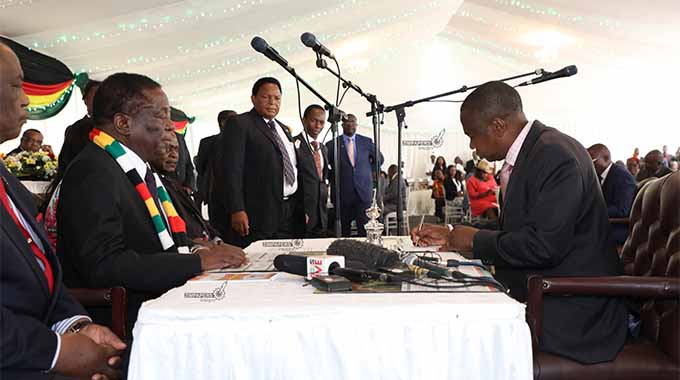
Golden Sibanda, Harare Bureau
Newly appointed Finance and Economic Planning Minister, Mthuli Ncube, has pledged extensive economic reform measures expected to begin with scrapping of Zimbabwe’s surrogate currency, bond notes and reining in Government spending to restore macro-economic stability and sustainable growth.
Minister Ncube, a professor of economics and finance, said he already had plans and a vision of what reform measures the wobbly economy required and that the 2018 Mid-Term Monetary Policy to be presented by the Reserve Bank later this month will carry part of his immediate currency reform initiatives.
He made the remarks in an interview with journalists in Harare after the swearing-in ceremony for President Mnangagwa’s newly appointed 20-member Cabinet at State House yesterday.
He also said he needed to come up with a package of measures to address the country’s problems (building confidence through external debt arrears clearance, fiscal consolidation, improved tax collection and cutting budget deficit) and that he would appoint an international advisory board of eminent persons to help re-brand Zimbabwe, that has been shunned for nearly two decades.
Prof Ncube said while the bond notes will be among the first casualties of his planned onslaught on the current economic order; this will be instituted together with other critical reforms including fiscal consolidation and external debt arrears resolution.
He recently said the surrogate currency was bad money scaring away good money and was partly to blame for causing the acute shortage of the much sought US dollars in Zimbabwe.
“The issue of currency reform obviously will begin (soon) and will be underway; it is important that we do that, but currency reform alone is not adequate, it needs a second leg; it works with fiscal policy because the two are linked, so, fiscal reforms, fiscal consolidation together with currency reforms . . . work together to create stability. Because monetary policy and currency reform work together; they are two legs of the same body,” he said.
Zimbabwe is currently struggling with unsustainable external debt (about $11 billion including arrears), annual budget overruns ($2,52 billion in 2017) or 16,6 percent of 2017 National Budget, unsustainable trade deficits, slow economic growth, high unemployment and sluggish industrial production and poor infrastructure among others.
The new treasury chief said clearance of international debt arrears with institutions such as the African Development Bank and the World Bank was critical to restore international confidence in Zimbabwe.
“There is a plan that I have put in place and will accelerate to make sure that this debt issue is dealt with; it is one building block towards creating confidence; towards investors investing in Zimbabwe,” he said, adding domestic investors also wanted to see movement on the issue of debt resolution.
Minister Ncube stressed that ultimately, he wanted to create a credible macro-economic environment that supported the re-introduction of Zimbabwe’s currency, the Zimbabwe dollar.
“Ultimately, I want to be very clear, I would want to see the Zimbabwe dollar come back as a sovereign currency, a store of value and legal tender, absolutely.”
Zimbabwe scrapped its domestic currency in 2009 and replaced it with a basket of currencies including the US dollar at a time the value of the local unit had been ravaged by hyperinflation, which peaked at 231 million percent at the last official count in August 2008.
The new finance minister said to re-introduce the local currency there were several steps to be taken including building confidence, building foreign currency reserves and securing external lines of credit.
He said initiatives to this end will begin urgently.
On dealing with fiscal imbalances, the minister said while it was easy for finance ministers to target the civil service there were also simple issues to do with service delivery, which was key to dealing with the costs of civil service.
He said he will think and reflect on it and consult (including President Mnangagwa) on how best to address the issue.
Currently, recurrent expenditure chews about 94 percent of National Budget and while civil service wages take up more than 75 percent of the budget; leaving little to invest in key infrastructure or capital formation.
“The culture of service delivery, using the money properly, value for money is (also) very critical; just changing the culture without necessarily retrenching people is also a very important issue,” he said.
The finance chief said the issue of cash shortages, which is affecting the country, was a symptom of the poor general macro-economic picture on the fiscal and macro-economic front and low external confidence.
“All that is causing or impacting the cash crisis issue; so one has to look at the holistic picture in order to deal with it, but clearly there will be steps on the monetary policy that I am going to take,” Minister Ncube said.



 derick.khumalo