Chronicle Editor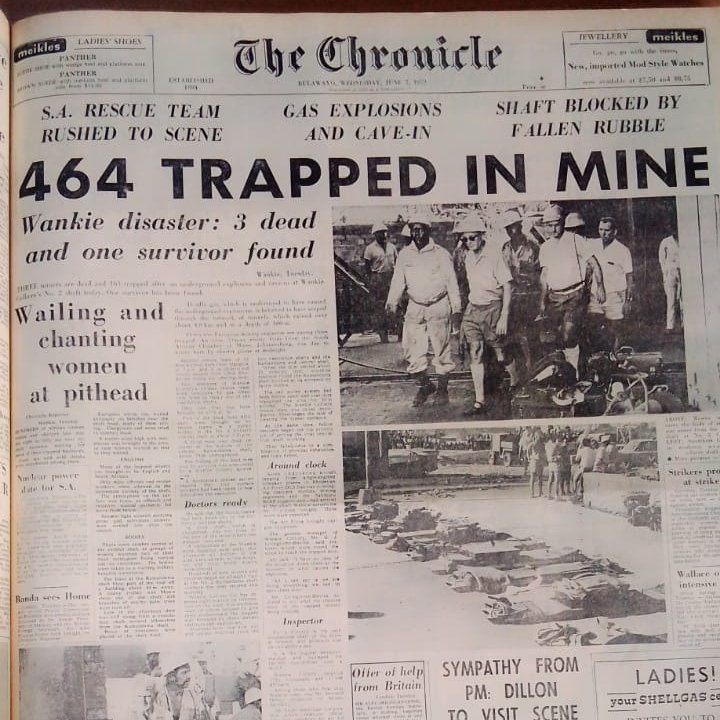
Sikhumbuzo Moyo,
EXPERTS predicted the 1972 Kamandama Mine disaster that claimed 427 miners 12 years before it happened, it has emerged.
The disaster happened on June 6, 1972, when a series of underground explosions occurred at the Wankie No.2 colliery. With 427 fatalities, it remains the deadliest mine accident to date in the country’s history and the ninth in the world.
Eight men were pulled alive from the mine after the initial explosion at around 10.25am on June 6, but two new explosions on the following day poured poisonous gas into the 4.8 km of tunnel rendering further rescue operations impossible.
On June 9, the then Wankie Colliery Company general manager, Mr Gordon Livingstone Blevins, decided to leave the 424 bodies where they were, bringing to 427 disaster casualties after the recovery of three bodies from the initial explosions.
A mass memorial service took place on June 11 at a nearby football stadium, where a crowd of about 5,000 people paid tribute.
“This has cast a gloom over the whole country,” Rhodesian Prime Minister Ian Smith said during the service.
According to the 1973 report of the Commission of Inquiry into the disaster and general safety in coal mines, prior to the disaster, the mine had experienced some major incidents which were however not recorded.
It states that at 9.30am on 29 December 1960, three persons were severely burnt as a result of ignition of methane in No.4 Section, Kamandama Area No.2 Colliery.
The ignition occurred when a match was struck to light a fuse igniter. Mr Mooney, the inspector of mines, then stationed at Wankie conducted the investigation. He formed the opinion and the evidence indicated that minor ignitions had occurred previously, but had not been reported.
“Although this accident is the first recorded accident from this cause it is regarded as a timely warning, as conditions in the respect are likely to worsen in the future when the Kamandama and North shaft workings (No.2 Colliery) approach the Deka fault and north development at No. 3 Colliery extends under the Matura hills where the depth will be about 1 500 feet (450metres),” Mr Mooney told the commissioners
“Daily gas testing has been instituted in all parts of the mine and a close study of all records submitted is being maintained.”
The events of the 1972 disaster completely changed the safety and health conditions of the mining industry in the country such as the formation of the Mine Rescue Association of Zimbabwe; founded in 1973 whose mandate is to coordinate mine rescue activities in the country.
At the time of the disaster, there were no rescue teams in the country and rescue teams responded from Zambia, South Africa and Botswana.
According to the coal mining giant’s official website, the company learnt its lessons from the Kamandama mine disaster and since then, great efforts have been made to ensure that there would never be a repeat accident in any of the company`s mines or workstations.
The statutory regulation for coal mines and fiery mines were drastically changed and adopted as more mines were declared fiery. Fiery mines were categorised to have methane and any other inflammable gases as well as mines containing coal dust.
The company has established a fully-fledged safety, health, environment and quality department with competent practitioners who drive various proactive accident preventive strategies.
“Notable improvements at HCCL from Kamandama Mine disaster to date are underground only use for flameproof equipment, stone dust application. Senior supervision with stringent conditions during any flame cutting and welding activities underground, all workers who operate electrical machines are trained and equipped to test for gases, banning of contraband entering the mine as well as the construction of refuge chambers,” said the HCCL.
As part of its corporate social responsibility, the company has been taking care of the victims’ widows through monthly groceries and school fees payment.
While there were no main commemorations today due to what the company said were unforeseen circumstances, there have previously been held on an annual basis, except during the pick of the Covid-19 pandemic period.
@skhumoyo2000.


 Online Reporter