Online Reporter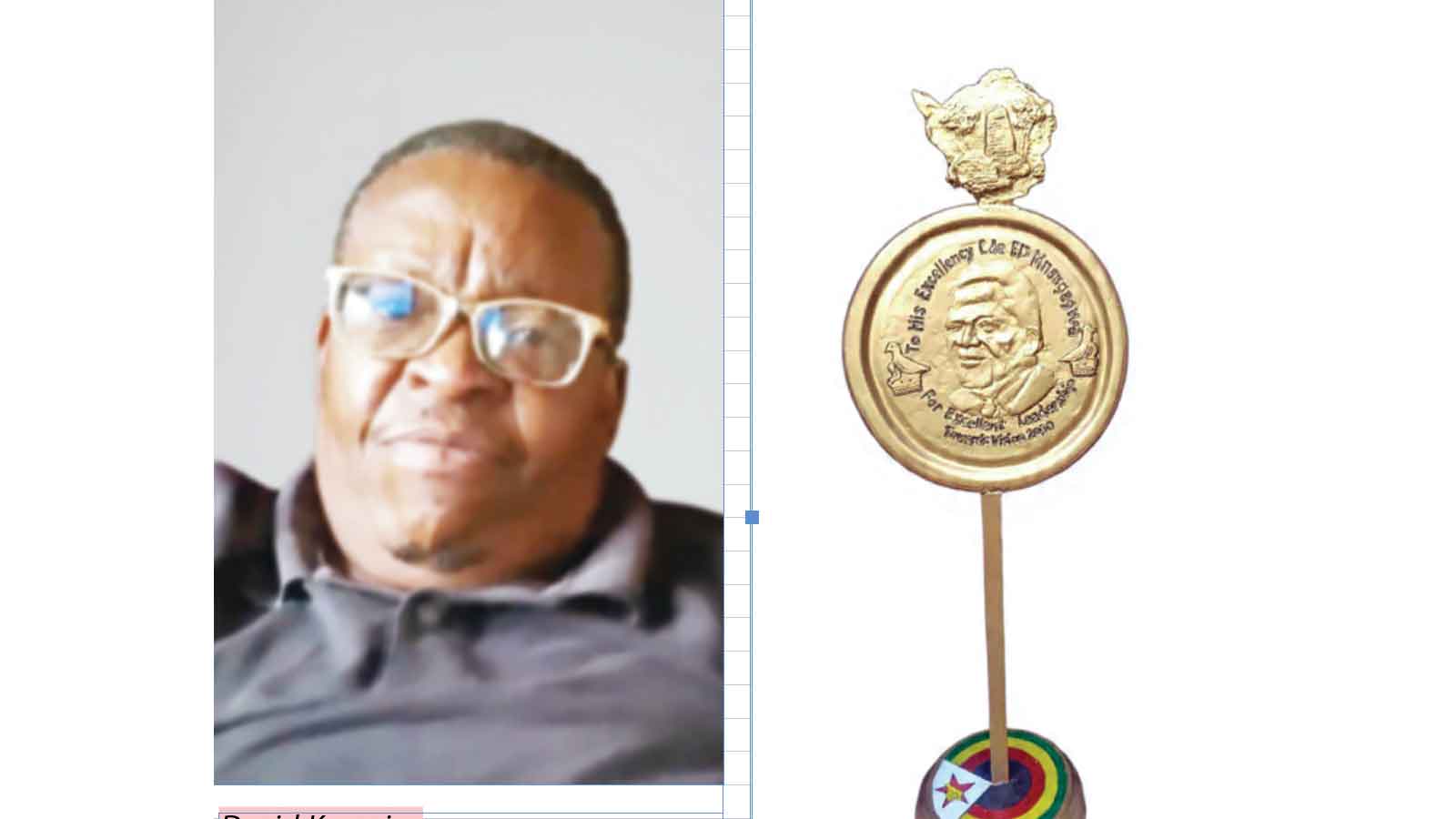
Trust Khosa
Zimpapers Arts and Entertainment Hub
VETERAN visual artist and lecturer David Karavina has paid tribute to President Mnangagwa’s Vision 2030 agenda by crafting a commemorative medal in recognition of his visionary leadership and contribution to Zimbabwe’s development.
The artwork, titled “Vision 2030 Medal,” is being kept at the Museum of African Liberation in Harare and was created to honour the President for his outstanding leadership and commitment to national transformation.
Karavina, a lecturer at the National Gallery of Zimbabwe and several local colleges, described the President as a living hero, visionary leader, and father-figure who deserves recognition not only during Heroes Month in August, but throughout the year.
“I spent six months working on this medal between 18 November 2025 and 28 April 2026,” he told Zimpapers Arts and Entertainment Hub.
“I have since forwarded it to the authorities at the Museum of African Liberation for safekeeping.
“It’s something I did wholeheartedly in appreciation of President Mnangagwa’s hard work.
“He, along with the First Lady, has been a champion of development and needs to be honoured.
“If you look closely, you will see that the President has been giving awards to outstanding Zimbabweans, and yet he is also being honoured back.
“I came up with this medal as an honour of excellence.”
A patriotic visual artist in his own right, Karavina said the Second Republic has transformed lives while demonstrating that Zimbabwe is endowed with abundant artistic talent and creative potential.
“I have carved this piece out of love for my country and respect for the Office of the President.
“I will always do my best and make sure I serve my country with distinction.”
In an additional statement, Karavina’s camp also explained the making of the Vision 2030 Medal by the visual artist.
“The medal was built in four main stages. The first stage was clay modelling, which began with clay preparation and early sketches drawn directly onto the clay.
“Over several weeks, this developed into a detailed model, including a small map of Zimbabwe worked into the clay by hand, with a brass insert placed inside it. Once the clay model was finished, Karavina moved to mould making.
“He created a negative mould of the piece, first in plaster of Paris and later reinforced in cement, to hold the shape for casting.
“The third stage was resin casting. Karavina used polyester resin and a catalyst. He applied a mould release agent, poured the resin into the mould, and left it to cure.
“Added the statement:
“The resin piece was then polished by hand until smooth. In the final stage, the different parts of the medal were assembled.
“This included fitting a flat metal bar as a plinth, treating it with red oxide to prevent rust, and attaching the Zimbabwe map piece to the base.
“The medal was then painted in Zimbabwe’s national colours before gold was applied to the surface as a finishing touch. Inscribed on the medal are the words: “
To His Excellency Cde ED Mnangagwa: For Excellent Leadership Towards Vision 2030.”
Karavina describes the medal as a piece that carries meaning beyond its materials.
“This medal is more than metal and resin,” he said.
“It represents Zimbabwe — its land, its people, and its history.”
According to his biography, Karavina works as a visual artist in Harare.
He previously worked with the National Gallery of Zimbabwe, gaining experience in sculpture, exhibition work, and the preservation of Zimbabwean art and heritage.
“This is one of his personal projects undertaken independently and funded from his own resources.”
Karavina’s name is often associated with the BAT Visual Art School, which is historically linked to the country’s premier national training ground for emerging creators.
Originally established in the 1960s as a workshop school by Frank McEwen, the programme became the BAT Work-shop Studio.
Today, the institution is officially registered and known as the National Gallery of Zimbabwe School of Visual Art and Design (NGSVAD), with its campus based in Mbare.
He spent years as an exhibition designer at the National Museums and Monuments of Zimbabwe, and also worked on exhibitions for the University of Zimbabwe’s Department of History and Archaeology and the Chinhoyi Provincial Heroes Acre.
He has lectured in art and design at the National Gallery of Zimbabwe, the University of Zimbabwe, Harare Polytechnic, and Chinhoyi University of Technology.
His achievements include a scholarship to study art in Stockholm, Sweden, a role in reunifying the two pieces of the Zimbabwe Bird — joining the upper part held in Germany with the lower part in Zimbabwe — and a NAMA Award. “Karavina has now expressed his wish to formally present the Vision 2030 Medal to President Mnangagwa, as a gesture of respect and a mark of the completion of the project.”