Online Reporter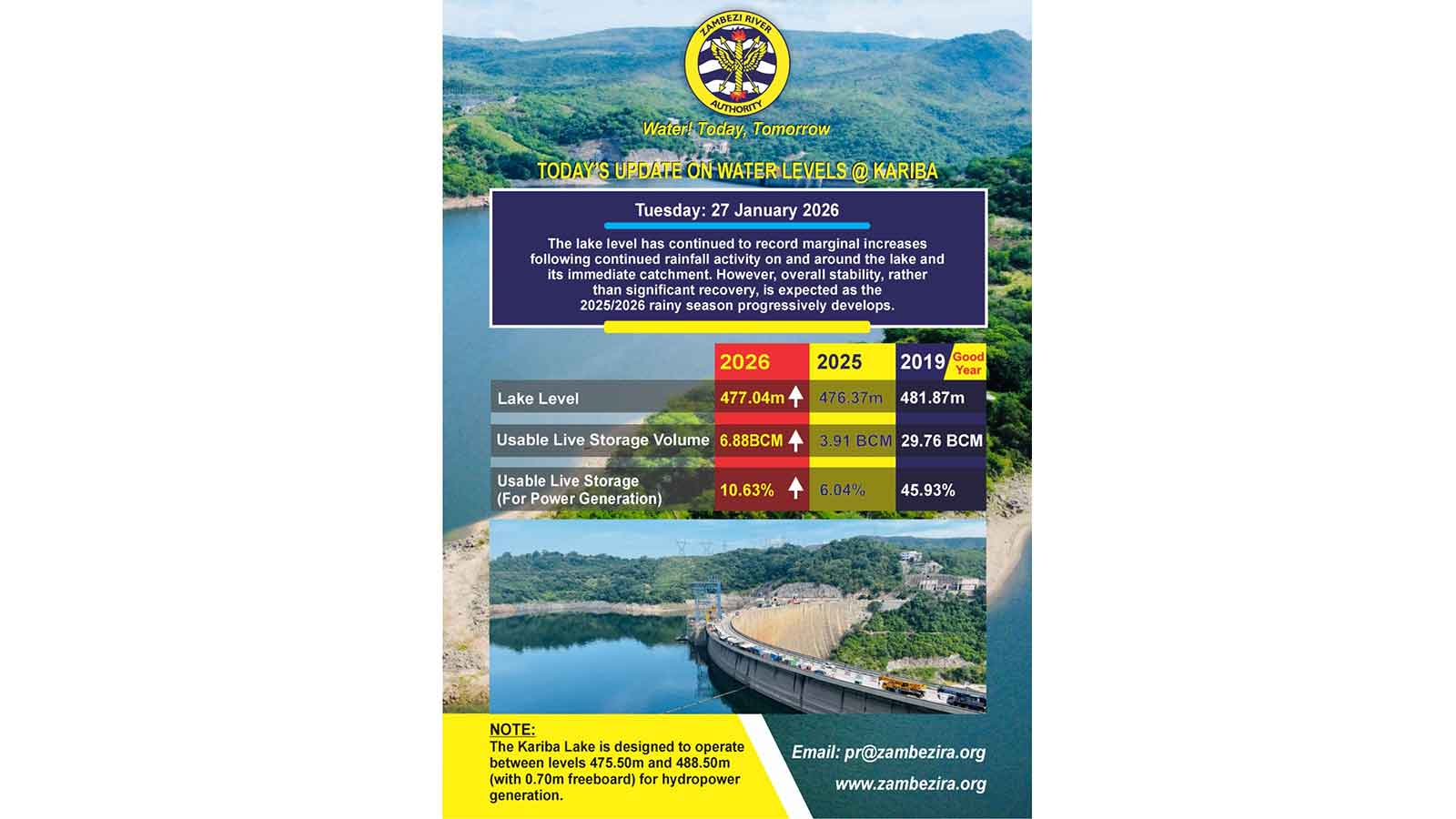
Conrad Mupesa
Mashonaland West Bureau
LAKE Kariba has recorded marginal but steady increases in water levels, offering cautious optimism for hydropower generation prospects, the Zambezi River Authority (ZRA) has said in its latest update issued today.
According to the ZRA, the improvement follows continued rainfall activity on and around the lake and its immediate catchment area, although authorities have cautioned that overall stability rather than a significant recovery is expected as the 2025/2026 rainy season progresses.
The latest figures show that Lake Kariba’s water level has risen to 477, 04 metres, up from 476.37 metres recorded during the same period last year.
While this represents an improvement year-on-year, it remains significantly below levels recorded during historically strong hydrological seasons such as 2019, which ZRA classified as a “good year” when the lake stood at 481, 87 metres.
In terms of usable water, live storage volume has increased to 6,88 billion cubic metres (BCM), a notable rise from 3,91 BCM recorded in 2025.
However, this is still far below the 29,76 BCM available in 2019, underlining the long-term impact of recurring droughts and erratic rainfall patterns in the Zambezi basin.
For power generation, the usable live storage now stands at 10, 63 percent, up from 6, 04 percent last year.
By contrast, usable storage for hydropower generation stood at 45, 93 percent in 2019.
Despite the gradual improvement, ZRA emphasised that the lake remains within a delicate operational range.
Kariba is designed to operate between 475, 50 metres and 488, 50 metres, with a 0, 70-metre freeboard, to safely support hydropower generation at both the Zimbabwean and Zambian power stations.
The authority reiterated that while current inflows were encouraging, they were not yet sufficient to allow major changes in power generation policy, and stakeholders should continue to exercise caution in water utilisation.
Lake Kariba, Africa’s largest man-made reservoir by volume, plays a critical role in electricity supply for both Zimbabwe and Zambia.
Low water levels in recent years have resulted in reduced generation capacity, contributing to power shortages across the region.
ZRA said it will continue to closely monitor hydrological conditions in the Zambezi catchment and provide regular updates as the rainy season unfolds.