Online Reporter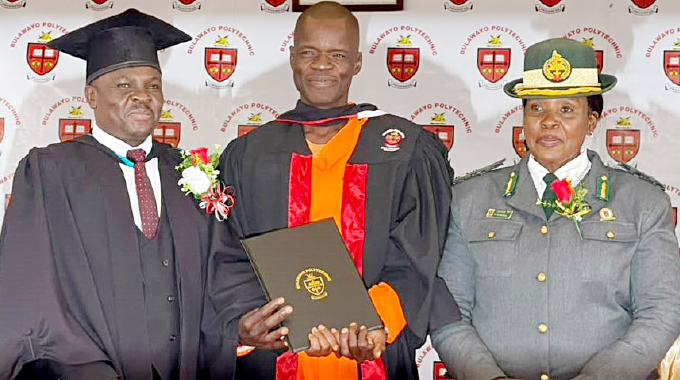
Sikhumbuzo Moyo, [email protected]
FOR Emmanuel Ncube, graduation day was more than a ceremony, it was a glimpse of a future he once feared he might never have.
The 12-year sentence he is serving for rape has taken away years of his freedom, but an opportunity to study and acquire a trade at Khami Prison has given him hope, something he says he desperately needed.
Yesterday, Ncube was among 73 inmates from Khami Prison who graduated alongside 3 844 other students at Bulawayo Polytechnic College’s 97th graduation ceremony.
For the inmates, the graduation marked an important milestone in their rehabilitation, with the skills they acquired expected to help them rebuild their lives and contribute to the country’s development once they complete their sentences.
Ncube graduated as a boilermaker through a partnership between the Zimbabwe Prisons and Correctional Services (ZPCS) and Bulawayo Polytechnic under the Work-for-Fees and Integrated Skills Expansion Outreach Programme (ISEOP).
“I extend my appreciation to the Second Republic led by President Mnangagwa. I was chosen to be part of this programme and this has brought a future for me because I know one day I will get out of prison and pursue this profession,” he said on the sidelines of the ceremony.
Fellow inmate Mandlenkosi Ndlovu, who is also serving a sentence for rape, said the opportunity to study has helped him reflect on his past and focus on becoming a different person.
“Although my arrest was difficult, I have used my time in prison to transform my life. We are asking for forgiveness from the families of those I wronged, including the victim,” he said.
“I have transformed my life and look forward to contributing to the development of my country once out of prison.”
Ndlovu urged other inmates to take advantage of educational and skills-development programmes offered by ZPCS.
“The ZPCS must really be commended for this programme. I call upon fellow inmates not to be shy in taking up such initiatives,” he said.
Another inmate, Lungisani Mazanga, who graduated in crop production and animal husbandry, said his achievement is a step towards fulfilling a bigger ambition of contributing to the country’s food security after his release.
Mazanga, who is the organic gardens overseer at Khami Medium Prison, deliberately chose the agricultural courses because he wants to put his skills to use in rebuilding his life and contributing to national development.
“I salute the ZPCS for affording me this chance. I chose these courses because I want to ensure that Zimbabwe returns to its status as the breadbasket for the continent by 2030,” he said.
The stories of the three inmates reflect the broader purpose of the partnership between ZPCS and Bulawayo Polytechnic, using education and skills development to turn time behind bars into an opportunity for personal
transformation.
Deputy Minister of Higher and Tertiary Education, Innovation, Science and Technology Development Simelisizwe Sibanda, who was the guest of honour, said the initiative demonstrated the importance of ensuring that education was accessible to people from different backgrounds.
“Such initiatives demonstrate inclusivity and social responsibility by Bulawayo Polytechnic,” he said.
A total of 3 917 students graduated, comprising 1 894 males and 2 023 females. Of these, 1 866 students, representing 47,6 percent of the graduating class, were trained in STEM-related disciplines.
“These graduands represent the future innovators and industrialists who will drive Zimbabwe’s transformation agenda,” said Deputy Minister Sibanda.
Under the Government’s rural industrialisation thrust, 691 students comprising 330 males and 361 females were trained through ISEOP, with the 73 inmates from ZPCS forming part of the cohort.
Bulawayo Polytechnic also supported 47 financially constrained students through the Work-for-Fees Programme and enrolled 21 differently abled students.
Held under the theme, “Equipping Globally Competitive Human Capital for Rural Industrialisation and
Digitalisation,” the graduation highlighted the growing role of technical and vocational education in preparing graduates for a changing economy.
For the 73 inmates, however, the significance of the day went beyond certificates and graduation gowns. It offered them a second chance to leave prison with skills, purpose and the confidence that they can still make a meaningful contribution to society.