Debra Matabvu in Antalya, Türkiye
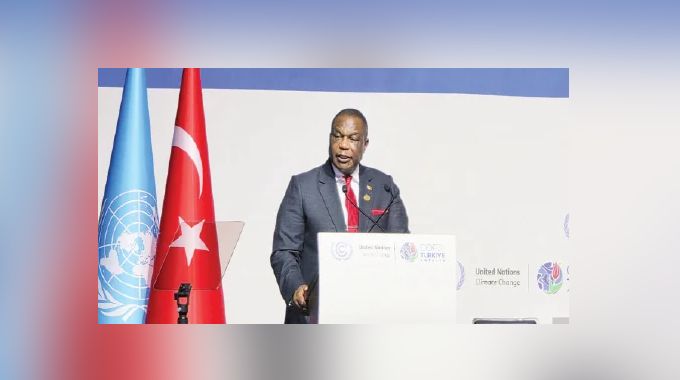
Developed countries must honour their commitment to mobilise at least US$300 billion annually in climate finance and ensure transparent, measurable funding flows to support vulnerable nations in addressing climate change, Vice-President Dr Constantino Chiwenga has said.
Delivering Zimbabwe’s National Statement during the COP31 World Leaders’ Summit here yesterday, VP Chiwenga said climate finance commitments must translate into tangible support for developing countries, particularly communities already bearing the brunt of climate change.
He called for increased adaptation financing and adequate resourcing of the Loss and Damage Fund, saying vulnerable communities could not afford further delays in receiving assistance.
“The commitment to mobilise at least US$300 billion annually under the Paris Agreement must translate into transparent and measurable financial flows, with developed countries taking the lead,” he said.
“In the same vein, scaled-up adaptation finance must deliver real improvements for underserved communities. The fund for responding to loss and damage must be adequately resourced and accessible.
Communities already suffering climate change impacts cannot afford prolonged delays in receiving support.”
Dr Chiwenga said climate finance should be new and additional, predictable and adequate to enable developing countries to strengthen resilience and pursue sustainable development.
He also called for the timely operationalisation of the just transition mechanism ahead of COP32, supported by adequate financing, technology transfer and capacity building.
The Vice-President said the global transition to low-carbon economies should not undermine developing countries’ development aspirations but should instead create opportunities for industrialisation, employment and expanded energy access.
“The low carbon transition must be one that protects the environment while expanding energy access, creating decent jobs and accelerating industrialisation,” he said.
“It must respect national circumstances and allow countries to define their own development and energy pathways.”
He said Africa should move beyond supplying raw materials for the global energy transition and participate meaningfully in the industries, technologies and economic opportunities arising from it.
“Africa must move from merely supplying raw materials for the global energy transition to actively participating in the industries, technologies and prosperity it creates,” he said.
Dr Chiwenga said Zimbabwe was advancing mineral beneficiation and value addition to develop domestic industries, create employment and retain more economic value from its natural resources.
Turning to the country’s climate commitments, he said Zimbabwe was implementing its third Nationally Determined Contributions (NDCs), which target a 40 percent reduction in per capita emissions by 2035.
The country was also advancing climate-smart agriculture to help smallholder farmers withstand climate shocks, safeguard food production and sustain rural livelihoods.
“We are advancing climate-smart agriculture programmes, supporting millions of smallholder households to withstand climate shocks, secure food production and sustain rural livelihoods,” he said.
Dr Chiwenga said Zimbabwe was also promoting wetland protection and restoration as part of its broader environmental conservation efforts.
He said the country was approaching COP31 in a spirit of partnership, calling for the summit to translate international climate commitments into practical action.
“COP31 must move from commitment to concrete action and Zimbabwe is committed to doing its part,” he said.
He said a sustainable future should be one in which climate resilience strengthens development, the energy transition generates shared prosperity and no country is left behind.