Online Reporter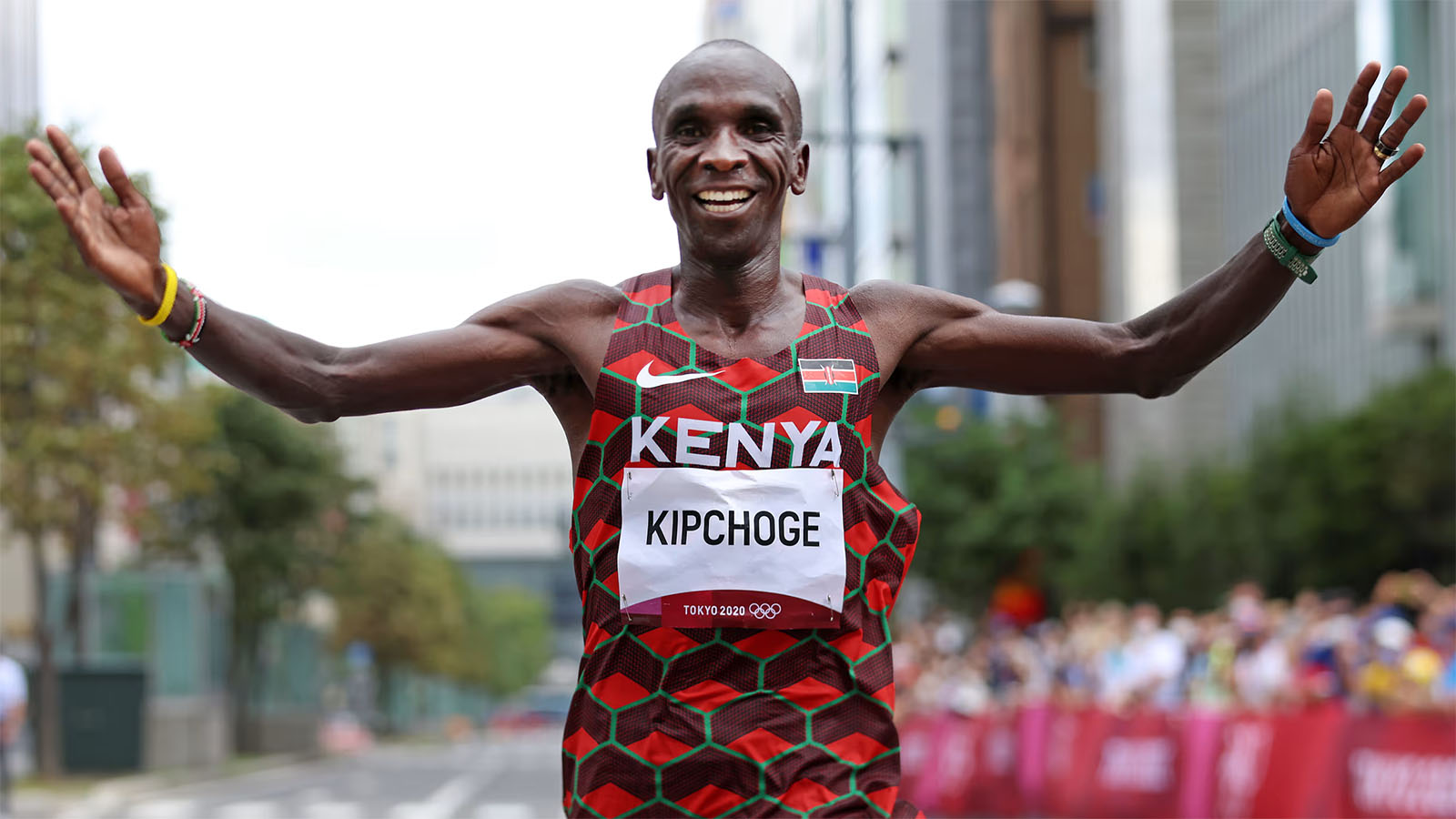
ELIUD KIPCHOGE talks exactly how he runs: smoothly, with purpose, and in pursuit of big dreams.
“I want to make this world a running one. That’s the only way to reach everybody,” he says, between sips of tea.
“My mind has been running back and forth for the last two weeks,” he tells The Athletic over a 30-minute video call, having recently returned home to Kenya from the United States.
After running 2:14:36 for 17th place at the New York City Marathon on November 2, he celebrated his birthday (three days later) by first having a pizza, then heading to Washington, DC to meet his hero, former US President Barack Obama. Safe to say he has transcended the sport.
“We talked about legacy, the future, leadership and mentorship of our youth around the world and in Africa,” Kipchoge says.
“And, above all, how I can use sport to bring change, to mentor people to lead in a good way, to empower communities and to really make everybody think in a positive way to improve the world.”
After his thirties brought two world records, double Olympic marathon gold and a stellar sub-two hour marathon — the first, and only, athlete to break the iconic barrier — the 41-year-old is making a slight career change. This is realignment, rather than retirement. “I’m reading a book called The Second Mountain,” Kipchoge says.
Written by Canadian-American author David Brooks, it is about a human tendency to pursue personal achievements (the first mountain) before realising that more joy and happiness can be found in something deeper, more societal and altruistic.
“I want to put the knowledge I’m getting into the world tour. That is my second mountain,” he continues, speaking about ‘The Eliud Kipchoge World Tour’. “The tour will cover the whole world, which is seven marathons in seven continents (over two years). Let me try to run for a (bigger) purpose, let me go to every continent to get a chance to meet fans, to empower and bring more people to the marathon.
“I want to leave a mark in sport, to leave my footprint,” he adds with genuine humility, as if his 2:00:25 and 1:59:40 time-trial marathons in Monza, Italy, in 2017 and Vienna, Austria, two years later were not motivational enough (those are, unofficially, the two fastest marathons ever).
Kipchoge does know how impactful his achievements, kindness and belief are.
“When I’m walking around, people are shaking my hands, telling me the stories of inspiration, of how somebody gets into running and their life has changed. Those stories are the things that make me wake up and move on, go for training and prepare for the next marathon.”
He has tangible goals for his world tour, too.
“I want to make education affordable in Kenya, to build a lot of libraries here. In the future, I want to build a library in every capital city in Africa. I want to make Africa, as far as education, go high. I want to conserve the environment, to plant trees around Kenya, (then) expand to East Africa, to Central Africa, and all of Africa.”
The same ambitious, dream-chasing mindset that made Kipchoge such a successful marathoner — he has proved his famous tagline of “No human is limited” — shines through here.
“The phrase came in 2017, when Nike approached me to run sub-two,” he says.
“I agreed, because they have been my sponsors for the last 23 years, and we were working together in a good way. We were asking ourselves, ‘How are we going to make it?’ “Everybody was talking about it in a positive way, in a negative way, and that’s life. I tried to say ‘No human is limited’ to tell everybody that was saying this thing is not possible.
“After running 2:00:25, everybody accepted that nobody actually is limited, (so) let us still push the limits. Two years down the line, I broke the two-hour barrier.”
The idea for this global tour, Kipchoge says, has been in his head all year. He dreams of having headquarters in cities across the world as the foundation grows.
“To see people changing in sport, getting people to sit down (and listen). That’s what I need, that’s what I’m really focusing on. I believe that, with my sport, I can push education to everybody, push the environment to change this world. This (planet) is our only home, and we need to make it green.”
Already, he is thinking about trying to get six-figure participation numbers in a single marathon, after this year’s New York event set a world record for finishers (59,226) and, for two years running, there have been record numbers of ballot entrants for its London equivalent — more than a million people applied for 2026.
“The marathon has changed,” he says. After more than a decade in the sport, few have been better placed to observe this latest running boom.
“People love marathons. It can bring them together. People are into humanity, and most marathons are into charity — people are happy to register, to donate and see lives changing, which will bring more joy to sport. “We’ll announce the cities soon,” Kipchoge says of his tour — which is intended to include a marathon in Antarctica. “(This year) I’ve been purely concentrating on the marathon majors,” he adds, having raced in London in April (2:05:25, finishing sixth) and Sydney, Australia, at the end of August (2:08:31, ninth), before going to New York.
It makes this the first season in which he has run three marathons.
“It was a hard time, but I did not change my training so much. The idea actually was still to push, because I’ve been actually consistently running two marathons per year,” he says. “In the next two years, I will be doing seven marathons. One year might be four marathons, and the other year might be three, so it was a good test for my body to really get ready for something which is coming.” — nytimes.com