Chronicle Editor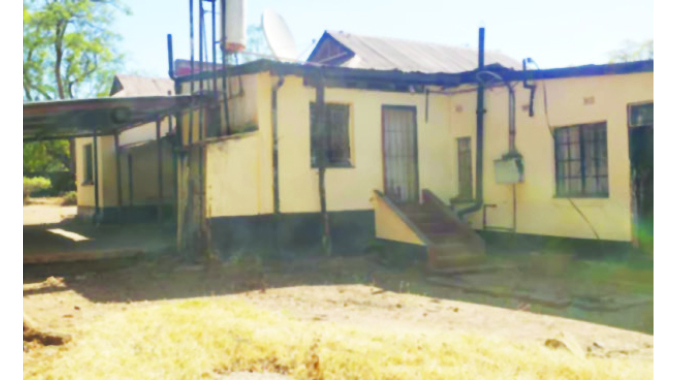
Michael Magoronga
WITH her head clutched in her hands as she fought back tears, Ms Kimberly Rusike was beside herself as she explained how her family escaped death by a whisker.
The Rusike family house located at one of Kwekwe’s oldest compounds, Globe and Phoenix, caved into an underground mining shaft. This is the home they had known for the past three decades after purchasing it from its former white owner who was a mine manager.
Although the family had deserted their home a few months before the incident after detecting sounds from mining activities taking place underneath the house, some people still lived in it.
Their fears were confirmed after the dining room and kitchen collapsed into the tunnel which swallowed most of their property.
The family is now homeless and according to Ms Rusike, they are struggling to make ends meet as they relied on rentals from the house to sustain themselves and their elderly parents.
Speaking on behalf of her family, Ms Rusike recounted their fortunate escape from the collapsing house.
“We decided to look for alternative accommodation after hearing some sounds coming from underneath the house and left. But there were challenges with thieves so we looked for some people who took care of our property after we left. Those are the people who almost died,” said Ms Rusike.
A tremendous blast from the neighbouring mines ultimately sealed the fate of the Rusike family home. Irreparable damage was inflicted upon their property, with the chimney vanishing into the seemingly bottomless depths of the tunnel. Ms Rusike admitted to the unknown depths of the tunnel but described it as a haunting sight.
Having resided in the house for 23 years, the Rusike family now finds itself in dire straits. Their plea for assistance reverberates through the community, as they face homelessness and uncertainty.
While a generous benefactor has provided temporary accommodation, they yearn for a more permanent solution, no longer wanting to rely on the goodwill of others.
“We’re in trouble as a family. We have nowhere to go and we’re requesting any stakeholders who can assist to come to our rescue because we have nowhere to go. We were given temporary accommodation by a well-wisher but obviously we can’t continue relying on someone’s property,” she said.
What befell the Rusikes was not a first in the “City of Gold”, which has vast mineral deposits, especially gold.
Several tunnels have developed beneath the City of Kwekwe forming a network with those from Gaika Mine, which were left behind by miners back in the day.
The longest tunnel that passes beneath the CBD is said to be 43km long and 873 metres deep, translated to level 26 and 27, which is way below sea level.
Back then, the miners would leave pillars supporting the tunnels no matter how gold-rich the pillars were for the sake of safety.
Globe and Phoenix Mine in its lifetime produced over 4,2 million ounces of gold at an average grade of 27,6 grammes per tonne.
The mine was responsible for the construction of a number of infrastructure in the city including schools, a compound for workers, post office, houses for management and Phoenix Hotel, now Shumba Hotel, among a number of other infrastructure.
Being a very rich gold mine, and its proximity to the CBD which is easily accessible, illegal mine activities have taken their toll on Globe and Phoenix Mine as illegal gold miners now allegedly go after the pillars and extract alluvial from them.
Evidence shows that mining activities, both legal and illegal, are digging new tunnels which link to the old tunnels, leaving the mining town sitting precariously on top of a number of tunnels.
Kwekwe Town Clerk, Dr Lucia Mnkandla said the local authority doesn’t have the mandate to control mining activities, shifting the prerogative to the police.
“We don’t regulate mining activities, that’s the mandate of the ZRP,” she said.
Surveys have been conducted many times with engineers saying illegal gold panners can only go as deep as levels 1 and 2. Levels 3 to 46 are covered by underground water and illegal gold panners have no capacity to access such levels.
The tunnels are also too narrow to cause significant disturbances outside those depths, say the engineers.
However, recent developments have left residents in the mining town cursing the gods for the abundant gold deposits that have led to land degradation and infrastructure destruction.
Residents fear for their safety amid reports that the city is hanging precariously on top of underground mining tunnels.
Back in February 2014, a few kilometres away from the Globe and Phoenix compound, a miner on his way to work was killed when the ground gave in under him.
Around the same time, an entire garden and a three-metre guava tree were swallowed by a suspected mine tunnel some 30 metres beneath the suburb.
Most recently, a classroom block at Globe and Phoenix Primary School collapsed into an underground mining tunnel injuring scores of learners who were in class.
Illegal miners were reportedly disregarding the existence of the school as they were determined to lay their hands on the precious metal until they found themselves underneath a classroom block which they blast open.
The century-old school has since been closed off and learners have been transferred to the nearby Sally Mugabe Primary School where they are learning from tents.
Following the incident, President Mnangagwa ordered a geo-technical survey to be conducted to ascertain the extent of damage caused by the mining activities.
The report of the survey is yet to be released.
However, Government departments housed at one of the biggest Government complexes in Kwekwe were ordered to evacuate immediately.
The Government departments including the District Development Co-ordinator, Registry, Civil Court, District Development Fund (DDF) and Ministry of Information among others, occupied the structure which was constructed as the Globe and Phoenix Mine Post Office more than 100 years ago.
Authorities in Kwekwe are still running around looking for alternative premises to house the said Government departments.
Midlands Provincial Affairs and Devolution Minister, Senator Larry Mavima visited the Rusike house after it collapsed and expressed sadness over what is obtaining in Kwekwe.
Minister Mavima did not mince his words when he said the mining activities needed to be stopped for the safety of residents.
He said while the Joint Operation Committee (JOC) was in the process of compiling a report, if the rampant mining activities continue, the Government would be left with no option but to close the mines in the area.
“The future is uncertain for the people in this area hence the report will clearly show the impact of the mining activities here and the only option will be to close down the mines,” said Minister Mavima.
He said Kwekwe was under siege from these rampant mining activities and they cannot be allowed to continue damaging infrastructure and the environment.
“The level of destruction is very worrisome. Even if people want money, they should look for legal and better ways of making it. We have a serious situation in this town that not only these houses are facing collapse but even surrounding buildings may collapse. This is a disaster,” he said.
Worryingly, illegal mining activities continue to take place willy nilly within the CBD and threaten to destroy Queens Sports Club along Harare Road.
Illegal miners conduct their mining activities in broad daylight while everyone watches but no one seems to care.
Environmental Management Agency (EMA) spokesperson, Ms Amkela Sidange said Kwekwe District was one of the worst districts in terms of land degradation caused by illegal mining activities which was now causing the crumbling of infrastructure.
“The Midlands province, Kwekwe District in particular, is among the leading provinces when it comes to issues of land degradation caused by gold mining activities. It’s among the top three provinces when it comes to land degradation due to mining. The detrimental effects extend beyond the province’s natural resources; the rivers are also bearing the brunt of gold mining, while the infrastructure suffers from compromise,” she said.
According to Ms Sidange, the country has over 1,5 million small-scale illegal gold miners across the country.
“The last survey we did as EMA indicated that an estimated 100 153 hectares of land, as well as a stretch of 1 555km of the riverine ecosystem, have been degraded due to gold mining.”
These numbers, she said, highlight the urgency of finding sustainable solutions to protect the environment.
“Fines are not deterrent enough because you find polluters back on the ground soon after paying the fine. However, statutes are undergoing review and the amount of fines paid by polluters is something that will be considered,” she noted.
Young Miners Foundation chief executive officer and co-founder, Mr Payne Kupfuwa is of the idea that the formalisation of small-scale miners could help address the situation.
“Formalisation and professionalisation of small-scale miners is the answer to these challenges of infrastructure falling into shafts. A well-structured shaft being managed by professional engineers can’t risk host inhabitants’ lives. The whole idea of extracting these minerals is to make a better living for our own people so we won’t do anything to harm them,” said Mr Kupfuwa.
He believes all mining activities should be run formally and professionally to avoid unnecessary loss of lives.
“We have a lot of human capital in the country and experts in these issues so let’s utilise the resources to save lives and property,” he said.
Until the issue is fully addressed however, illegal mining will continue unabated while environmental and infrastructural degradation and destruction will continue.
The people of Kwekwe will continue guessing the extent of damage underneath the revered City of Gold and most of all their safety. A solution is needed now.


 Online Reporter