

 admin
admin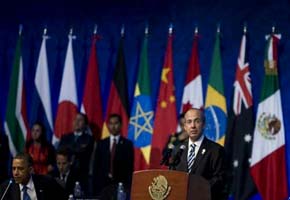
The International Monetary Fund trumpeted $456 billion in pledges to a firewall fund intended to stave off future crises, but it was the current downward spiral in Europe that preyed on the minds of the world’s major powers.
Mexico’s President Felipe Calderon welcomed the likes of US President Barack Obama, newly returned Russian leader Vladimir Putin and German Chancellor Angela Merkel to a conference centre in the hills above the beach resort of San Jose del Cabo.
To build confidence in the frail global economy, the Group of 20 leading economies vowed to “act together to strengthen recovery and address financial market tensions,” according to a draft communique obtained by AFP.
“All G20 members will take the necessary actions to strengthen global growth and restore confidence,” it said.
Obama, who fears the turmoil in Europe will drag down the broader world economy and torpedo his hopes of re-election in November, said through his spokesman after meeting Merkel that he was “encouraged” by Europe’s plans.
The optimistic language, however, could do little to hide the dismal economic backdrop, with Spain’s sky-high cost of borrowing stealing the focus after the brief respite provided by Greece’s election result.
In Sunday’s polls in debt-ridden Greece, parties committed to the terms of their European Union and IMF-led bailout held off a strong challenge by a leftist anti-austerity party.
The IMF has indicated it is willing to renegotiate Greece’s 130 billion euro ($165 billion) bailout programme and senior US Treasury official Lael Brainard led calls in Los Cabos for Athens to be given more time to meet its obligations.
But hopes that the Greek vote would help the single currency bloc turn a corner were dashed as attention moved onto the fragile economies of other EU members and Spanish borrowing costs soared to levels seen as unsustainable.
Adding to the gloom, a report from Spain’s central bank said bad debts in the country hit their highest level for 18 years in April, sparking concerns that a 100 billion euro ($126 billion) bailout for its banks might not be enough.
European leaders tried to present a united front on the path forward at Los Cabos but divisions linger.
Merkel, leading Europe’s largest economy, has emphasized financial responsibility, while Obama, along with newly elected French President Francois Hollande, have put the focus on growth.
“We’re seeing a noticeable shift in the European discussion regarding the critical importance of supporting demand and job growth,” Brainard said.
However, Merkel gave no indication that she was about to abandon her hardline stance on the austerity measures Europe imposed on indebted eurozone members, which some argue have sabotaged economic growth.
“Elections cannot call into question the commitments Greece made. We cannot compromise on the reform steps we agreed on,” Merkel said.
Merkel said that full details of plans to extricate Europe from its vicious cycle of debt would not be revealed until the EU meets at the end of the month, but added that she expected a “good” G20 summit.
In a sign of the underlying tensions at the Los Cabos gathering, European Commission chief Jose Manuel Barroso bristled when questioned on European credibility and issued a fierce defence of the bloc’s handling of the crisis.
“Frankly, we are not coming here to receive lessons in terms of democracy or in terms of how to handle the economy,” he said.
Keenly watched at the summit was the head-to-head meeting between Obama and Putin, their first since the Russian president’s return to the Kremlin in May.
The two appeared cordial but formal during a meeting with the media after two hours of talks. They issued a joint call for an end to violence in Syria and said its people should be allowed to democratically decide their future.
Obama sees his “reset” of relations with Russia as a key achievement, despite Putin’s often strident anti-Western rhetoric, but the two leaders remain far apart on many issues.
The world’s 20 leading industrialised and developing nations need to seek new progress while ensuring stability, Chinese president Hu Jintao said on Monday.
In a speech delivered at the G20 summit here, Hu said that while there has been some improvement in growth prospects, the world economy is still facing prominent destabilising factors and uncertainties.
New risks are emerging and building up as the underlying causes of the international financial crisis are yet to be removed, he said.
“Faced with this situation, we need to consolidate what we have achieved in countering the financial crisis, and maintain economic and social stability and development,” he said. “At the same time, we should endeavour to make new progress while ensuring stability.”
In a more detailed five-point proposal, the Chinese president said the G20 members should be firmly committed to promoting steady recovery of the world economy.
At present, securing growth, increasing jobs and promoting stability should still be the top priority of G20 members, Hu said, emphasising the need for “a spirit of unity and win-win co-operation” in addressing the systemic risks in the world economy and strengthening the hard-won momentum of economic recovery. — Al Jazeera/Xinhua.


 Online Reporter