

 happiness Chikwanha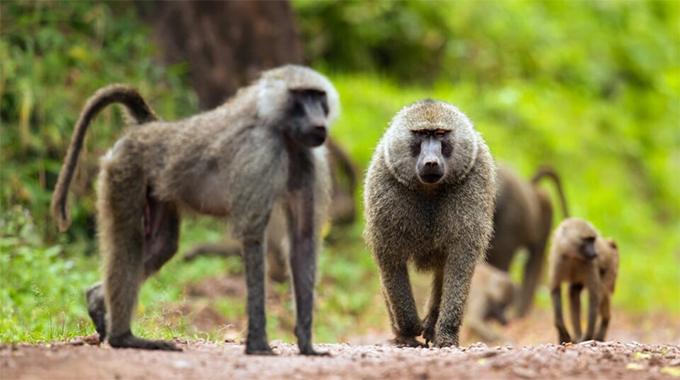

BASS FISHERMAN’S APPROACH: by Ben Chiganze
Last weekend I went tiger fishing at Tiger Safaris in Chirundu with my friends Proud, Day and Stillo from Bulawayo. For three consecutive days I chased shadows while my friends from the City of Kings and Queens enjoyed themselves.
Over the years I have learnt the art of finding something interesting in any negative situation. Having lost the battle in the river I shifted my focus to enjoying nature.
The urbanisation of Chirundu has to some extent disturbed the ecosystem in the border town. Predators such as leopards have moved farther downstream thereby boosting the population of baboons and monkeys.
I took an interest in observing the fascinating behaviour of a troop of baboons which was permanently patronising the lodges (we were renting) and its environs.
The troop appeared to be organised in a hierarchy which is led on patriarchal lines unlike elephants which are led along matriarchal lines.
The leader of the troop is a male baboon commonly known as “Hombiro” in Shona. Within the hierarchy are other male baboons. There are also mothers and children within the group. The entertainers are known as mangoi.
In any troop of baboons, the Hombiro is the most powerful and influential baboon. Depending on the situation at hand its leadership style can alternate from servant leadership to an autocratic leadership.
I observed that in this animal kingdom the social order is key in achieving their social and economic objectives.
For instance, a small baboon cannot eat a scorpion in front of a big baboon. Any young baboon which fails to observe this standing rule will be thoroughly beaten by the Hombiro or any other older baboon.
This implies that in any situation at work, a leader is supposed to instil discipline among their subordinates. In the baboon world, discipline is not a negotiable requirement so is in business.
Leaders have a responsibility of defending their followers from potentially dangerous environments. One of the amazing occurrences during last weekend’s excursion is when Stillo tried to intimidate baboons.
The Hombiro responded by attacking Stillo viciously. Stillo only survived by back-pedalling and taking to his heels. The Hombiro was not afraid to stand its ground. Leaders must be willing to take personal risks to ensure safety or success of the followers.
In addition to inspiring and motivating followers to work hard, there are times when leaders are required to get their hands dirty by going into the thick of things to solve problems which might be affecting their subordinates/followers. At times simply issuing instructions from afar without getting in the thick of things will not achieve the desired results. At times demonstrating how things are done can serve as a form of positive behaviour reinforcement rather than merely lecturing on how things are supposed to be done.
One of the key success factors of leadership is the ability to take calculated risks. Leaders play a double role of being the first or last line of defence depending on the situation at hand.
I was also fascinated by the Hombiro’s behaviour when its troop was crossing a gully. It led the way and then stopped in the middle of the gully and stood there until all the members of the troops have passed. It only proceeded after noticing that all other baboons had crossed the gully. A leader who crosses the gully and proceeds while his or her followers are still on the other end of the gully is not worth his or her salt. The Hombiro was actually practising servant leadership. It has an obligation to serve the troop.
It must ensure that the whole troop is moving in the same direction and above all that it is safe from other predators.
Leadership is not defined by how much or how far you are in front of your followers, but by how close your followers are to you in terms of the vision and running with it.
Even though he is supposed to inspire others to perform interchangeably he or she can be at the first or last line of defence depending on the situation.
The writer is a Managing Consultant at CLC Training International. E-mail [email protected].



 Online Reporter