

 admin
admin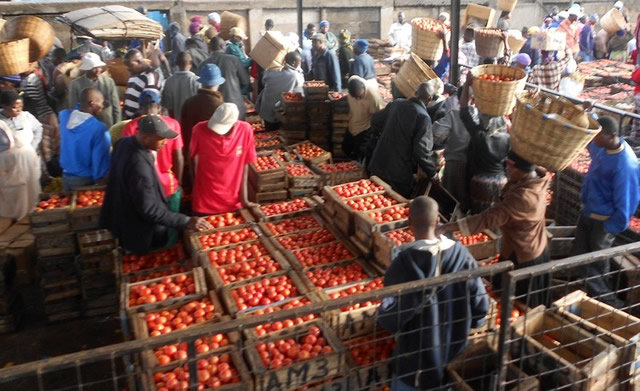
 Charles Dhewa
Conflict resolution and confidence building are continuous processes at every level of society.Many people including policy makers can learn a lot from how agricultural markets deal with conflict resolution and confidence building. In the majority of cases, farmers have their own perspectives on commodity prices while traders and consumers also bring their own perspectives.This creates a fertile ground for conflict around prices in informal agriculture markets, especially when market forces do not quickly come in to calm tempers.
Through different quality standards and appearance, commodities play a central role in bringing both parties to an amicable settlement — preventing conflict. In the market commodities pass through many hands — from farmer to farmer to trader or food chain store and finally, to the consumer. By being exchanged through all these players, the commodity shows its level of acceptance. Conflict resolution happens in all these stages.
A keen observer can see how these processes are underpinned by a rich set of theories, although farmers and buyers may not realise that theories are an integral part of their practices. For instance, relationships between farmers and traders are driven by the need to reciprocate past communications (exchange theory) and to minimise the cost of communication (theories of self-interest) while maximising access to resources (resource dependency theory).
There is also a tendency for farmers and traders to communicate with those who are similar to them (theories of homophily) as well as those most accessible to them (theories of proximity). Overall, there are sterling efforts to minimise conflict by maximising the collective value of communication (theories of collective action).
Conflict related to
competitive edge and
limited resources
Conflict is more of a competitive edge which informs farmers how to manage their businesses. If the standard of your commodities is inferior you go and improve it. You cannot try to force your product on buyers or consumers.
When livestock farmers take their cattle to an auction, the decision to accept or reject the market price rests with the farmer. Cattle are the ones competing with each other, not people. A farmer can go back and pen-feed in order to improve quality and then bring the beast to the market.
Markets reduce human interface which would result in conflict when people do not agree. Where commodities do not agree they adjust in terms of price: more volume for the same price during gluts and higher price for the same volume in case of a better commodity.
Where commodities take a lead in unforeseen negotiations, people are called in to exchange knowledge with producers. If you try to move your commodities to a different market thinking you will get a better deal elsewhere for the same product, you may discover that markets speak to each other. Grade A or B tomato is often the same in all markets.
Conflicts tend to happen where there are limited resources to be shared among many actors. In a market with few buyers, where supply outweighs demand, the product with a competitive edge survives. Producers cannot force. If there is a shortage, those who have buying power go for the commodity. In fact, it’s the commodity that has buying power not people as the commodity goes to the highest bidder.
How conflict leads to
misuse of resources
Avoiding conflict leads to best use of resources. On the other hand, conflict result in misallocation of resources. Where farmers are forced by buyers to be price takers, their commodities will not get the best value and that kills trust and confidence between two actors.
From the knowledge and commodities that are produced competitively, relationships are built between farmers and the market. This contributes to the evolution of niche markets and clusters based on trust and confidence among actors.
However, in the case of tobacco marketing, oligopolies caused by a few buyers colluding result in farmers being price takers. This is where the disadvantage of someone negotiating on your behalf as a farmer becomes visible. Where a farmer does not participate in market negotiations, there tends to be suspicion which erodes trust, leading to conflict.
The role evidence in minimising conflict and
building confidence
How much knowledge do farmers have about the capacity of their land versus available resources? When you take commodities to the market you must be able to see if you have put enough effort to achieve anticipated returns. To what extent do farmers fully utilise available resources to deserve the returns they expect?
If a farmer under-utilises resources s/he denies the nation potential revenue. On the other hand, if a farmer fully utilises the land s/he should be able to get returns equivalent to the effort put in. That means if the farmer has farmed for at least 10 years, s/he must have benefited a lot from using the land through investments in other businesses.
One of the contemporary debates in Zimbabwe at the moment is about compensating former white commercial farmers following the land reform. A home-grown solution to this simmering conflict should be anchored on strong evidence rather than perceptions.
The effort should not be for pleasing the international community or funders but Zimbabweans and former commercial farmers. Honest facts and figures may go a long way in reaching a win-win solution devoid of suspicion. Compensation as conflict resolution mechanisms can be looked at from many angles including the one below:
We can take the four factors of production — land, labour, capital and entrepreneurship as a starting point. During the past 10 years a commercial farmer got capital from banks and managed to pay back the loan with interest.
The farmer was also able to pay workers, including bonuses, after good harvests. The farmer’s entrepreneurial skills enabled him or her to reap profits which s/he invested in the business and somewhere else.
The question is: What did the farmer pay to the land? If the same farmer has been handsomely paid by the land for many years, isn’t asking the government to compensate the farmer similar to double payment?
Should compensation be based on a case by case scenario such that the farmer who paid back the land by carefully taking care of the land can be compensated differently from the one who didn’t feed the land with new nutrients?
The farmer was able to pay the bank, labour and harvested profits from his/her entrepreneurship but did not pay back the land which enabled him/her to build an empire. These are some of the issues that should not be swept under the carpet when discussing the past and future of Zimbabwean agriculture.
Sustaining agriculture through smart resource
allocation
Sustained agricultural production and marketing during different periods including drought years has been ensured by farmers who have been good at allocating their resources to all factors of production. These farmers have been able to properly manage the land so that it stays productive. They have paid their labour. They have been able to pay back loans and re-invest their entrepreneurial benefits.
This has seen markets surviving for a long time and defying drought, among other calamities. Unfortunately, most actors including farmers and banks lack this important knowledge. They are good at blaming the market, middlemen and erratic rainfall.
Proper allocation of resources to all factors of production can prevent this blame game which is leading to continuous conflicts.
Current financial inclusion initiatives should strive to understand these dynamics from the market. This will avoid a fresh blame game culture which feeds conflicts. We should be guided more by evidence from the action on the ground than by perceptions.
At the moment, financial inclusion is targeting the formerly excluded who are still to recover their confidence in the financial sector. How do policy makers rebuild confidence in this sector without disturbing the existing ecosystem (which can cause conflicts)? In-depth research and longitudinal engagement is critical.
Some conflicts have been caused by institutionalising categories such as A1, A2, and large scale farmers. These are mere artificial boundaries that have become barriers to knowledge sharing, creating unnecessary conflicts and suspicion. As if that is not bad enough, different NGOs work with different farmers and communities where they introduce their own values.
Some farmers work with parastatals and contract companies where they are subjected to different rules and regulations. All these situations are fodder for conflict.
Enhancing the connectivity of agricultural actors to
minimise conflict
Conflict resolution and confidence building in Zimbabwe’s agriculture sector can be achieved through facilitating relationships, coalitions and other partnership structures. It seems the history of relationships between different classes of citizens and farmers is fanning conflicts.
Confidence building is also being sapped by power imbalances between farmers and market actors. Not to mention the adequacy of resources and the degree to which competition for resources is linked to the basic survival of different actors such as farmer unions.
When building relationships in the agriculture sector, it is not enough to rely on interviews of key leaders and observations because many relationships are leveraged in ways that are not fully observable, for example word of mouth, gossip, market visits, email, whatsapp and private meetings at key moments.
Changes in relationships among farmers, traders and other actors always occur in multiple ways that tell a story of change in progress. Efforts to solve conflicts and build confidence in our agriculture system should look at all these factors.
Charles Dhewa is a proactive knowledge management specialist and chief executive officer of Knowledge Transfer Africa (Pvt) (www.knowledgetransafrica.com) whose flagship eMKambo (www.emkambo.co.zw) has a presence in more than 20 agricultural markets in Zimbabwe. He can be contacted on: [email protected] ; Mobile: +263 774 430 309 / 772 137 717/ 712 737 430.



 Online Reporter