

 admin
admin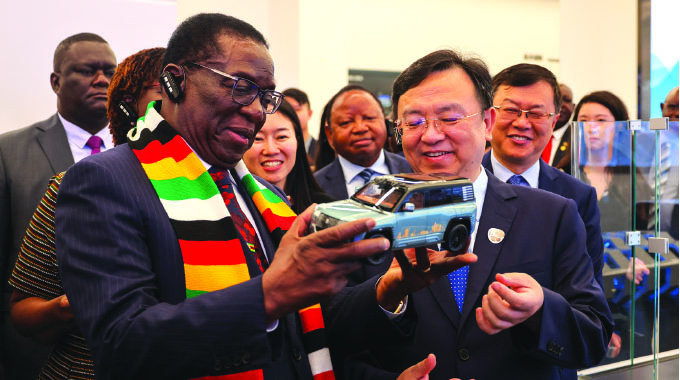
Fungi Kwaramba in SHENZHEN, China
President Mnangagwa has urged Zimbabweans to leverage on China’s rapidly advancing technological innovations to drive the country’s development towards achieving an upper-middle-class economy by 2030.
The President yesterday toured Chinese electric car manufacturing company, Build Your Dream (BYD), and global telecommunications giant, Huawei, in China’s technology-hub city of Shenzhen.
Writing on his official X account after the tour, President Mnangagwa said: “Today, I had the privilege of visiting Build Your Dream (BYD) Auto in Shenzhen, a leader in electric vehicle innovation. We discussed the potential of bringing their advanced green technology to Zimbabwe.
“At Huawei, I signed an MoU to strengthen our digital transformation partnership. This agreement is a key step towards enhancing Zimbabwe’s digital infrastructure and driving our nation forward”.
RELATED STORIES
Speaking to journalists here, President Mnangagwa said Zimbabwe must leverage on enduring relations between Harare and Beijing that were soldered during the liberation struggle, to hasten the country’s industrialisation and modernisation drive.
“Each time we pay a visit to the People’s Republic of China, and in particular on both visits, I have been given an opportunity to visit Huawei, and each time you find out that they have moved on, it does seem that technology evolves year after year. I hope that our people in Zimbabwe will embrace the technology that we have been exposed to here in China. These are our closest friends,” he said.
President Mnangagwa said Zimbabweans should exploit the longstanding relations between the two countries to leapfrog their advancement, particularly in the field of science and technology.

President Mnangagwa witnesses the exchange of documents between his Information Communication Technology, Postal and Courier Services Minister Dr Tatenda Mavetera (right) and Huawei officials after the signing of a Memorandum of Understanding on Strengthening Digital Transformation Partnerships in Shenzhen, China, yesterday. — Picture: Presidential Photographer Mike Muswere
The President, who was among the first crop of Zimbabwean guerrillas to receive military training in China, said young people should hold dear the long historical ties, nurturing them for the benefit of Zimbabwe.
“In 1963 and 1964, we trained here to fight the British. These are our solid friends, and I am happy that up to today we relate and you the younger generation must make sure you consolidate the strong relations,” said President Mnangagwa.
BYD, which is already established in Zimbabwe, is a Fortune 500 listed company. It is a global leader in electric vehicles and the third largest automotive brand in the world, based on market capitalisation.
At its headquarters in Shenzhen, President Mnangagwa was taken on a tour of its modern inventions, which include buses, trains, and Sport Utility Vehicles, by the company’s president, Mr Wang Chuanfu.
While Zimbabweans are familiar with Huawei for its mobile phones, on display during the tour by President Mnangagwa yesterday were not mobile phones, but cutting age technology that can be harnessed to provide telemedication, Artificial Intelligence (AI) that can be deployed in the country’s critical sectors like mining and agriculture for optimum production and productivity, as well as fast speed internet connection that can help bridge the rural-urban technological gap, among other products.
Shenzhen is a major city in Guangdong Province, China, known for its thriving technology industry and is home to global tech giants.
It is a hub for innovation and entrepreneurship, subjects that resonate with President Mnangagwa’s development thrust, riding on the Education 5.0 model, which positions schools and colleges as incubation hubs for solutions to everyday challenges, in the process creating entrepreneurs among Zimbabweans.
The President, who is accompanied by Cabinet Ministers and other senior Government officials, is also expected to visit the city of Changsha in Hunan Province and Nanjing in Jiangsu Province.
After the business engagements, the President will head to Beijing, the capital city of China, for a State visit. The President will later join other Heads of State and Government for the trenial Forum on China-Africa Cooperation ( FOCAC), which will run from 4 to 6 September.
Under President Mnangagwa’s leadership, Zimbabwe has witnessed a significant surge in trade with China. Notably, Chinese private sector investments in Zimbabwe have grown exponentially, from US$445.9 million in 2019 to a substantial US$3.4 billion in 2023, representing a remarkable seven-fold increase.
In recent years, China has invested heavily in Zimbabwe, committing over US$2.2 billion to multi-billion dollar projects primarily in mining and manufacturing.
The investments include the US$1,5 billion in the Manhize Dinson Iron and Steel Project, the Afrochine Ferrochrome Smelters, the Sinomine Resources, Zhejiang Huayon Cobalt and Chengxin Lithium Group among others.
To date, 472 investment licenses have been issued to Chinese companies, with more in the pipeline. China’s support has solidified its position as Zimbabwe’s “all-weather friend”, with bilateral ties yielding significant benefits that also include concessional funding for projects in energy, telecommunications, agriculture, defense, and health.
The construction of Hwange Thermal Power Station Units 7 and 8 (US$997 million), Kariba South Hydro Power Station (US$533 million), the expansion of Robert Mugabe International Airport (US$153 million), and the upgrading of Victoria Falls Airport (US$150 million), are some of the major projects undertaken by Chinese firms.
Additionally, China has assisted Zimbabwe in building key national projects, such as the Parliament Building in Mt Hampden (US$140 million), and the National Pharmaceutical High-Performance Centre.
The two nations also co-operate extensively in health and agriculture, with China providing significant support during the Covid-19 pandemic and drilling boreholes across the country to aid Zimbabwe’s modernisation and industrialisation efforts towards Vision 2030.


 Online Reporter