admin
admin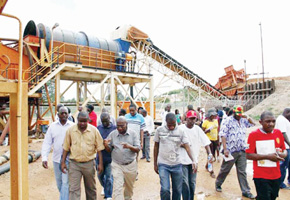
China industrialists of late have made great strides in terms of starting new businesses not only in Zimbabwe but across the African continent. This has seen some African countries able to harness the new technology and expanding their export capacity from raw materials to finished products.
Recently, President Mugabe commissioned a hotel near the Chiadzwa diamond fields in Marange built by the Chinese. Such are examples of how the Chinese business industries and factories have continued to increase in this 20th century. This has come at a time when African manufacturing has been struggling for quite some time now.
In Eastern Nigeria for example, the shoemakers no longer export. In Bulawayo textile industries such as Merlin and Cotton Printers also closed. In Togo, the textile workshops are now disused and fabric is now being imported.
It is only in Egypt and South Africa where there is still the industrial-sector jobs. The African Report 2011 says Africa is the only region in the world where there is rapid industrialisation without industrialisation. This has also increased the number of unemployed people in many countries including Zimbabwe. Industrialisation cannot also take place without power, transport and infrastructure.
According to the World Bank and the African Development Bank, the African continent needs over $30 billion in infrastructural development per year for the next decade. Where then can such an amount come from?
Apart from their ability to establish new business, China has also been very popular with its cheap prices and goods. The following are some of the industries set by China in some of the African countries:
These are just but a few examples. In 2010, China-African trade was estimated to top $100 billion, half which is for importation of Chinese goods, 10 percent machinery and the rest is for inexpensive consumer goods.
While many industries in Bulawayo are looking forward to recapitalisation and the consequent kick-start of businesses, women in business are hit hardest especially as they try to compete in the once-male dominated business areas.
Generally, women have a problem accessing loans to open new businesses as well as to strengthen existing ones. About 43,8 percent of women interviewed in a survey of Women Entrepreneurs in Zimbabwe highlighted that it is very difficult to obtain credit from a commercial bank, the main reason being collateral as most women do not own immovable property such as houses.
Most women in business are concentrated therefore on businesses that require little capitalisation such as food industries mainly in the form of shops, restaurants and coffee shops. There has been an improvement though with more and more women entering into the hospitality industry. A number of lodges are owned by women such as Mpala Lodge in Famona, Glen Lodge in Newton West, Rubis Lodge in Morningside and Entembeni Lodge in Hillside.
The Ministry of Women Affairs, Gender and Community Development has greatly assisted women to start income-generating activities through its Women’s Development Fund and training of women through the Internal Savings and Lending concept (ISAL). Through the ISAL concept, women are able to form clusters, pull their financial resources together and start businesses. The women groups are also taught business management skills and how to keep business record books. The latter is a prerequisite and contributes immensely to good business practices.
Harvest House International in Bulawayo led by Apostle Sarah Nyathi has set the pace as a shining example of business generation from the ISAL concept. Four of the clusters have opened a grocery shop in Sizinda, a supermarket and butchery in Old Pumula and a bakery in Newton West. It means that given the opportunity, women can still do well in business, thereby contributing to the economic growth of a country.
A newly formed women in business group, Women Alliance of Business Association in Zimbabwe (WABAZ) has recommended the establishment of a One Stop shop for business registration and licensing so that women can formalise their enterprises. In the same survey conducted on Women Entrepreneurs in Zimbabwe, results indicated that very few women are members of business fora, chambers of commerce or otherwise.
The majority of respondents (63,5 percent) are not members of any business fora. Of those who are members 22,6 percent belonged to the Zimbabwe National Chamber of Commerce and a paltry 3,6 percent belonged to Indigenous Business Women’s Organisation (IBWO). The rest which included PROWEB, AAG, ZWITAD, JCI, NEC, NYC and Hospitality Association of Zimbabwe had the least percentage of 0,7 percent.
Reasons cited for non-membership included lack of knowledge on the existence of such fora, membership fees which some considered too high and that some fora did not offer desired services. There are some respondents who did not consider such fora as important.
The study highlighted the need for business associations to better publicise their programmes and develop services that help attract new women entrepreneur members.
It was further noted that the business fora should offer different training programmes, provide information on market opportunities and facilitate linkages between buyers and sellers of goods and services. All this said and done, women entrepreneurs feel that their engagements in various activities cannot be achieved without improved services especially in the areas of water, roads, electricity as well as improved current tax protocols. The study further recommended the need for more public information on labour regulations including intellectual property rights.
• Vaidah Mashangwa is the Provincial Development Officer in the Ministry of Women Affairs, Gender and Community Development. She can be contacted on 0772111592 or 889 224. Email: [email protected]


 Online Reporter