admin
admin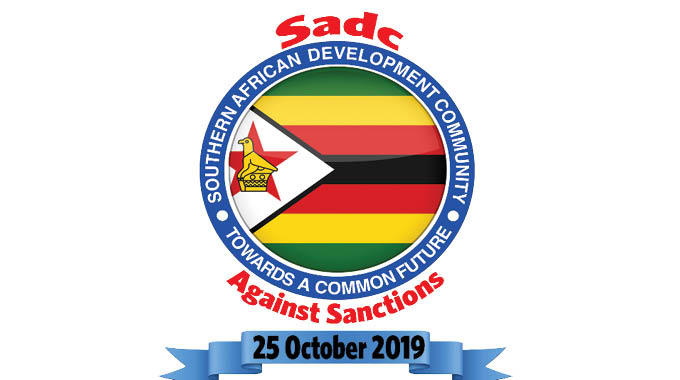
Cuthbert Mavheko
Tomorrow, Sadc will express its solidarity with the people of Zimbabwe by joining hands with them in demonstrating against the illegal sanctions imposed on the country by the West.
The day is a milestone in Zimbabwe’s history as it accords Zimbabweans from all walks of life a unique opportunity to stand as one with our brothers and sisters in the Sadc region and speak with one voice in calling for the unconditional removal of the ruinous economic sanctions, which are causing so much misery and suffering in the country.
The people of Zimbabwe have been battered and bruised by the illegal sanctions for decades. This is now our time to say enough is enough.
Let us use this glorious opportunity to send a petition to Western nations to reconsider their stance on the ruinous sanctions imposed on the country at the request of the MDC formations.
Not so long ago, MDC-Alliance principals Tendai Biti and Nelson Chamisa, who is languishing in political quicksand due to perennial leadership wrangles within his strife-torn party, went to the US and asked Donald Trump’s administration to put in place more sanctions against the country.
Prior to this, one of the founding fathers of the MDC, Morgan Tsvangirai did the same thing when he asked the UK, the US and the European Union (EU) to impose sanctions on Zimbabwe.
The illegal sanctions are not targeted against certain individuals or institutions as some have been led to believe. They are also not hurting the heartless political clowns and charlatans who lead the MDC-Alliance and persistently clamour for their retention. Their brunt is being faced by ordinary Zimbabweans.
The imposition of the illegal sanctions has, over the years, seen multitudes of Zimbabweans cross the Limpopo to look for employment opportunities in South Africa while others, mostly women, engage in cross-border shopping sprees.
However, the great trek of job seekers and shoppers is now finding its way to Botswana as black foreigners are no longer welcome in South Africa, where they are now facing hostilities.
When you visit bus termini in our urban areas you will find Zimbabwean women pushing and shoving to get into Botswana-bound buses, where they are packed like peas in a pod. The shoppers hardly spend a week at home. They are always in a hurry to get back to Botswana to replenish their stocks.
Buses and “omalayitsha” laden with refrigerators, stoves, groceries, door and window frames, roofing materials and so forth are a common feature on our roads.
Cross-border trips are fraught with all types of danger. Accommodation is a nightmare in foreign countries. Some Zimbabweans put up at bus termini and railway stations where they can easily fall prey to muggers, robbers and thieves. Others end up looking for “lovers” to accommodate them, thereby exposing themselves to HIV infection.
These, in a nutshell, are some of the challenges being faced by ordinary Zimbabweans as a result of the devastating sanctions imposed on the country by Western nations.
What offends my own moral sensibilities is that the same Western nations, which imposed sanctions against Zimbabwe, claim to be adherents of the Christian faith. And yet their actions are a glaring antithesis of the fundamental tenets of the Christian faith which, among other things, teach us to love our neighbours as we love ourselves.
Africa, and indeed the entire world, need to be told the true Zimbabwean story because Western imperialists are shamelessly peddling falsehoods that the sanctions on Zimbabwe were imposed because of human rights abuses. This absurdity is worse than a cruel lie and must be treated with dismissive scorn.
The honest truth is that these sanctions, which have been denounced by Sadc, the AU and other progressive organisations and nations stem from the implementation of Zimbabwe’s historic land reclamation exercise.
The sanctions were not imposed by the United Nations, but by a few Western nations eager to protect the interests of their kith and kin who lost land in the country’s lucrative farming sector during Zimbabwe’s watershed land reform exercise.
It is worth noting that the current diplomatic rift over the land reforms was mischievously upgraded to be a matter of human rights and the rule of law by the West and its European allies to give a veil of justification and legitimacy to the imposition of sanctions against the country. And yet this was simply a bilateral issue between Britain and Zimbabwe over the land issue.
Sadly though, some Zimbabweans, especially youths, think the land that was acquired by the Government through land reforms in 2000 belonged to the whites. Nothing could be further from the truth.
It is not a secret that some of our youths have a distorted knowledge of the history of this country because it was written by our erstwhile colonisers. Through Western media, the Zimbabwean story has been painted by a wrong brush that has left marks of stereotypes. If we do not write the true Zimbabwean story ourselves, the story of the hunt will forever be told by the hunter.
For instance, at school we were taught that David Livingstone discovered the Victoria Falls. This is not true because indigenous blacks lived near the majestic waterfalls long before the arrival of David Livingstone and they called the falls ‘Musi Wa Tunya’ (the smoke that thunders).
Due to the fact that our history was distorted by the whites, the generality of our youths have not heard the true story of how the white settlers colonised this country in the 18th century.
They have not heard of how Chief Negomo of Murehwa and legions of his people were massacred by the white colonial settlers in 1890 for resisting the colonial occupation of their land, or how Chief Rekai Tangwena and his subjects were forcibly removed from their land, Gaeresi Ranch, in Nyanga when the Land Tenure Act was enacted by the colonial regime.
The true Zimbabwean story must be told and retold boldly and fearlessly by Zimbabweans themselves so that it remains indelibly inscribed in the minds of our people, especially the youths, who are our future leaders.
Our youths are entitled to know that Zimbabwe was born out of a bloody, protracted liberation struggle- one of the worst ever witnessed in Africa.
They are also entitled to know, even by way of repetition, that the major reason why we took up arms against the racist white settlers was to reclaim our land.
The current dispute between Zimbabwe and the West, which culminated in the imposition of sanctions against our country, has its origins in the colonisation of this country.
When the white settlers invaded this country in 1890, they forcibly removed our forebears from all fertile land. This saw them being relegated to the peripheries of their productive ancestral land.
Mbuya Nehanda, Sekuru Kaguvi, Sekuru Mukwati, among others, resisted the occupation of their land by foreigners with much bravery. But they were subdued by the colonial invaders.
However, it was Mbuya Nehanda Nyakasikana, a fearless female freedom fighter, who was more outstanding. Even as she faced the hangman’s noose, she remained defiant to the end, telling her tormentors that “my bones will rise and fight again”.
Sure enough, her bones did “rise and fight again” in the sense that it was her formidable fighting spirit and heroic antics, which inspired the Second Chimurenga/Umvukela of the 1960s and 1970s to its finality.
λ Cuthbert Mavheko is a freelance journalist living in Bulawayo. His contact details are 0773 963 448 or mavheko [email protected]



 Online Reporter