Chronicle Editor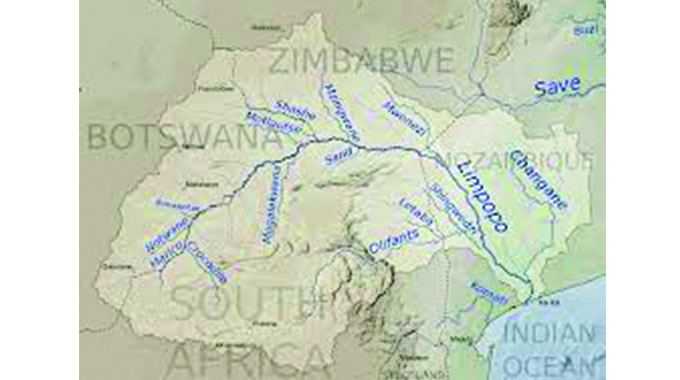
Thupeyo Muleya – [email protected]
THE four countries that share the Limpopo River Basin, which includes Botswana, Mozambique, South Africa and Zimbabwe yesterday reaffirmed the need to collaborate and promote sustainable development of the basin.
Stakeholders from the four nations made the commitment in a joint statement following a series of in-country meetings organised by the Limpopo Watercourse Commission (LIMCOM) to apprise their governments on the implementation of the project.
The initiative is running under the theme: “Integrated Transboundary River Basin Management for the Sustainable Development of the Limpopo River Basin.”
The in-country meeting for Botswana was held on May 16 and 17 while the meeting for South Africa took place on May 23 and 24. Zimbabwe and Mozambique had similar engagements on May 30 and 31 and June 7 and 8 respectively.
Zimbabwe was represented by the Director of Water Resources Development and Utilisation in the Ministry of Lands, Agriculture, Fisheries, Water and Rural Development, Mr Gilbert Mawere.
Mr Mawere who is also a LIMCOM Commissioner said it was critical for the four countries to continue working together.
“We should continue working together because any unco-ordinated activities in any of the countries will have an impact on the other,” he said.
Deputy Director for Water in the Ministry of Lands and Water Affairs in Botswana, Dr Kobamelo Dikgola, said the sustainable development of the basin would ensure that transboundary water resources were preserved for present and future generations.
She said Limpopo was a key strategic basin for Botswana and that her country would continue to work with other member states to ensure that all interventions implemented in the Basin benefit local communities.
Echoing the same sentiments was Mozambican Director for Public Works, Housing and Water Resources, Mr Messias Macie.
He said his country remained at the disposal of the Secretariat and other member states to ensure that all interventions are effectively implemented in the basin.
South Africa was represented by the Inter-Governmental Relations and Sector Collaborations Manager for Sekhukhune in the Department of Water and Sanitation, Ms Perpetua Mphahlele.
“We reiterate South Africa’s commitment to support transboundary decision-making across in the Basin, and the improvement of livelihoods of communities living in the corridor,” she said.
As part of the meetings, LIMCOM visited the identified Sustainable Land Management (SLM) pilot sites in each of the four countries to engage with the communities living in the area. The stakeholders said these pilot sites were expected to yield socio-ecological benefits whilst exploring opportunities for Payment for Ecosystem Services.
For Botswana, the pilot site is at the Mogobane Dam in the Notwane sub-catchment and the Massingir Dam in the Lower Elephant’s sub-catchment was chosen in Mozambique. In South Africa, the point is at the B41C Quaternary Catchment, Mapochs in the Middle Olifants sub-catchment. Zimbabwe has its site along the Guyu-Chelesa irrigation scheme in the Shashe sub-catchment area.
It is understood that the implementing partners will run a pilot project to reduce land degradation, including sedimentation at these selected sites.
They will then promote the replication and up-scaling of land degradation control activities to other areas in future.
LIMCOM executive secretary, Mr Sergio Sitoe said the in-country meetings were a huge success.
“Such interactions are critical in promoting ownership of the project and its successful implementation,” he said.
The Limpopo River Basin is one of the major River Basins in southern Africa and its catchment area is estimated at 408 000 km² and has a population of over 18 million people.
The river flows north from South Africa where it creates the border between South Africa and Botswana and then the border between South Africa and Zimbabwe before crossing into Mozambique and draining into the Indian Ocean.-@tupeyo



 Online Reporter