Online Reporter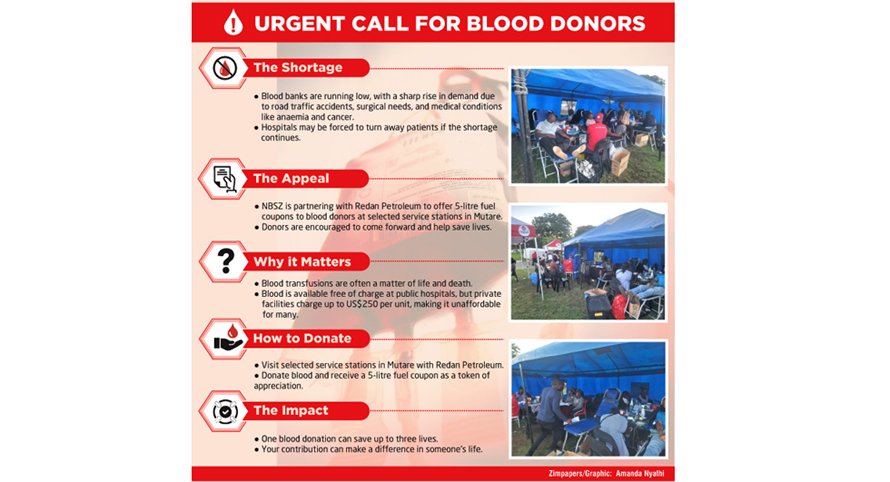
Tendai Gukutikwa
Health Reporter
THE National Blood Service Zimbabwe (NBSZ) has raised alarm over a severe blood shortage across the country, with Manicaland Province also affected, as the national blood bank runs perilously low.
The crisis has prompted an urgent appeal for donors.
The shortage has been attributed to a sharp rise in demand, largely driven by a spike in road traffic accidents during the festive season, alongside other surgical and medical needs.
Hospitals are struggling to cope, with thousands of patients—ranging from accident victims to those battling anaemia and cancer—at risk.
In a bid to boost donations in Manicaland, NBSZ has partnered with Redan Petroleum to provide five-litre fuel coupons to blood donors at selected service stations in Mutare.
The initiative is part of the ongoing Red and Blood Drive, which seeks to strengthen supplies at a time when demand remains persistently high.
The dangers of depleted blood stocks cannot be overstated. Blood transfusions are often a matter of life and death, and without adequate reserves, hospitals face the grim reality of turning away patients in need.
In Zimbabwe, blood is available free of charge at public hospitals through a Government-funded coupon system. However, private facilities charge up to US$250 per unit, making it unaffordable for many.
Speaking in an interview, NBSZ blood supply executive, Mr Menard Mutenherwa, described the shortage as a national challenge, and urged citizens to step forward.
“Across the country, our total target from all sites is 2 530 units of blood. Donate blood and be a hero. Your action today could mean the difference between life and death for someone in need,” he said.
Mr Mutenherwa emphasised that blood donation should be seen, not only as charity, but as a civic responsibility that directly supports the health system.
He added that partnerships with the private sector are vital in expanding the donor base and reaching demographics that may not ordinarily participate in routine blood donation programmes.
“Through initiatives like this, we are able to reach new donors, particularly working adults and families in Mutare, while reinforcing the message that saving lives is a collective effort that cuts across all sectors of society,” he said.
The Red and Blood Drive highlights the importance of community involvement in sustaining the nation’s blood supply. With demand rising from both emergencies and routine medical needs, NBSZ is calling on citizens to respond urgently.
For every donation, donors will receive a five-litre fuel coupon as a token of appreciation for their life-saving contribution.
The campaign could not come at a better time, coinciding with the opening of schools, a critical and reliable constituency for NBSZ.
Schools have historically been a key source of blood donations, with learners often eager to contribute to their communities. – offering a golden opportunity to replenish dwindling stocks and meet soaring demand.
“The coupons are a token of gratitude, proof that giving blood, not only saves lives, but also keeps the nation moving,” he said, adding that the timing of the Red and Blood Drive could not be more critical, as the nation continues to experience high demand for blood due to various health and emergency needs.
“This drive is coming at a very critical time. The demand for blood remains consistently high because of maternal health needs, road traffic accidents, chronic illnesses and emergency surgeries,” said Mr Mutenherwa, adding that while demand remains steady, blood donation levels are often affected by seasonal factors, resulting in fluctuating supplies.
“At the same time, donation levels tend to fluctuate due to seasonal factors. That is why proactive blood drives like this one are essential to maintaining adequate and safe blood stocks across the country,” he said.
Though provincial statistics were not readily available, Mr Mutenherwa urged people from Manicaland, who may be hesitant, and first-timers, to come forward with confidence, assuring them that the donation process is safe and professionally managed.
“To all people from Manicaland who may feel hesitant or who are donating blood for the first time, our message is very simple. Your single donation can save up to three lives,” he said, further stressing that blood donation is a straightforward process carried out under strict medical standards.
“Blood donation is safe, quick, and conducted by trained professionals following strict medical protocols. We encourage people to come forward with confidence, knowing that their contribution truly makes a difference,” he said.
Looking ahead, Mr Mutenherwa said NBSZ is focusing on strengthening the country’s blood supply system in line with international best practices.
“As we look ahead, our key priorities include expanding the voluntary non-remunerated blood donor base. Voluntary non-remunerated blood donation is extremely important, and it is what the World Health Organisation recommends,” he said.
Mr Mutenherwa said the organisation also aims to improve donor retention, strengthen blood collection infrastructure and increase national awareness around regular blood donation.
“The sustainability of our blood supply depends on consistent donations from informed and committed citizens across all age groups,” said Mr Mutenherwa.
He said decentralised blood drives, such as the one being held at the Mutare Flyover, are central to NBSZ’s long-term strategy of embedding a culture of blood donation within everyday community spaces.
“Partnerships like this initiative are central to our long-term strategy. They help us decentralise blood donation services, increase accessibility, and embed a donation culture within communities,” he said.
By working closely with trusted private sector partners, Mr Mutenherwa said NBSZ is building a more resilient and future-ready blood supply system.
“Through these collaborations, we are building a diversified and reliable blood supply system that can consistently meet Zimbabwe’s healthcare needs,” he said, adding that the blood drive forms part of a nationwide effort, with multiple collection sites operating across the country.