

 admin
admin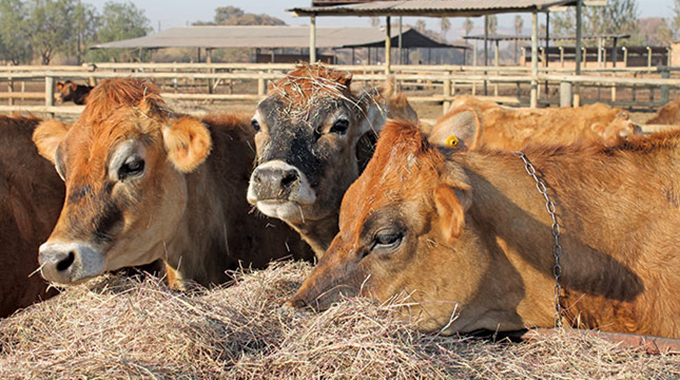
Bulawayo Bureau
LIVESTOCK farmers in Matabeleland South are using fodder grown in the province as affordable supplementary feed for their animals, which will help prevent livestock dying from lack of pasture.
Self-production of stockfeed is among the cornerstones of the Second Republic’s vision of restoring Matabeleland as the country’ s prime livestock and beef processing hub.
The intervention has been identified as a major approach to boosting the national herd through ensuring that farmers have access to highly nutritious stockfeed at affordable costs.
One of the major producers of fodder in the province is Artherstone Irrigation Scheme in Insiza District, where farmers have 25 hectares under lucerne.
By such schemes providing ever more fodder Zimbabwe expects to boost the national herd, which recorded a marginal growth of 0,6 percent to 5 509 983 in 2021 from 5 478 648 in 2020.
Official statistics also show that cattle mortality rate has declined from 11,1 percent in 2020 to 8,86 percent in 2021.
President Mnangagwa launched the Presidential Livestock Scheme as part of efforts to grow the livestock sub sector.
Under the scheme, farmers are receiving legume seeds, fertilisers and forage sorghum among other inputs. Distribution of the inputs is set to boost creation of forage banks for improved animal nutrition.
Priority is being given to the country’s drier southern areas that suffer the highest cattle drought-related deaths.
Livestock production is a critical source of income and safety net for millions of people but recent prolonged dry spells due to climate change are negatively affecting agricultural production including pastures.
The scheme falls under the livestock growth plan, which is part of the agriculture and food systems transformation strategy that is expected to turn agriculture into an US$8,2 billion industry by 2025 and contribute towards the achievement of Vision 2030.
To augment Government efforts irrigation holders have been urged to put a portion of their land under fodder production.
Small-holder irrigation farmers and communal farmers have set aside a portion of land for fodder production.
A target of 20 percent of arable land at irrigation sites in Matabeleland South Province is set to be put under fodder production to ensure that farmers have access to nutritious supplementary feed for their livestock during the dry season.
A farmer at Singe Irrigation Scheme in Insiza District, Mr Sisa Sibanda, said he buys fodder crop from Artherstone Irrigation Scheme. He said lucerne was the best plant as it was nutritious.
“Production of lucerne has brought huge relief to us as we are now able to access supplementary feed for our animals at an affordable cost. Lucerne is generally cheaper when compared to stock feed that we buy from shops,” he said.
“Lucerne has helped me boost my animals for sale and also to boost animals whose condition is deteriorating because of drought. Lucerne is also convenient compared to other stock feed which require us to feed animals and supply them with water in one place.
“With lucerne I can feed the animals and then drive them to the dam to drink. With the other stock feed animals should not feed and then walk a long distance to get water as it causes them to deteriorate.”
Mr Sibanda said the condition of his animals has greatly improved ever since he started feeding them lucerne. He said lucerne is readily available locally compared to commercial stock feed, which he could only buy from Gwanda.
A farmer at Artherstone Irrigation Scheme, Mr Zenzo Jele, said lucerne production had not only brought a source of livelihood for them but they now had a reliable source of supplementary feed for their own livestock.
He said the area has limited pastures and during this time of the year farmers struggle to find grazing space for animals.
Mr Jele said A1 and A2 farmers and a few communal farmers from the area were getting their fodder from the irrigation scheme.
“This fodder production project has brought huge relief to us as farmers. Now when we run out of pasture, we can just revert to lucerne for supplementary feed. Locals are benefiting from it a lot,” he said.
Matabeleland South provincial livestock specialist Mr Hatitye Zondai said livestock in the province were in a fair to good condition. He said farmers were encouraged to supplement their animals using fodder produced at irrigation schemes around the province.
Mr Zondai said most farmers had set aside a portion of land under fodder production and there was also need for farmers to expand production to increase supply for animals.



 Online Reporter