Chronicle Editor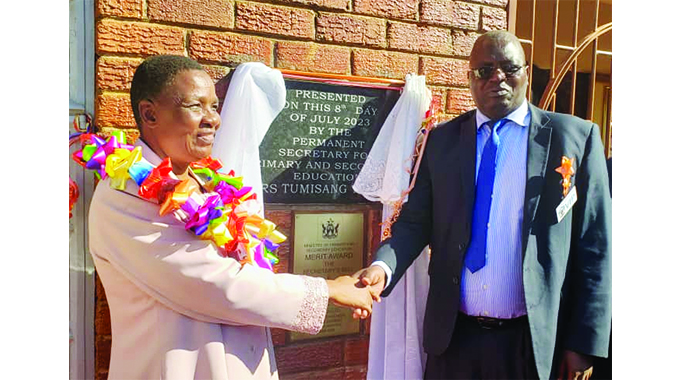
Michael Magoronga – [email protected]
AT the height of the Covid-19 pandemic when schools resorted to online learning, the Government called for schools to take the opportunity to adopt resilient building strategies in fighting the pandemic as they prepared for the return to physical learning better prepared.
Silobela-based Catholic school, Loreto High grabbed the opportunity with both hands and was able to successfully navigate the global emergency of Covid-19, as it did not allow operations to stop but turned lemons into juice.
Through their Textile Technology and Design Department, the school produced 10 000 masks, which were used by pupils, and donated some to neighbouring schools and the community.
The science department was not to be outdone as it also produced 1 000 litres of sanitizers, which were also used by the school and the community.
Loreto High School also complied with the Standard Operation Procedures for the prevention of Covid-19, which saw not a single pupil testing positive to the pandemic while four teachers tested positive but they all recovered.
These endeavours, coupled with other projects like green houses for the tomato crop, five-hectare horticulture garden, four fish ponds with over 50 000 fish, 1000 broiler project, 600 layers, 14 Jersey dairy cows, 20 beef cattle, and a 50-hectare maize farm, among other projects, saw the school being awarded the Secretary’s Merit Award ahead of all other secondary schools in the Midlands Province.
Conferring the award to the school recently, Permanent Secretary in the Ministry of Primary and Secondary Education, Mrs Tumisang Thabela, applauded the school for responding to Government calls to commercialise production units and urged other schools to emulate Loreto High.
“The ministry appreciates and commends the school for taking great strides in combating and managing Covid-19 through face mask production, broadening the revenue base for the school, and at the same time saving lives,” she said.
“The ministry applauds the school for responding to the directive by the Government to commercialise production units.”
Mrs Thabela said the school’s massive production units provide a sustainable food security source and revenue base, adding that schools should industrialise and commercialise.
She also hailed Loreto High School for producing some of the best Physical Education and Mass Displays through a number of sporting activities with one of their learners, Lovemore Mutune, having won a number of medals after representing the country in karate.
The school was also commended for having maintained a good academic performance, which saw the institution achieving between 60 percent and 90 percent at Ordinary Level and between 80 percent and 100 percent at Advanced Level since 2017.
Mrs Thabela said the competence-based curriculum is meant to scale up the uptake of technical and vocational education in all schools.
“The intention is to have graduates at all school levels being able to produce goods and services for their communities and the country at large. It is also meant to enable all schools to apparently train communities’ human capital for the future in all possible career and entrepreneurial levels,” she said.
So as to increase the uptake of STEM learning areas, and encourage innovation and creativity, the ministry, in line with equity development, has converted ordinary classrooms into science and computer Laboratories.
“We need to redefine our assessment models to cater for this pathway in our system to avoid this irony of someone being deemed to have failed in our system but going on to make their millions in spite of our initial negative judgment as a formal system,” said Mrs Thabela.
The curriculum framework 2015-2022 is under review and the consultations with stakeholders are still ongoing as part of the review process.
Therefore, the permanent secretary said the contributions from the pupils are and remain critical to the process so that the revised framework will speak to the Fourth Industrial Revolution and expectations of the 21st Century digital citizens. The latest achievement by Loreto High School came a few months after another school from Kwekwe District, Kwekwe Primary School, was conferred with almost a similar award in primary schools’ category.
Speaking on the same occasion, Midlands provincial education director, Mr Jameson Machimbira, praised the work being done by schools across the province but urged unregistered schools to do so.
The province has 450 000 primary school learners and 360 000 in secondary school pupils.



 Online Reporter